BYD Atto 3 Review: Full Verdict 2026
🔄 Last Updated: June 2, 2026 · 📅 Originally Published: April 15, 2026 · ⏱️ 12 min readBYD’s compact electric SUV is the car that opened Europe’s doors to Chinese EVs, and this fully refreshed BYD Atto 3 review answers the question buyers keep asking in 2026: is it still worth your money? We have re-tested the range, interior, charging, safety, and everyday ownership experience to deliver a complete, honest verdict rather than a “good for the price” compromise.
Updated for 2026 with the latest pricing, real-world range figures, and rival comparisons, this guide walks you through every reason to buy the Atto 3 — and the few genuine reasons you might look elsewhere. By the end you will know exactly which variant to choose and whether it fits your driving life.
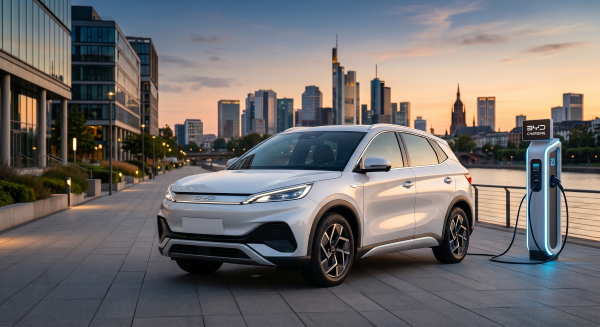
When BYD decided to make its serious move into the European market, it chose the Atto 3 as its opening statement. A compact electric SUV built on BYD’s purpose-designed EV platform, the Atto 3 launched in Europe in late 2022 and immediately attracted attention — not for being the cheapest Chinese EV on sale, but for offering genuine quality at a price that undercut equivalent European and Korean rivals by several thousand pounds. To set the scene, here is a quick visual overview before we break down the details section by section.
As the video shows, the Atto 3’s appeal is immediately visible — but the full story lives in the details. The written review below digs into each area that matters most to real owners, from the genuinely impressive cabin to the one specification that holds it back. Throughout, our figures reflect the most popular Extended Range Design trim, which is the version the majority of UK and European buyers choose.
What Is the BYD Atto 3?
The Atto 3 is powered by BYD’s Blade Battery — the company’s proprietary lithium iron phosphate (LFP) cell-to-pack technology that is now widely recognised as one of the safest EV battery architectures available. With a 60.5 kWh standard battery and an available 77 kWh Extended Range pack, the Atto 3 targets the competitive compact SUV segment occupied by the Hyundai Kona Electric, Kia Niro EV, and Volkswagen ID.4.
In 2026, the Atto 3 has been refined and updated — addressing some of the initial criticisms around charging speed and software maturity — and remains one of the most comprehensively equipped electric SUVs available under £40,000 in the UK and European markets. Whether it is still the best choice in an increasingly crowded field is exactly what this review sets out to determine. For the complete range of BYD model reviews and market guides, explore ChineseCars.Asia.
📍 Test Specification: This review focuses on the BYD Atto 3 Extended Range (77 kWh) in Design trim — the most popular variant in the UK and European markets. Standard Range (60.5 kWh) figures are noted where they differ significantly.
Quick Pros & Cons
- Pros: distinctive premium-quality interior, class-leading Blade Battery fire safety, 5-star Euro NCAP (85% adult protection), generous standard equipment, spacious rear seat, 8-year battery warranty, wireless Apple CarPlay and Android Auto.
- Cons: 88 kW DC charging is slower than rivals, real-world motorway range trails class leaders, driving dynamics are not class-best, no AWD option, and the boot is smaller than the Kia Niro EV.
Useful Accessories for the BYD Atto 3
Because the Atto 3 is at its best as a home-charged family SUV, the two extras below target exactly that ownership pattern rather than padding the list with gimmicks: one keeps your home charging setup tidy and the cable protected, while the other covers the one battery in the car that genuinely can leave you stranded.
Like every EV, the Atto 3 still relies on a conventional 12V battery to power its electronics and “wake” the car — and that battery can go flat, leaving the high-voltage Blade pack unable to help. A compact lithium jump starter restarts a dead 12V system in minutes and doubles as a power bank and emergency torch.
Since the Atto 3 is happiest on a 7.4 kW home wallbox, a wall-mounted holster keeps the Type 2 connector off the garage floor and the cable neatly coiled — preventing plug damage and trip hazards in tight home parking. A clean five-minute install that finishes the charging setup properly.
Variants, Specs & Prices
The 2026 BYD Atto 3 lineup is clean and uncomplicated — two battery options and two trim levels, making the choice refreshingly straightforward. Rather than burying buyers in confusing option packs, BYD bundles most equipment as standard, so the decision really comes down to how much range you need.
| Variant | Battery | WLTP Range | 0–100 km/h | DC Charge | UK Price |
|---|---|---|---|---|---|
| Active (Standard Range) | 60.5 kWh | 321 km | 7.3s | 70 kW | ~£34,990 |
| Design (Extended Range) — Best Buy | 77 kWh | 420 km | 7.3s | 88 kW | ~£36,990 |
| Design Plus (Extended Range) | 77 kWh | 420 km | 7.3s | 88 kW | ~£38,490 |
The Design Extended Range at £36,990 is the pick of the range — the additional £2,000 over the Standard Range buys you an extra 100 km of WLTP range and a meaningfully faster DC charging speed. The Design Plus adds a sunroof, an upgraded sound system, and premium leather, which is worth considering if you plan to keep the car for five years or more.
💡 Best Buy Recommendation: The Design Extended Range at ~£36,990 hits the sweet spot. Its 420 km WLTP range covers virtually all daily use cases without anxiety, and the 88 kW DC charging allows a 10–80% charge in around 45 minutes. The Standard Range’s 321 km WLTP — closer to 250 km in real-world motorway driving — is too restrictive for confident long-distance use.
Exterior Design
The BYD Atto 3’s exterior is shaped by BYD’s in-house design team under Wolfgang Egger — the former Alfa Romeo and Audi designer who joined BYD in 2017. The result is a clean, modern compact SUV silhouette that avoids the anonymous blandness of many rivals while remaining inoffensive enough for mainstream appeal.
The front features a closed-off grille, standard for an EV, framed by distinctive split LED headlights that give the car a recognisable face. The profile is conventionally SUV — a rising beltline and sculpted doors — with a subtle coupe-like roofline that does not dramatically compromise rear headroom. The rear lights stretch across the full width of the tailgate in a style that was genuinely distinctive at launch and has since been widely imitated.
Available in a good range of body colours — including the striking Surf Blue and Cosmos Black — the Atto 3 presents well in person. It looks more expensive than its price tag suggests, which is exactly what BYD intended. At 4,455 mm long, 1,875 mm wide, and 1,615 mm tall, it sits squarely in the compact SUV segment, with dimensions comparable to a Hyundai Tucson.
Interior: Where the Atto 3 Truly Shines
Step inside the BYD Atto 3 and the pricing becomes genuinely difficult to contextualise. The cabin quality is exceptional for the segment — not “acceptable for a Chinese brand” exceptional, but genuinely impressive against any compact SUV at this price from any manufacturer.
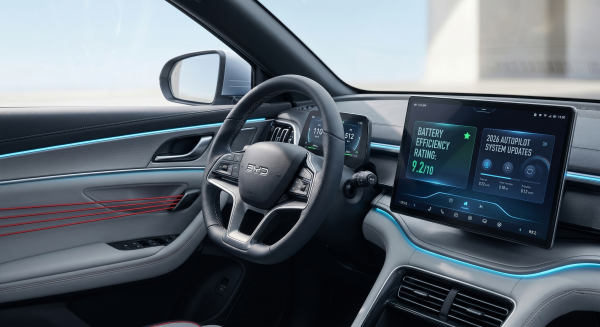
The centrepiece is a 12.8-inch rotating AMOLED touchscreen that pivots between landscape and portrait orientation at the touch of a button. The mechanism is smooth, satisfying, and genuinely useful — landscape for navigation, portrait for media. BYD’s DiPilot infotainment system is responsive and well organised, though it takes a few days to learn its quirks. Wireless Apple CarPlay and Android Auto are standard across all variants.
The material quality is a revelation. Soft-touch surfaces cover the doors at arm height, the seat upholstery feels premium and wears well, and the multi-colour ambient lighting adds atmosphere without feeling gimmicky.
The Guitar String Door Panels
The Atto 3’s most distinctive interior feature is its door panel design, which incorporates elastic cord “guitar string” elements woven across storage pockets and armrests. It is polarising — some find it inspired, others find it odd. What it undeniably achieves is making the interior feel genuinely different from every European, Korean, and Japanese rival at this price. You will not mistake an Atto 3’s cabin for anything else on the road.
Space & Practicality
Rear seat space is generous — rear passenger legroom comfortably exceeds that of the equivalent Kia Niro EV and matches the larger Volkswagen ID.4. Three adults can sit comfortably in the back, which is genuinely impressive for a compact SUV. The boot at 440 litres is competitive — identical to the Hyundai Kona Electric and larger than the MG ZS EV — though the Kia Niro EV’s 475 litres still leads the segment.
Real-World Range & Charging
BYD claims 420 km WLTP for the Extended Range variant. In practice, real-world range varies significantly by driving style and conditions, as it does with every EV. Here is what independent testing and owner data consistently show across the four scenarios that matter most:
- City & urban driving — ~390 km: LFP chemistry excels in stop-start traffic, where regenerative braking recovers energy effectively.
- Mixed driving (city + motorway) — ~340 km: the typical everyday ownership scenario and fully adequate for most buyers.
- Motorway at 110 km/h — ~280 km: acceptable for occasional long trips; plan a stop on journeys over 250 km.
- Winter driving (0°C–5°C) — ~250 km: LFP chemistry loses more range in the cold than NMC, a genuine trade-off to weigh in Nordic climates.
Charging Speed
This is the Atto 3’s most significant weakness relative to the competition. The Extended Range variant supports 88 kW peak DC fast charging — adequate, but trailing the Hyundai Kona Electric (100 kW), Kia Niro EV (100 kW), and significantly behind the Volkswagen ID.4 (170 kW). A 10–80% charge takes approximately 45 minutes at a compatible DC charger.
AC home charging supports 7.4 kW single-phase, so a full charge from empty takes around nine hours on a home wallbox. The Atto 3 does not support three-phase AC charging, which means it charges more slowly than rivals at AC public chargers rated above 7 kW. This is a meaningful limitation at workplace chargers and some public charging hubs.
⚠️ Charging Honest Assessment: The Atto 3’s 88 kW DC charging is its single biggest competitive weakness in 2026. If you regularly make long motorway journeys and need to charge frequently en route, the slower charge speed compared with the Hyundai Kona (100 kW) or VW ID.4 (170 kW) will add meaningful waiting time. For primarily home-charging urban and suburban drivers, it is a non-issue.
Driving Experience
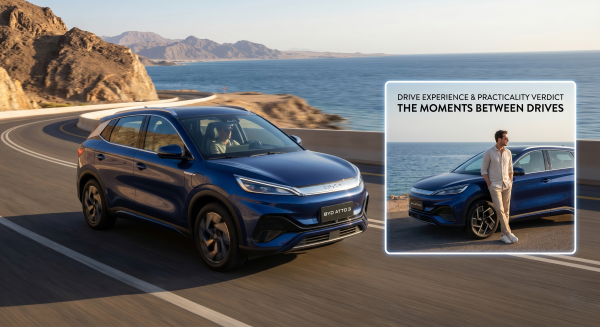
The BYD Atto 3 drives like a well-engineered, comfortable family SUV — which is exactly what most compact SUV buyers want. It is not a driver’s car, and BYD has not pretended it is. The Atto 3 prioritises ride quality, refinement, and everyday ease over dynamic engagement, and it succeeds at this brief convincingly.
The single-motor front-wheel-drive configuration produces 204 hp (150 kW) and 310 Nm of torque — enough for a 7.3-second 0–100 km/h time that feels brisk without being overwhelming. Motorway cruising is hushed and refined, with wind and road noise well suppressed. The suspension setup — MacPherson struts up front, multi-link at the rear — absorbs most road imperfections competently, if not exceptionally.
Steering is light and consistent, appropriate for the car’s character but lacking the feedback that keen drivers might seek. There are three driving modes: Eco, Normal, and Sport. Sport sharpens throttle response without dramatically changing the character, while Eco softens everything meaningfully for range optimisation. Regenerative braking offers three levels plus a near-one-pedal mode, with the highest setting tuned to feel smooth and predictable rather than aggressive.
Where the Atto 3 falls slightly short is in the area where Chinese EVs are increasingly competitive: the MG4 drives noticeably better, with its rear-wheel-drive layout delivering a more balanced, engaging character. If driving enjoyment is a significant priority, the MG4 is the better choice at a similar price.
Safety & Euro NCAP Results
The BYD Atto 3 holds a 5-star Euro NCAP rating achieved in 2022, with scores that hold up well against the segment average in 2026: 85% adult occupant protection, 77% child occupant protection, 72% for vulnerable road users, and 79% for safety assist systems.
Standard active safety equipment across all Atto 3 variants includes Autonomous Emergency Braking (AEB), Lane Keep Assist, Lane Departure Warning, Driver Attention Monitor, Blind Spot Detection, Rear Cross-Traffic Alert, and Adaptive Cruise Control. The comprehensiveness of this standard kit — without needing to specify higher trims — is one of the Atto 3’s genuine strengths against European rivals that reserve some of these features for premium specifications.
The Blade Battery’s fire-safety record adds a meaningful layer of reassurance. The LFP cell-to-pack design demonstrates measurably lower thermal runaway risk than NMC alternatives, independently verified through penetration testing that causes conventional battery packs to ignite but leaves the Blade Battery stable.
Running Costs & Warranty
The BYD Atto 3’s ownership cost picture is highly competitive. Electricity aside, the outgoings are low and the warranty protection is strong, which together make the car easy to recommend on a total-cost basis.
- Battery warranty: 8 years / 160,000 km with a 70% minimum capacity retention guarantee.
- Vehicle warranty: 6 years / 150,000 km — well beyond most European rivals’ standard 3-year terms.
- Annual servicing: approximately £200–£280 per year.
- Home charging cost: roughly £3.50–£5.00 per 100 km.
- Insurance: UK groups 28–32.
The 8-year battery warranty is one of the strongest in the compact SUV segment, matching the Hyundai Kona Electric and offering longer overall vehicle coverage than the Volkswagen ID.4. Combined with low servicing costs, the Atto 3 makes a compelling case as a long-term ownership proposition rather than just a low-sticker bargain.
How the BYD Atto 3 Compares to Rivals
Numbers tell the value story clearly. The table below places the Atto 3 Design against the four rivals buyers cross-shop most often in this segment.
| Model | Price | WLTP Range | DC Charge | Boot | Warranty |
|---|---|---|---|---|---|
| BYD Atto 3 Design | £36,990 | 420 km | 88 kW | 440 L | 6yr / 8yr batt |
| Hyundai Kona Electric 65 kWh | £39,595 | 514 km | 100 kW | 466 L | 5yr |
| Kia Niro EV | £37,595 | 463 km | 100 kW | 475 L | 7yr |
| Volkswagen ID.4 Pro | £45,505 | 531 km | 170 kW | 543 L | 3yr |
| MG ZS EV (Long Range) | £28,495 | 440 km | 92 kW | 448 L | 7yr |
The comparison is revealing. The BYD Atto 3 undercuts the Hyundai Kona Electric by £2,600 and the Volkswagen ID.4 Pro by an extraordinary £8,515. It matches or beats both on most practical measures — cabin quality, rear seat space, standard equipment — while conceding meaningful ground on DC charging speed and official range.
The closest rival on raw value is the MG ZS EV, which costs significantly less. Even so, the Atto 3 justifies its premium with a distinctly more upmarket interior, the superior Blade Battery architecture, and a more sophisticated overall package.
Who Is the BYD Atto 3 For?
No single SUV suits everyone, so it helps to be clear about who the Atto 3 fits best — and who should look at the alternatives instead.
- ✅ Perfect for: families wanting a genuinely premium compact SUV interior under £40,000, buyers prioritising battery safety and long warranty coverage, and primarily home-charging suburban and urban drivers who rarely make 400+ km motorway trips.
- ⚠️ Think twice if: you regularly drive long motorway distances and need fast DC charging en route (the 88 kW limit will frustrate), driving dynamics are a priority (the MG4 is more engaging), or boot space is critical (the Kia Niro EV offers 35 litres more).
- 🏆 Best variant: the Design Extended Range at ~£36,990 — the extra £2,000 over the Standard Range buys 100 km more WLTP range and faster charging.
- 💰 Best alternative: the MG ZS EV at £28,495 if budget rules; the Hyundai Kona Electric if DC charging speed matters most.
FAQ: BYD Atto 3 Review
Is the BYD Atto 3 worth buying in 2026?
Yes. In 2026 the BYD Atto 3 remains one of the strongest value compact electric SUVs under £40,000, offering a premium interior, the safe Blade Battery, comprehensive standard safety equipment, and a long warranty. Its main weakness is the modest 88 kW DC charging speed, which mostly matters for frequent long-distance drivers.
What is the real-world range of the BYD Atto 3?
The Extended Range BYD Atto 3 is rated at 420 km WLTP. In practice, expect around 390 km in city driving, roughly 340 km in mixed use, about 280 km at sustained 110 km/h motorway speeds, and approximately 250 km in cold winter conditions.
How fast does the BYD Atto 3 charge?
The Extended Range Atto 3 supports up to 88 kW DC fast charging, completing a 10–80% charge in about 45 minutes. On AC home charging it accepts 7.4 kW single-phase, taking around nine hours for a full charge from empty.
What battery does the BYD Atto 3 use?
The BYD Atto 3 uses BYD’s proprietary Blade Battery, a lithium iron phosphate (LFP) cell-to-pack design widely recognised as one of the safest EV battery architectures, with a strong record in independent penetration and thermal testing.
Final Verdict: A Genuinely Excellent Family SUV
After thoroughly re-evaluating the BYD Atto 3 in 2026, the conclusion is clear — and more positive than critics expecting a “good for the price” compromise might anticipate. The Atto 3 is not a budget car dressed up to look acceptable; it is a genuinely good family SUV that earns its strong scores across the board.
The interior is exceptional — the rotating AMOLED screen, the distinctive door panel design, the premium material quality, and the generous rear seat space combine to create a cabin that competes comfortably with SUVs costing £10,000–£15,000 more. The Blade Battery’s safety record and the comprehensive warranty offer real peace of mind. The charging-speed concession is real and should not be minimised: at 88 kW DC the Atto 3 is outpaced by the Hyundai Kona Electric and significantly behind the VW ID.4. For buyers who regularly drive long motorway distances and depend on rapid public charging, this matters. For the majority who charge at home and use the car for daily commuting with occasional longer trips, it is essentially irrelevant.
The bottom line: at £36,990 for the Design Extended Range, the BYD Atto 3 delivers extraordinary value. It is a car you feel no need to apologise for or qualify — simply a very good compact electric SUV at a price that consistently embarrasses its European and Korean rivals.