Li Auto L9 2026 Review: Luxury Extended-Range Family SUV Tested
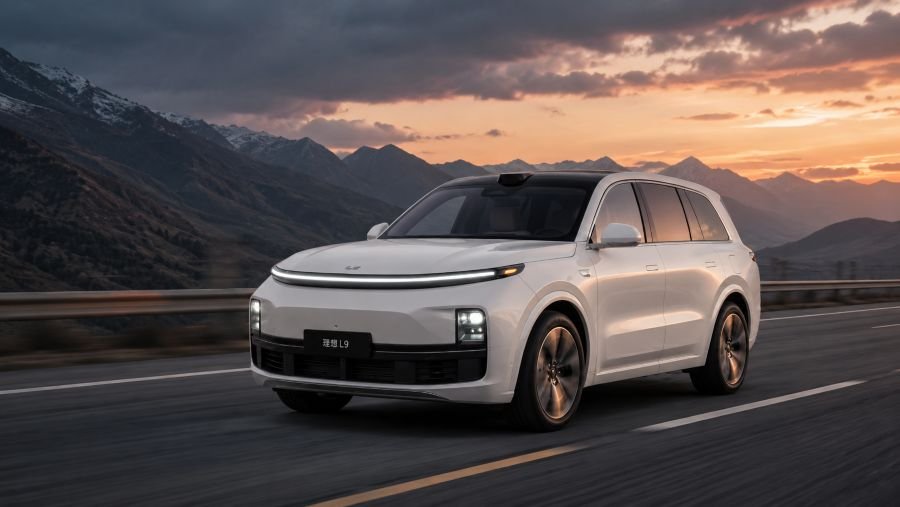
The Chinese luxury SUV landscape rarely stands still, and the 2026 Li Auto L9 review you are about to read captures a flagship that has been thoroughly reinvented rather than merely refreshed. Launched in May 2026 in two trims — Ultra and Livis — this six-seat, full-size SUV doubles down on the extended-range formula that made the original a runaway success, while layering on a larger 72.7 kWh battery, a 563-horsepower drivetrain, and a chassis that borders on science fiction.
For families weighing a long-distance, technology-rich SUV that sidesteps range anxiety entirely, the L9 makes a compelling argument. In this detailed look at the Li Auto L9 2026 specs, we break down its powertrain, real-world range, cabin comfort, smart-driving hardware, and how it stacks up against fierce rivals such as the AITO M9 and NIO ES8.
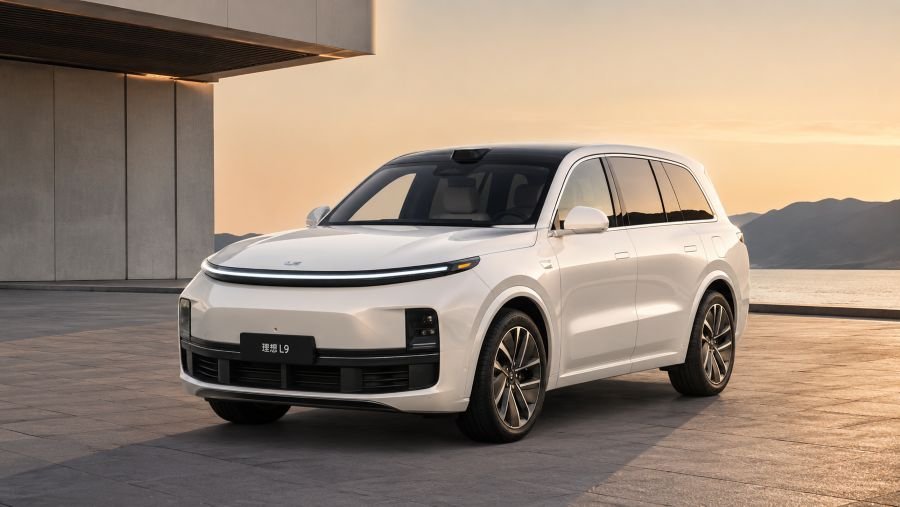
Li Auto built its reputation on a simple insight: most buyers want the smoothness and silence of an electric vehicle without ever worrying about where the next charger might be. The L9 answers that with an extended-range electric vehicle (EREV) layout, pairing a healthy battery with a compact petrol generator. The 2026 update sharpens every element of that recipe, and the result feels less like a facelift and more like a generational leap. To understand why the new model matters, it helps to start with the heart of the car.
Before we dig into the numbers, the short video below gives a quick visual walkaround of the 2026 Li Auto L9, highlighting its design, cabin, and extended-range setup in just over a minute.
With that overview in mind, let’s break down exactly what makes this extended-range family SUV stand apart from the EV crowd.
What Makes the Li Auto L9 2026 an Extended-Range Standout
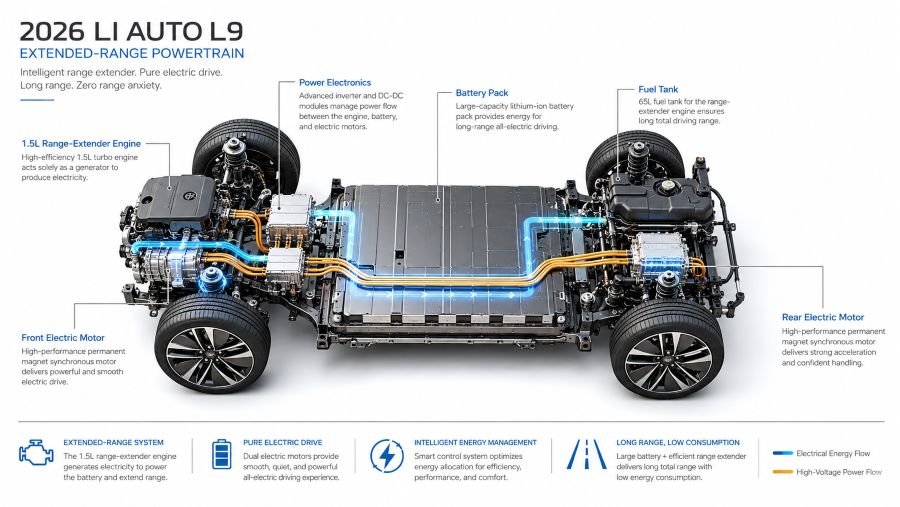
At the centre of this Li Auto L9 review sits the third-generation extended-range system, a self-developed setup that the company has refined across several model cycles. Crucially, the 1.5-litre turbocharged engine never drives the wheels directly. Instead, it functions purely as a generator, topping up the battery whenever charge runs low. The wheels are always turned by electric motors, which means the driving experience stays EV-smooth regardless of whether the tank is full or the battery is nearly empty. That distinction separates the L9 from a conventional plug-in hybrid and explains much of its long-distance appeal.
Equally important, the 2026 generation grows its battery substantially. Where the original L9 relied on a 44.5 kWh pack, the latest car carries a 72.7 kWh ternary NMC battery from CATL. The payoff is a pure-electric range of up to 420 km on the CLTC cycle, enough for the vast majority of daily commutes and city errands without ever firing up the generator. When longer journeys beckon, the petrol engine quietly extends total range to roughly 1,650 km, transforming the L9 into a genuine cross-country tourer that needs no charging infrastructure at all.
Practical Accessories for Long-Haul Family Trips
The L9 is built for the long road, so the two extras below target exactly that: keeping a six-seat cabin organised on extended journeys, and maintaining clear visibility in every weather over the kind of cross-country mileage this SUV invites. Both are universal fits that suit the L9 in any market.
With six seats and journeys measured in the thousands of kilometres, clutter builds fast. A slot-in console organizer tray keeps phones, cards, sunglasses, and charging cables tidy and within reach, protecting the L9’s premium trim from scratches and keeping the minimalist cabin looking its best on every trip.
A vehicle designed to cover up to 1,650 km between stops will meet every weather along the way, so reliable visibility matters. A set of all-weather beam blades clears rain, sleet, and grime smear-free without seasonal swapping — choose the sizes listed for your exact model’s windscreen.
How the EREV Powertrain Works
The beauty of the system lies in how seamlessly it juggles two energy sources. In practice, the car behaves like a pure EV until the battery dips low, at which point the generator hums to life without disrupting the cabin’s calm. Here is how the key elements come together:
- The 72.7 kWh CATL battery handles daily driving, delivering up to 420 km (about 261 miles) of pure-electric range on the CLTC cycle.
- When charge runs low, the 1.5-litre generator (rated at 115 kW) fires up to replenish the battery, never connecting mechanically to the wheels.
- Combined petrol-plus-electric range climbs to roughly 1,650 km (around 1,025 miles), enough to cross most countries without stopping.
- 5C ultra-fast charging tops the pack from 10% to 80% in about 10 minutes when a compatible charger is available.
- Drained-battery fuel consumption of 6.3 L/100 km on the WLTC cycle marks close to a 20% improvement over the previous generation.
Li Auto L9 2026 Specs and Performance at a Glance
Performance is where the new L9 surprises sceptics who assume a family hauler must feel sluggish. The dual-motor, intelligent all-wheel-drive system produces a combined 420 kW (563 hp) and 710 N·m of torque, propelling this near-three-tonne SUV from 0 to 100 km/h in just 4.9 seconds. That is genuinely quick for a vehicle of this size, and it places the L9 among the more athletic full-size luxury SUVs on sale. The instant torque delivery of the electric motors makes overtaking effortless, while the extended-range setup ensures that brisk acceleration remains available whether you are running on stored electricity or generator-replenished charge.
Beyond raw numbers, the L9 has grown in every dimension. The new body measures 5,255 mm long, 2,000 mm wide, and 1,810 mm tall, riding on a generous 3,125 mm wheelbase. Those proportions translate directly into limousine-grade interior space, and they also allow the SUV to tow up to 1,500 kg — a capability the first-generation car lacked. The table below summarises the headline Li Auto L9 2026 specs at a glance.
| Specification | Li Auto L9 2026 |
|---|---|
| Vehicle type | Six-seat full-size EREV SUV |
| System power | 420 kW (563 hp) |
| Peak torque | 710 N·m |
| 0–100 km/h | 4.9 seconds |
| Battery | 72.7 kWh (CATL ternary NMC) |
| Electric range (CLTC) | 420 km (~261 mi) |
| Combined range (CLTC) | ~1,650 km (~1,025 mi) |
| Fast charging | 5C, 10–80% in ~10 min |
| Range extender | 1.5L turbo, 115 kW |
| Dimensions (L/W/H) | 5,255 / 2,000 / 1,810 mm |
| Wheelbase | 3,125 mm |
| Computing power | 2,560 TOPS (dual Mach 100 chips) |
| Starting price (China) | from ~459,800 yuan (~$67,600) |
💡 Pro Tip: Because the L9 delivers up to 420 km of pure-electric range, most owners can treat it as an EV for daily use and save the petrol generator for road trips. Charging overnight at home and reserving the tank for highway runs is the cheapest, quietest way to live with the car.
Inside the Cabin: A Six-Seat Luxury Lounge
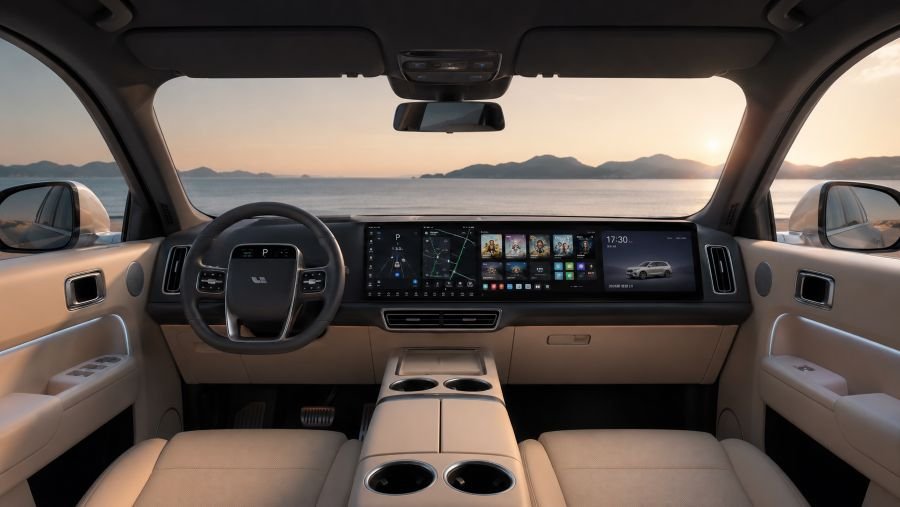
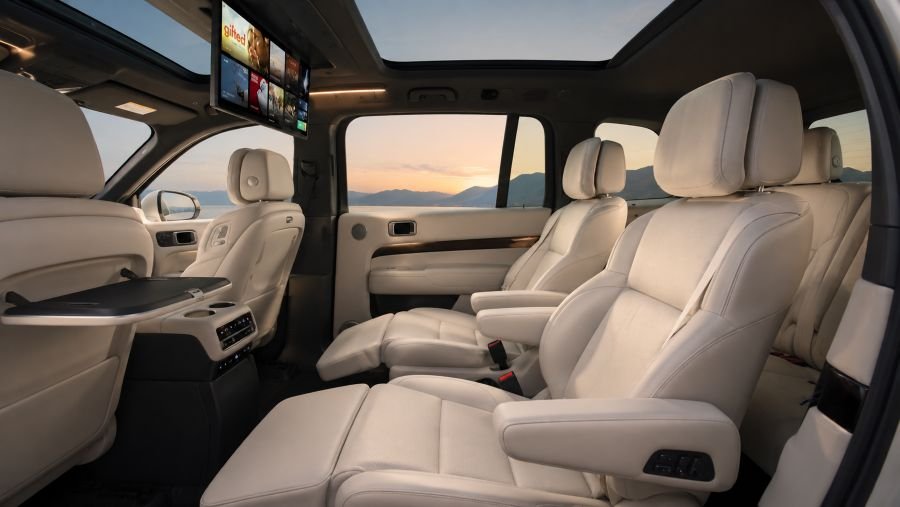
Step inside and the L9 reveals why families gravitate toward it. The six-seat layout, arranged in three rows of generously sized chairs, prioritises comfort over outright passenger count. The second-row captain’s chairs recline and offer plenty of legroom, while the dashboard is dominated by a striking 29-inch ultra-wide 6K panoramic display that stretches across nearly the full width of the interior. Rather than a traditional instrument cluster, this single sweeping screen handles navigation, media, and vehicle information in crisp detail.
Material quality has long been a Li Auto strength, and the 2026 car continues that tradition with soft-touch surfaces, ambient lighting, and a hushed cabin that absorbs road and wind noise impressively well. Thoughtful touches abound, from a ceiling-mounted entertainment screen for rear passengers to refrigerated storage and abundant USB connectivity. The overall impression is of a mobile living room engineered for long journeys, which dovetails neatly with the car’s extended-range mission.
Smart-Driving Hardware: A 2,560 TOPS Brain
If the powertrain is the L9’s heart, its driver-assistance suite is the brain — and an extraordinarily powerful one. The 2026 model deploys two in-house 5nm Mach 100 chips that together deliver a combined 2,560 TOPS of computing power, a figure that ranks among the highest of any production vehicle. Feeding that processing muscle is a sensor array that includes four LiDAR units providing 360-degree coverage, alongside numerous cameras and radar.
This hardware underpins Li Auto’s advanced assisted-driving system, which handles navigation on highways, complex urban roads, and parking manoeuvres. While regulations and capabilities vary by market, the sheer headroom in computing power means the L9 is well positioned to absorb future software upgrades. For buyers who value longevity, that future-proofing is a meaningful part of the value proposition.
Chassis Innovation and the Range-Topping Livis
The L9 launches in two trims, and the differences go well beyond badges. The entry Ultra covers the core experience, while the flagship Livis introduces some of the most advanced chassis technology yet seen in a mainstream SUV. Chief among these is an 800-volt fully active suspension system capable of raising or lowering each wheel independently. By doing so, it can effectively neutralise body roll in corners and dive under braking, removing the need for conventional anti-roll bars entirely.
The Livis also adopts a full drive-by-wire chassis that bundles steer-by-wire, four-wheel steering, and an Electro-Mechanical Brake (EMB) system. These technologies improve manoeuvrability — particularly useful for a vehicle of this footprint — and add layers of redundancy across the safety-critical systems. It is a genuinely ambitious package, and it signals where premium Chinese SUVs are heading in the years ahead.
Driving Impressions and Real-World Range
On the move, the L9’s defining quality is refinement. Power delivery is silky, the cabin remains serene at speed, and the air suspension on higher trims smothers imperfect surfaces. The car carries its considerable mass with composure, and although it will never feel like a sports SUV, it changes direction more tidily than its dimensions suggest. For its target buyer — a family covering long distances in comfort — these are exactly the right priorities.
Real-world range, naturally, depends on driving style, climate, and load. The CLTC figures are optimistic by design, so expect a touch less in mixed conditions. Even so, the combination of a sizeable battery and a fuel-efficient generator means the L9 rarely demands a stop. In effect, the car erases the single biggest objection many buyers raise about electric SUVs, and it does so without sacrificing the EV driving feel that makes the genre appealing in the first place.
⚠️ Important Note: Pricing and exact specifications can differ between the Chinese home market and export versions. An international rollout is expected from the third quarter of 2026, so figures, trim names, and available features may vary by region. Always confirm local details with an official Li Auto representative before purchase.
How the Li Auto L9 2026 Compares With Rivals
The premium full-size SUV segment in China has become fiercely competitive, and the L9 no longer enjoys the open road it once did. Its most direct rivals include the AITO M9, another extended-range heavyweight that has dominated sales in its class, and the NIO ES8, a fully battery-electric alternative that appeals to buyers committed to charging. The Denza N9 and Zeekr 9X round out a crowded field, each vying for the same affluent, technology-minded families.
Against this backdrop, the L9’s trump cards are its enormous combined range, its record-setting computing power, and the price-to-equipment ratio. Where imported luxury SUVs such as the BMW X7 command a significant premium, the L9 undercuts them while offering longer range and arguably more advanced suspension technology. Buyers who place the highest weight on long-term resale value or an established global service network may still gravitate toward legacy brands, but on outright capability for the money, the L9 makes a strong case.
FAQ: Li Auto L9 2026 Review
Is the Li Auto L9 2026 fully electric or a hybrid?
The Li Auto L9 2026 is an extended-range electric vehicle (EREV). It always drives on its electric motors, while a 1.5-litre turbocharged engine works solely as a generator to recharge the 72.7 kWh battery when needed. The engine never powers the wheels directly, so the experience stays EV-smooth even on long trips.
What is the total range of the Li Auto L9 2026?
On the CLTC cycle the Li Auto L9 2026 offers up to 420 km of pure-electric range, while the combined petrol-plus-electric range reaches roughly 1,650 km (around 1,025 miles) on a full tank and full charge.
How much does the Li Auto L9 2026 cost?
In China the 2026 Li Auto L9 starts at around 459,800 yuan (about $67,600) for the Ultra trim and rises to roughly 509,800 yuan (about $75,000) for the range-topping Livis. An international version is expected to roll out from the third quarter of 2026.
How fast does the Li Auto L9 2026 charge?
The L9 supports 5C ultra-fast charging with a peak rate of up to 420 kW, allowing the battery to go from 10% to 80% in about 10 minutes under ideal conditions with a compatible charger.
The Verdict: Is the Li Auto L9 2026 Worth It?
Taken as a whole, the 2026 Li Auto L9 is one of the most complete extended-range family SUVs money can buy. It combines genuine luxury, exceptional long-distance range, brisk performance, and a staggering amount of smart-driving hardware at a price that meaningfully undercuts established premium rivals. The bigger battery, more efficient generator, and reworked chassis address the few weaknesses of the outgoing model, and the range-topping Livis showcases technology that feels years ahead of the curve.
No vehicle is flawless, and buyers should weigh factors such as export availability, after-sales support in their region, and resale considerations before committing. Yet for families seeking a spacious, refined, and effortlessly long-legged SUV without the anxiety of constant charging, the L9 delivers on its promise convincingly. As Chinese flagships go, this is a benchmark — and a clear sign of how quickly the segment is evolving.