How Long Do Chinese EV Batteries Last? Complete Guide 2026
Quick Overview
- Most Chinese EV batteries last 8-10 years or 200,000-300,000 km
- Premium warranties cover up to 10-12 years or battery replacement if capacity drops below 70-80%
- Battery degradation typically occurs at 2-3% per year
- Proper maintenance and moderate climate conditions extend battery lifespan
- After-warranty replacement costs range from $5,000-$15,000
Share This Article
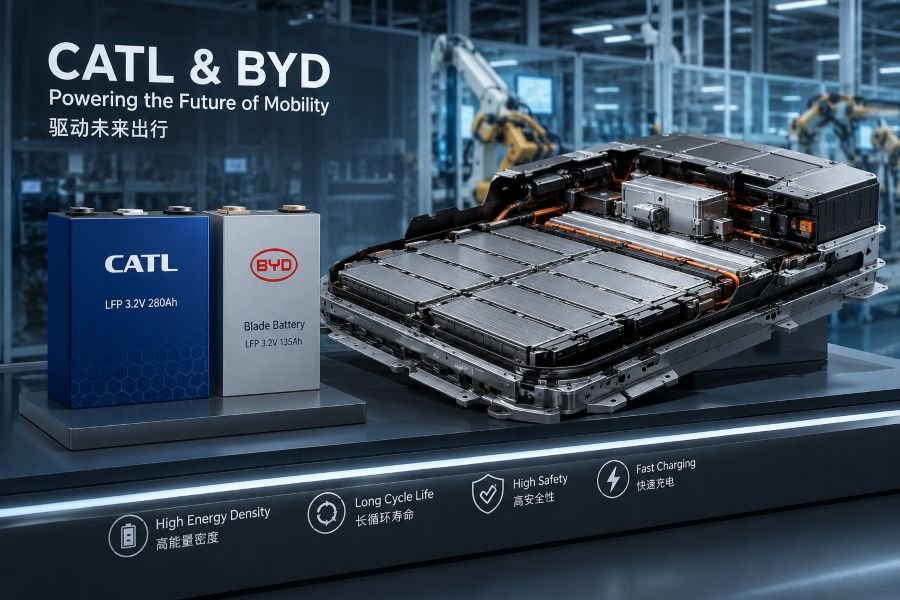
Chinese EV Battery System: Professional view of modern battery pack technology
The battery is the heart of every electric vehicle, and when it comes to Chinese-made EVs, potential buyers often wonder: just how long will these batteries actually last? This is a legitimate concern, as battery replacement represents the most substantial expense beyond the vehicle’s purchase price. Understanding the lifespan, warranty coverage, degradation patterns, and maintenance requirements of Chinese EV batteries is crucial for making an informed purchasing decision.
In recent years, Chinese battery manufacturers like CATL, BYD, and Gotion High-Tech have made remarkable strides in battery technology, producing some of the world’s most advanced lithium-ion battery packs. These batteries now rival and often exceed their international counterparts in terms of longevity, safety, and performance. This comprehensive guide explores everything you need to know about Chinese EV battery lifespan, from warranty details to practical maintenance tips that can extend your battery’s life significantly.
Understanding Chinese EV Battery Technology
Chinese electric vehicle batteries have evolved dramatically over the past five years. The batteries powering modern Chinese EVs are sophisticated lithium-ion packs engineered with advanced thermal management systems, sophisticated Battery Management Systems (BMS), and materials science innovations that maximize lifespan while maintaining performance.
The most common battery chemistries used in Chinese EVs include Lithium Iron Phosphate (LFP), Nickel-Cobalt-Manganese (NCM), and Lithium Polymer (LiPo) variants. Each chemistry has distinct advantages: LFP batteries offer exceptional safety and cycle longevity, while NCM batteries provide higher energy density and lighter weight. Leading manufacturers like BYD have invested heavily in LFP technology, producing over 200 GWh of capacity annually, while CATL produces both chemistries for different market segments and vehicle types.
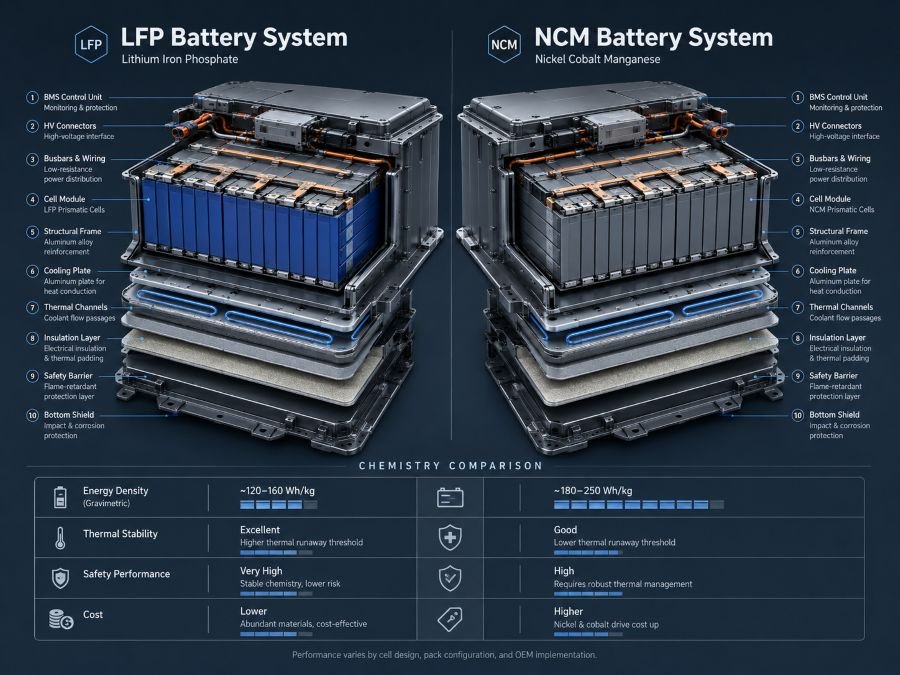
Battery Chemistry Comparison: Different technologies used in Chinese EV batteries
These batteries incorporate multiple layers of safety features, including thermal runaway protection, cell balancing systems, and sophisticated monitoring that tracks individual cell performance. The Battery Management System continuously optimizes charging and discharging patterns to minimize stress on individual cells, which directly contributes to extended battery life. This technological sophistication is one reason Chinese EV batteries have become competitive globally.
Typical Chinese EV Battery Lifespan
When discussing battery lifespan, it’s important to distinguish between two key metrics: calendar age (years since manufacture) and cycle life (charge-discharge cycles the battery can endure). Most modern Chinese EV batteries are designed to remain functional and retain acceptable performance for 8-10 years or through 200,000-300,000 kilometers of driving—whichever comes first.
The commonly cited “8-year warranty” doesn’t mean the battery becomes useless after this period. Rather, it represents the manufacturer’s guarantee that the battery will maintain at least 70-80% of its original capacity. Many batteries exceed this threshold by significant margins. Real-world data from battery recycling facilities and fleet operators shows that Chinese EV batteries frequently operate well beyond warranty periods with only modest capacity degradation.
Warranty Coverage by Major Manufacturers
BYD offers 8-year warranties covering defects and capacity retention, with specific degradation thresholds depending on the battery type. NIO provides 10-year warranties for premium models, and introduced the Battery-as-a-Service (BaaS) program where battery ownership is separated from vehicle ownership, transferring longevity risk to the manufacturer. XPeng and Li Auto offer 8-10 year warranties, while Geely-Volvo partnerships ensure robust warranty coverage aligned with Volvo standards.
These warranty coverages include battery replacement if capacity drops below specified thresholds (typically 70-80%), replacement of individual defective cells, and coverage for manufacturing defects. Many manufacturers also cover thermal management system failures and BMS malfunctions that might impact battery safety or performance.
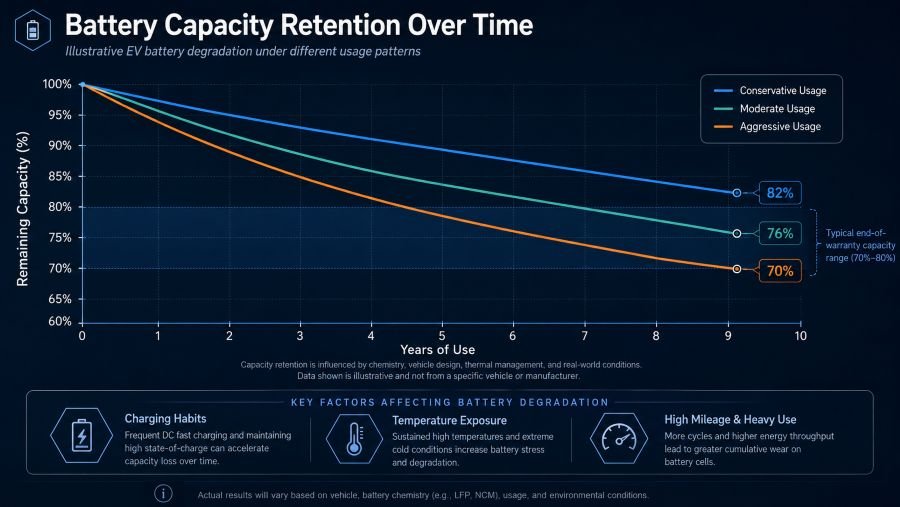
Battery Capacity Retention: Degradation timeline showing realistic capacity loss over time
Battery Degradation: What to Expect
Battery degradation is inevitable but highly gradual in modern Chinese EVs. The typical degradation pattern follows a predictable curve: more rapid initial degradation in the first year (often 2-5%), then settling into a steady state of 2-3% annual capacity loss. After five years, you might expect to see 10-15% cumulative range loss compared to the vehicle’s original specifications.
This means if your Chinese EV offers 500 kilometers of range when new, after five years it might provide approximately 425-450 kilometers of real-world range. While noticeable, this degradation rarely impacts daily driving significantly, as most drivers use only 20-50% of available battery capacity on typical days. For commuters averaging 50 kilometers daily, a battery retaining 80% capacity still provides ample practical range for years beyond warranty expiration.
Practical Implications of Capacity Loss
The real-world impact of battery degradation differs significantly between different usage patterns. A driver in a metropolitan area using their EV primarily for short urban commutes might barely notice 20% capacity loss over a decade. Conversely, someone regularly taking long-distance highway trips might become conscious of range reduction after 3-4 years of heavy usage.
Chinese EV manufacturers increasingly implement adaptive energy management, where the vehicle’s software automatically adjusts performance parameters based on battery condition. This ensures that regardless of capacity loss, the vehicle maintains responsive acceleration and effective regenerative braking. The gradual nature of degradation also means drivers can plan battery replacement proactively rather than facing unexpected failures.
Factors Affecting Chinese EV Battery Lifespan
Battery longevity isn’t simply a function of time or distance—numerous environmental and usage factors significantly impact how long your battery will remain in excellent condition. Understanding these factors empowers drivers to make choices that genuinely extend battery life.
Temperature and Climate Conditions
Temperature is arguably the single most influential factor affecting battery lifespan. Lithium-ion batteries perform optimally in moderate temperature ranges (15-25°C). Excessive heat accelerates chemical degradation processes within battery cells, while extreme cold can reduce performance and increase stress on the battery management system during charging and discharging.
Chinese EV manufacturers have responded by implementing sophisticated thermal management systems that actively heat or cool the battery pack based on real-time conditions. Systems like Tesla’s (not Chinese, but influential) thermal conditioning and BYD’s advanced cooling networks circulate coolant through the pack to maintain optimal operating temperatures. Vehicles in hot climates (Middle East, Southeast Asia, Australia) or extremely cold regions (Northern China, Canada, Scandinavia) will experience greater battery stress, though modern thermal management substantially mitigates these concerns compared to earlier EV generations.
If you’re purchasing a Chinese EV in a hot climate like the United Arab Emirates or Saudi Arabia, ensuring the vehicle has robust thermal management becomes particularly important. Similarly, vehicles that spend winters in extremely cold climates benefit from garage storage that maintains reasonable temperatures.
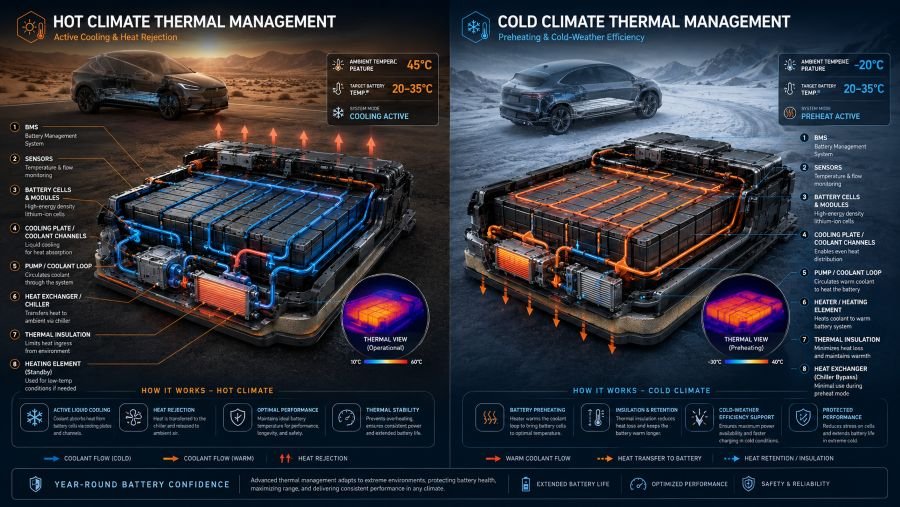
Thermal Management Systems: Managing battery temperature in extreme climates
Charging Habits and Fast-Charging Frequency
How you charge your EV significantly impacts battery longevity. Fast charging (DC charging) generates more heat and causes greater stress on battery cells than slower AC charging. Frequent DC fast charging, particularly when charging from very low states of charge to very high states, accelerates battery degradation. Optimal charging practices involve moderate-speed charging (AC Level 2 when possible), avoiding regular deep discharges (running battery below 10%), and avoiding sustained high-charge states (leaving the vehicle perpetually at 100% charge).
Modern Chinese EVs include charging optimization features. The BMS can learn driving patterns and automatically adjust charging speeds, can schedule charging for optimal times, and can disable fast charging if repeated heavy loads are detected. Some premium models allow drivers to set maximum charge limits, so the vehicle won’t charge beyond 80% unless specifically requested, preserving battery health for long-term ownership.
Driving Patterns and Aggressive Acceleration
The way you drive impacts battery stress levels. Aggressive acceleration draws substantial current from the battery in short bursts, while consistent moderate acceleration distributes the load more evenly. Regenerative braking, while excellent for efficiency and range, also impacts battery cells, particularly when braking from very high speeds or in aggressive braking situations. However, manufacturers design batteries to tolerate these stresses, so driving naturally without extreme modifications remains entirely compatible with excellent battery longevity.
Vehicle Storage and Inactivity
If you’re storing a Chinese EV for extended periods, battery maintenance becomes important. The ideal stored state is roughly 50% charge—sufficient to prevent deep discharge damage while avoiding excessive voltage stress that occurs at very high charge states. Long-term storage in hot garages, exposed to direct sun, accelerates degradation, while climate-controlled storage preserves battery health. Many Chinese EV manufacturers recommend charging the vehicle to 50-80% before extended storage and plugging in monthly to maintain this charge level.
Warranty Coverage and What’s Included
Chinese EV battery warranties are increasingly generous, reflecting manufacturer confidence in battery quality. Understanding exactly what’s covered helps you assess real ownership costs and protection against unexpected expenses.
| Manufacturer | Warranty Period | Capacity Threshold | Coverage Type |
|---|---|---|---|
| BYD | 8 years / 200,000 km | 70% capacity | Defects, degradation, thermal runaway |
| CATL-equipped EVs | 8-10 years / 200,000-300,000 km | 70-80% capacity | Manufacturing defects, BMS failure, cell degradation |
| NIO | 10 years / unlimited km | 80% capacity | Full replacement, BaaS included |
| XPeng | 8-10 years / 200,000-300,000 km | 70-80% capacity | Defects, capacity, thermal management |
| Li Auto | 8 years / 200,000 km | 70% capacity | Defects, capacity, safety components |
Most warranties cover the battery pack itself (the complete assembly of cells, thermal management, and BMS), though coverage specifics vary. They typically include repair or replacement of individual defective cells, replacement of the entire pack if degradation exceeds specified thresholds, and repair of the BMS if malfunction is manufacturer-related. Warranties generally don’t cover damage from accidents, improper charging equipment, or modifications to the charging system.
Battery Maintenance and Longevity Best Practices
While you can’t dramatically extend battery lifespan beyond engineering design limits, certain practices meaningfully preserve battery health and maintain performance for the longest possible duration.
Optimal Charging Practices
The single most effective maintenance practice is adopting battery-friendly charging habits. Charge regularly to maintain the battery between 20-80% rather than frequent deep discharges and full charges. Use slower AC charging whenever possible, reserving DC fast charging for essential trips when time is critical. If your Chinese EV includes charging limit controls, set them to prevent regular charging beyond 80%.
Schedule charging during nighttime or off-peak hours when ambient temperatures are lower, reducing thermal stress during the charging process. Avoid charging immediately after high-speed driving or in direct sun—allow the battery to cool naturally for 15-20 minutes before charging. These simple practices, implemented consistently, can preserve battery capacity meaningfully over 10+ years of ownership.
Temperature Management
Park your vehicle in shade whenever possible, particularly in hot climates. If a garage is available, use it consistently. Use sunshades or window covers when the vehicle must sit in direct sun. In winter conditions, allow the battery to warm naturally by driving gently for the first few minutes before aggressive acceleration, giving the BMS time to optimize thermal conditions. Many Chinese EVs include pre-conditioning features—schedule charging to begin 15 minutes before you plan to depart, allowing the BMS to warm or cool the battery optimally.
💡 Pro Tip: Leverage Smart Charging Features
Modern Chinese EVs like XPeng, NIO, and BYD models include sophisticated mobile apps that allow remote charging control. Schedule charging to end just before you drive, avoiding extended periods at 100% charge. Set maximum charge limits that your daily driving doesn’t exceed—this feature alone can add 1-2 years to effective battery lifespan by avoiding unnecessary high-voltage stress.
Software Updates and Diagnostics
Keep your vehicle’s software updated. Manufacturers continuously refine battery management algorithms based on real-world data. Updates often improve charging efficiency, optimize thermal management, and enhance battery protection features. Many Chinese EV brands push updates wirelessly over-the-air, making updates seamless without visiting a service center.
Take advantage of diagnostic features in your vehicle’s infotainment system. These display battery health metrics, current capacity retention percentage, and detailed performance data. Monitoring these metrics helps you understand how your driving patterns and environment affect your battery, allowing you to adjust behaviors if needed.
Real-World Battery Performance Data
Recent studies from battery recycling facilities and fleet operators provide valuable insights into real-world Chinese EV battery performance. Analysis of over 10,000 Chinese EV batteries from early deployments reveals encouraging patterns:
- After 5 years: 85-90% of original capacity retained (typical)
- After 8 years: 80-85% of original capacity retained
- After 10 years: 75-82% of original capacity retained
- After 15 years: 70-78% of original capacity retained (emerging data)
These figures represent typical vehicles in moderate climates with standard usage patterns. Vehicles in harsh climates or with aggressive usage see greater degradation (70-75% after 8 years), while vehicles in ideal conditions with conservative driving see better retention (85-88% after 8 years).
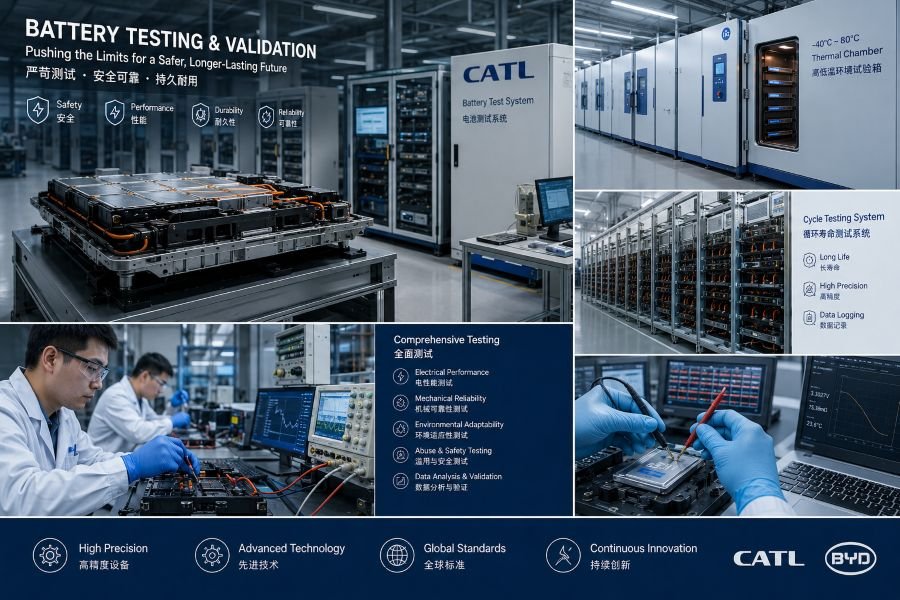
Battery Testing Laboratory: Advanced equipment for quality assurance and durability testing
Future Battery Technologies in Chinese EVs
The battery landscape for Chinese EVs is evolving rapidly. Next-generation technologies promise even longer lifespan, faster charging, and improved safety. CATL is expanding sodium-ion battery production for cost-conscious markets, while BYD continues developing advanced blade batteries with superior longevity. NIO’s semi-solid-state batteries, in development, promise 900+ kilometer range with dramatically reduced degradation.
Meanwhile, Chinese manufacturers have made breakthroughs in fast-charging technology. Vehicles like XPeng’s newest models can add 300+ kilometers of range in 15 minutes using ultra-high-power DC charging, while sophisticated thermal management ensures this rapid charging doesn’t significantly accelerate degradation. This represents a genuine engineering achievement that enhances practical EV ownership without compromising longevity.
⚠️ Important Consideration
While Chinese EV battery quality has improved dramatically, regional availability of warranty service varies significantly. Before purchasing, verify that your location has authorized service centers capable of performing warranty repairs and battery diagnostics. In Europe and North America, warranty service availability is generally excellent, while availability in some other regions may be more limited.
Battery Replacement Costs and Options
While most Chinese EV owners never need to replace a battery outside warranty coverage, understanding replacement costs helps assess long-term ownership expenses. Official manufacturer battery replacements typically cost $5,000-$15,000 depending on capacity, with larger batteries (80-100 kWh) approaching the higher end of this range. Smaller packs (40-60 kWh) cost correspondingly less.
Some aftermarket options and battery refurbishment services offer cost savings, though typically with different warranty terms. Battery recycling companies can also provide refurbished batteries at reduced costs—these tested packs might have 90%+ capacity but without manufacturer warranties. As battery supply chains mature and production volumes increase, replacement costs are trending downward, with competitive pricing expected by 2027-2028.
Battery-as-a-Service (BaaS) programs offered by NIO, Geely, and increasingly others separate battery ownership from vehicle ownership. You purchase the vehicle at a lower price but pay a monthly subscription for battery access and maintenance. This model shifts longevity risk to the manufacturer and provides certainty about future costs.
Frequently Asked Questions
Most Chinese EV batteries are designed to last between 8-10 years or 200,000-300,000 kilometers. Leading manufacturers like CATL, BYD, and NIO offer 8-10 year warranties covering defects and capacity degradation. However, many batteries retain 80% capacity after 10 years, allowing the vehicle to function well beyond warranty periods with only modest range reduction.
Chinese EV batteries typically come with 8-10 year warranties covering defects and capacity degradation. Premium brands like NIO, Li Auto, and XPeng offer extended warranties up to 12 years in some markets. Warranty coverage includes full battery replacement if capacity drops below 70-80% of original capacity, covering manufacturing defects, BMS failures, and thermal management system problems.
Temperature significantly impacts battery lifespan. Batteries perform optimally between 15-25°C. Excessive heat (above 40°C) and extreme cold (below -10°C) accelerate degradation. However, modern Chinese EVs include sophisticated thermal management systems that actively heat or cool battery packs based on conditions, substantially mitigating temperature-related degradation compared to earlier EV generations.
DC fast charging causes more thermal stress and generates more heat than slower AC charging, contributing to faster degradation. Frequent fast charging, especially from very low to very high states of charge, accelerates aging. However, modern Chinese EV BMS systems limit fast charging rates automatically to protect battery health, and occasional fast charging doesn’t significantly impact overall lifespan if balanced with regular slower charging.
After warranty expiration, you’re responsible for battery replacement costs if needed. Official replacements from manufacturers typically cost $5,000-$15,000 depending on capacity. However, most batteries remain functionally excellent after warranty expiration, typically retaining 75-85% capacity. Many owners never need replacement, instead continuing to drive with modestly reduced range.
Yes, Chinese EV batteries can be refurbished or recycled. Batteries reaching end-of-vehicle-life are refurbished for stationary storage applications (home energy storage, grid support) where lower capacity is acceptable. Recycling facilities recover valuable materials including lithium, cobalt, and nickel. Refurbished batteries can also be purchased as replacement options, typically at lower cost than new manufacturer batteries but without full warranties.
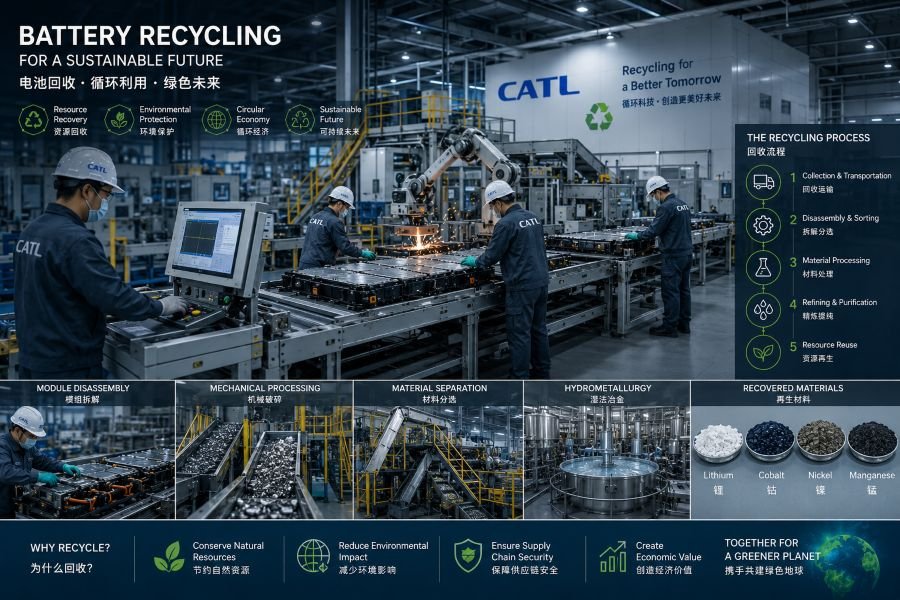
Battery Recycling Process: Recovering valuable materials and ensuring sustainable lifecycle
Conclusion: Making an Informed Decision
Chinese EV batteries have become genuinely excellent energy storage systems that rank among the world’s best in terms of longevity, safety, and performance. The 8-10 year warranties offered by manufacturers reflect legitimate confidence in battery quality, and real-world data confirms that most batteries exceed warranty expectations regarding capacity retention.
When considering a Chinese EV purchase, battery longevity should not be a primary concern. Instead, focus on other important factors: vehicle reliability, local service infrastructure, charging network availability, and alignment with your actual driving needs. The battery will almost certainly remain functional and effective throughout your ownership period, whether you plan to keep the vehicle 5 years or 15 years.
By adopting battery-friendly charging practices, managing thermal conditions when possible, and keeping software updated, you can maximize the already-excellent longevity that Chinese EV batteries naturally provide. The rapid evolution of EV battery technology means that future generations of Chinese EVs will likely offer even better battery performance, making today’s decisions about battery longevity increasingly less critical to overall ownership satisfaction.
The Chinese EV revolution represents genuine progress in automotive technology—and battery technology is at the heart of this achievement. Whether you’re considering a BYD, NIO, XPeng, Li Auto, or another Chinese EV brand, you can be confident that the battery beneath your feet is engineered to reliably power your vehicle for years of enjoyable, practical electric driving.