LFP vs NMC Batteries: Which is Better for Chinese EVs?
The electric vehicle revolution is fundamentally powered by battery technology, and two chemistry types dominate the Chinese EV market: LFP (Lithium Iron Phosphate) and NMC (Nickel Manganese Cobalt). While NMC batteries long held market dominance, LFP technology has undergone a remarkable resurgence, backed by industry giants like BYD and increasingly adopted by manufacturers worldwide.
This comprehensive comparison explores the critical differences between the two technologies — safety, longevity, performance, cost, and environmental impact — to help you understand which battery type is ideal for your next Chinese electric vehicle.
The video above offers an in-depth technical analysis of both battery chemistries — thermal stability, performance metrics, cost considerations, and environmental implications. As the EV market continues to evolve, understanding these fundamental differences becomes increasingly important for making an informed purchase. The sections below expand on these concepts with data, comparisons, and expert insights.
Understanding Battery Chemistry: LFP vs NMC
Before weighing the advantages and disadvantages of each battery type, it helps to understand what makes them fundamentally different. Battery chemistry determines nearly every performance characteristic of an electric vehicle — from how quickly it charges to how long it lasts and how safe it is under extreme conditions.
What is LFP Battery Technology?
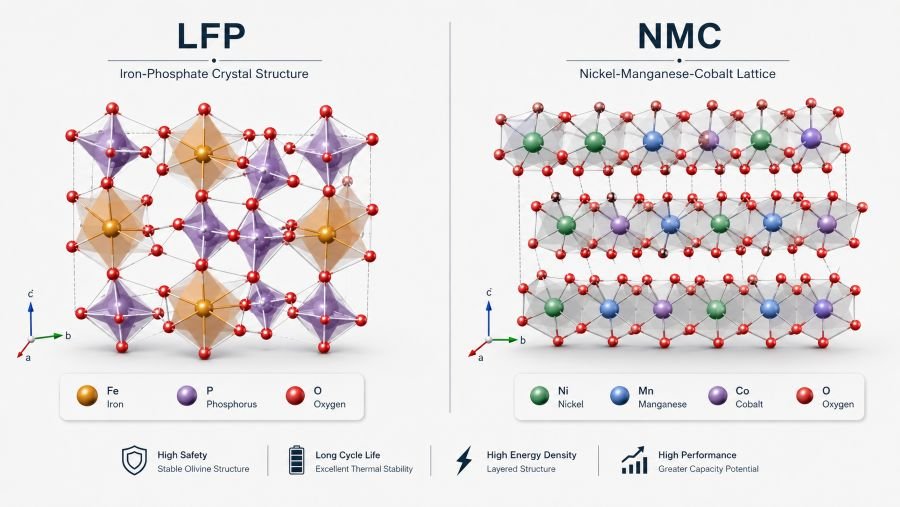
Lithium Iron Phosphate (LFP) represents a fundamentally different approach to battery design compared with traditional lithium-ion formulations. In an LFP battery, the cathode is composed of lithium iron phosphate compounds, while the anode remains graphite-based. This seemingly small change in chemical composition creates dramatic differences in performance, safety, and longevity.
The iron and phosphate compounds create an extremely stable crystal structure that resists decomposition even at elevated temperatures, and that structural stability is the foundation of LFP’s reputation for safety and durability. Chinese battery manufacturers, particularly BYD (which also produces the batteries for its own vehicles), have perfected LFP production processes, making China the global leader in LFP manufacturing and adoption.
What is NMC Battery Technology?
Nickel Manganese Cobalt (NMC) batteries use a more complex cathode material that combines nickel, manganese, and cobalt in various proportions. Common formulations include ratios such as 622 (60% nickel, 20% manganese, 20% cobalt) or 811 (80% nickel, 10% manganese, 10% cobalt), each designed to optimize energy density and performance.
The primary advantage of NMC chemistry is its higher energy density — more power output per kilogram of battery weight. This made NMC the preferred choice for performance-oriented vehicles and provided the efficiency needed for early EV adoption. However, this energy advantage comes with inherent trade-offs in safety and longevity that modern manufacturers and consumers are increasingly unwilling to accept.
💡 Technical Note: High-nickel variants like NMC 811 were specifically designed to reduce cobalt content and cost while improving energy density. But higher nickel content increases reactivity and thermal-runaway risk, creating a safety-performance paradox that LFP chemistry naturally avoids.
Battery-Friendly Accessories for EV Owners
Affiliate disclosure: As an Amazon Associate, Chinese Cars Asia earns from qualifying purchases. The links below may earn us a small commission at no extra cost to you.
Type 2 to Type 2 Charging Cable (22kW, 5m)
Whether your EV runs LFP or NMC cells, regular slower AC charging at home is gentler on battery health than constant DC fast charging. A TÜV-certified 32A Type 2 cable makes daily top-ups easy across UK and European wallboxes.
🛒 Check Price on AmazonEV Charging Cable Storage Bag
A waterproof, fire-retardant bag keeps your charging cable clean, dry and protected between charges — a small accessory that makes everyday home and public charging far tidier.
🛒 Check Price on AmazonSafety Performance and Thermal Stability
Safety is perhaps the most critical difference between LFP and NMC batteries — a distinction that has shaped industry decisions and regulatory approaches globally.
Thermal Runaway Resistance
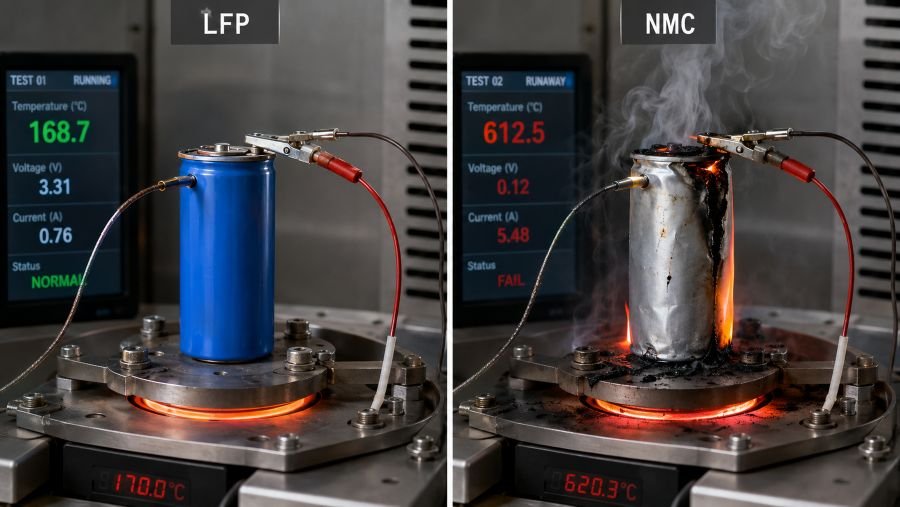
Thermal runaway is a catastrophic condition where a cell’s temperature escalates uncontrollably, potentially leading to fires or explosions. It occurs when a battery’s internal chemical reaction becomes unstable, generating excessive heat that accelerates further reactions in a self-sustaining cycle.
LFP batteries possess remarkable resistance to thermal runaway thanks to their stable iron-phosphate structure. Even when subjected to mechanical damage, overcharging, or elevated temperatures, LFP cells maintain structural integrity. Independent tests — including nail-penetration, crushing, and overcharge scenarios — have repeatedly shown LFP tolerating extreme conditions without igniting, which means LFP-equipped vehicles can operate with less complex and expensive safety-management systems.
NMC batteries, by contrast, contain reactive nickel and manganese compounds that are more prone to decomposition at elevated temperatures. The organic electrolyte becomes increasingly unstable as temperatures rise, potentially leading to thermal runaway if the management system fails or the cell is severely damaged. This necessitates more sophisticated thermal management, overcharge protection, and monitoring electronics — all of which add cost and complexity.
Real-World Safety Statistics
Insurance data and incident reports from Chinese EV markets provide compelling evidence of the safety gap. Vehicles equipped with LFP batteries consistently show lower fire-incident rates than NMC-equipped vehicles when normalized for vehicle age and driving patterns. This is not merely a matter of better management systems — it reflects the fundamental chemistry advantage LFP possesses. The Chinese regulatory environment has increasingly recognized this, with safety standards and certifications favoring LFP, and major manufacturers have responded by dramatically expanding LFP offerings even in premium segments.
Longevity and Cycle Life Comparison
Battery lifespan directly impacts total cost of ownership and environmental sustainability — and this is where LFP demonstrates its most compelling advantage over NMC. Manufacturers measure lifespan in cycles: a full cycle represents bringing a battery from completely empty to completely full.
| Characteristic | LFP Battery | NMC Battery |
|---|---|---|
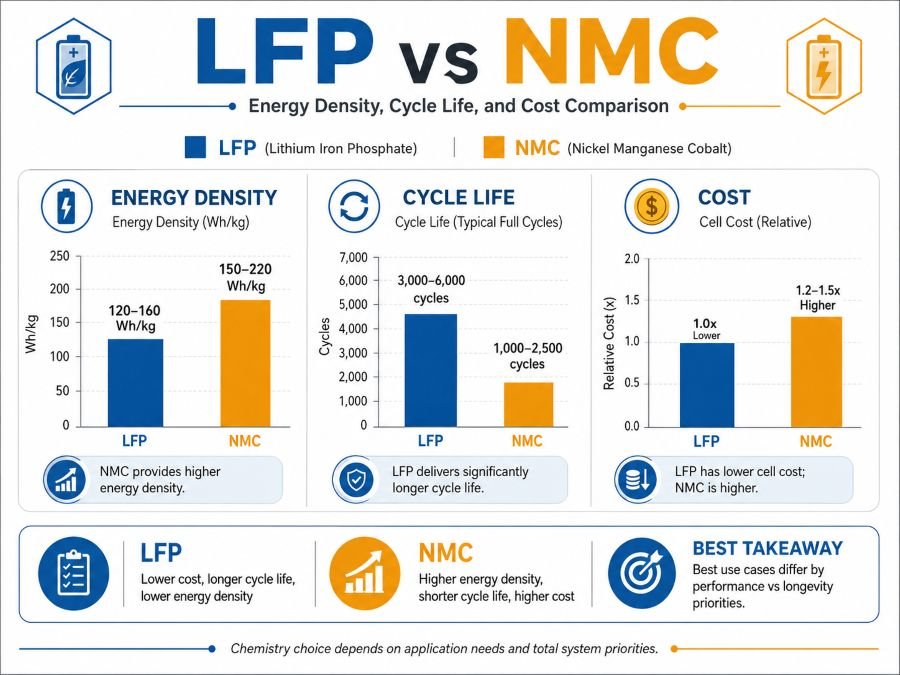
| Expected Cycle Life | 2,000–3,000+ cycles | 1,000–2,000 cycles |
| Capacity Retention (80%) | 6–10 years typical use | 4–6 years typical use |
| Estimated Vehicle Lifespan | 15–20 years of service | 10–12 years of service |
| Calendar Aging | Slower degradation | Faster degradation |
| Deep Discharge Tolerance | Excellent (handles 0–100%) | Sensitive (prefers 20–80%) |
Why LFP Lasts Longer
LFP’s longevity advantage stems from its chemical stability. The iron-phosphate structure undergoes fewer irreversible reactions during charge-discharge cycling, so each cycle causes minimal damage to the crystal lattice, allowing performance to hold over thousands of cycles. NMC batteries, particularly high-nickel variants, experience more significant structural changes — the reactive nickel compounds undergo subtle phase transitions and oxygen loss during discharge, which compounds over successive cycles, while the organic electrolyte degrades faster at high temperatures and high states of charge.
LFP Advantages
- Superior cycle longevity (2,000–3,000+ cycles)
- Minimal capacity fade over time
- Handles deep discharge cycles well
- Lower calendar-aging rates
- Predictable degradation patterns
NMC Challenges
- Lower cycle life (1,000–2,000 cycles)
- Rapid capacity fade in the first 2–3 years
- Prefers limited charge ranges (20–80%)
- Accelerated aging at high temperatures
- Less predictable degradation
Energy Density and Performance Characteristics
While LFP dominates the safety and longevity discussion, NMC maintains a distinct advantage in performance metrics that still matter to many buyers. Energy density represents the amount of electrical energy stored per unit of weight, directly impacting range, acceleration, and overall driving dynamics.
- LFP energy density: 150–170 Wh/kg (volumetric: 380–450 Wh/litre)
- NMC energy density: 200–230 Wh/kg (volumetric: 500–650 Wh/litre)
This roughly 25–35% energy-density advantage gives NMC superiority in specific applications: a vehicle with identical battery weight can achieve around 25% more range with NMC than with LFP. For buyers prioritizing maximum range and payload, that difference remains relevant.
Performance and Acceleration
NMC batteries can deliver higher peak power outputs, enabling quicker acceleration and more responsive driving dynamics. Premium Chinese EV brands like NIO, and high-performance variants of other brands, often specify NMC precisely for this reason — the chemistry’s higher voltage output and ability to sustain high discharge rates make it ideal for performance-oriented vehicles. However, those higher discharge rates stress the chemistry more significantly, contributing to NMC’s shorter lifespan and safety concerns.
Cost Analysis and Economic Considerations
The economic equation between LFP and NMC has transformed dramatically over the past few years. Historically, NMC was significantly cheaper to produce — typically 20–30% less per kWh than LFP — and that advantage drove its early dominance. But NMC’s cost edge relied on a few specific factors:
- Mature manufacturing infrastructure in developed nations
- Established supply chains for nickel, cobalt, and manganese
- Long-standing relationships with battery suppliers
Today’s market tells a different story. Chinese manufacturers have invested heavily in LFP production capacity, achieving scale that rivals or exceeds global NMC production. BYD, CATL, and others now produce LFP at costs competitive with — or potentially lower than — NMC on a per-kWh basis.
| Cost Factor | LFP (2024–2026) | NMC (2024–2026) |
|---|---|---|
| Per-kWh Manufacturing Cost | $80–100 USD | $90–110 USD |
| Raw Material Costs | Very stable, abundant | Volatile, cobalt supply concerns |
| Thermal Management System | Simpler, lower cost | Complex, higher cost |
| Vehicle Battery Cost (60 kWh) | $4,800–6,000 | $5,400–6,600 |
| Replacement Cost at 10 Years | $3,500–4,500 | $5,000–7,000 |
When analyzing total cost of ownership over a vehicle’s service life, LFP’s advantages become compelling. While initial battery costs may be marginally higher or equal, the superior lifespan and reduced degradation translate to significantly lower replacement costs — a benefit that grows for any owner keeping their EV beyond 10 years.
⚠️ Important Consideration: Battery replacement costs continue to decline as manufacturing scales. By the time an LFP-equipped vehicle needs a replacement pack in 2035–2040, prices will likely be 30–50% lower than today’s, partially offsetting any long-term cost comparison made now.
Which Chinese EV Brands Are Using LFP?
The shift toward LFP has been especially pronounced among Chinese EV manufacturers, and understanding which brands favor which chemistry can inform your selection.
LFP-First Manufacturers
BYD is the most aggressive adopter of LFP. As both a vehicle manufacturer and battery producer, it has vertically integrated LFP production into its business model, and its Qin, Song, and Yuan lineups increasingly feature LFP even in premium variants. XPeng incorporates LFP options across multiple segments, letting buyers choose between LFP and NMC depending on priorities. Li Auto and SAIC-GM-Wuling have increasingly integrated LFP in mainstream offerings, particularly urban-oriented vehicles where slightly lower energy density isn’t a meaningful limitation.
Hybrid-Approach Manufacturers
NIO continues to offer primarily NMC, reflecting its performance-luxury positioning where acceleration and maximum range remain paramount, though it has experimented with LFP for certain segments. Geely offers both chemistries across its lineup — NMC for performance variants, LFP for value-oriented models. Tesla has begun integrating LFP in certain Chinese-market vehicles, particularly lower-priced Model 3 and Model Y configurations sold domestically, marking a strategic shift for a historically NMC-focused manufacturer.
Environmental and Sustainability Impact
The environmental implications of battery-chemistry choice extend far beyond simple energy-efficiency metrics, touching raw-material sourcing and end-of-life recycling.
Raw Material Sourcing
LFP batteries use iron, phosphorus, and lithium — elements abundant throughout the Earth’s crust and available from many geographical sources. Iron mining is well established in stable nations including Australia, India, and Scandinavia, and phosphorus is commonly extracted as a byproduct of other mineral processing. This abundance and geographic diversity reduce supply-chain risk. NMC batteries, by contrast, depend on cobalt, nickel, and manganese in specific proportions; cobalt mining is heavily concentrated in the Democratic Republic of Congo, where environmental and labor practices are frequently questioned, and nickel mining carries substantial environmental concerns.
Battery Recycling and Circular Economy
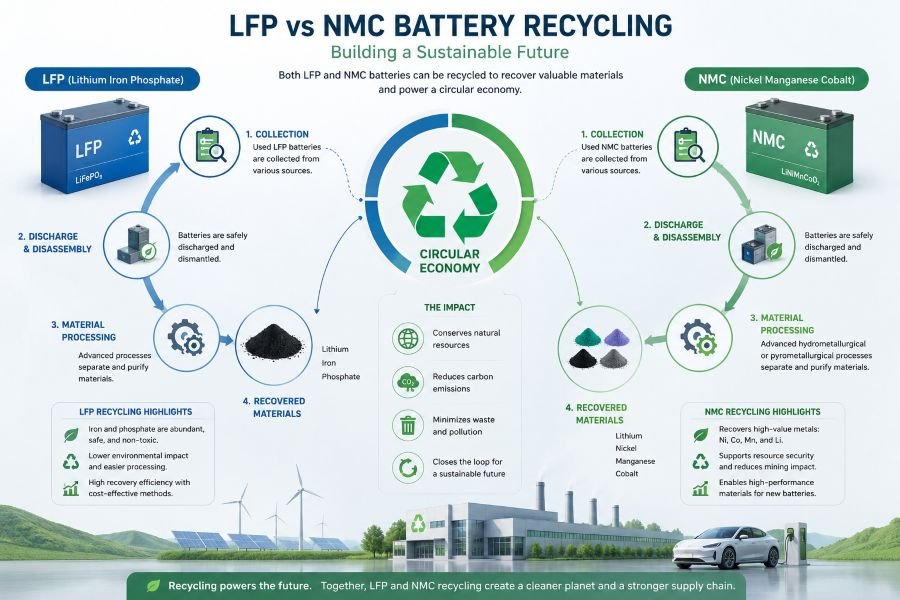
LFP batteries offer advantages in end-of-life recycling. The simpler, iron-based composition makes recovery of valuable materials more straightforward and less toxic, and recycled LFP material can be reused directly in new battery production with minimal processing. NMC recycling is more chemically complex and generates more toxic processing streams, with nickel, manganese, and cobalt recovery requiring specialized facilities and careful hazardous-waste management.
Cold Weather Performance Differences
Temperature tolerance is one area where NMC keeps a genuine performance advantage — an important consideration for buyers in northern climates. Both chemistries lose performance in the cold due to increased internal resistance, but the mechanisms and severity differ.
NMC in cold: energy loss of roughly 15–20% at 0°C and up to 40% at -20°C, though it recovers full capacity relatively quickly once warmed, and its higher voltage output enables more effective electrolyte heating and faster warm-up. LFP in cold: more pronounced range loss — potentially 30–40% at 0°C — but the gap narrows significantly in moderately cold conditions, and LFP’s superior thermal stability actually makes it less prone to damage from repeated cold cycling.
For buyers in consistently cold climates, the cold-weather advantage remains relevant, but it shouldn’t be an automatic disqualifier for LFP. Modern LFP-equipped vehicles incorporate technologies that have largely mitigated the disadvantage:
- Pre-heating systems that warm the battery before charging
- Heat-pump cabin heating that dramatically reduces energy draw
- Battery-management software that optimizes warm-up cycles
- Vehicle-to-cabin heating that uses waste heat from electronics
🌡️ Cold-Climate Tip: If you live somewhere cold and are choosing between LFP and NMC, prioritize recent model years (2024+) with advanced thermal management. Older LFP vehicles exhibited more pronounced cold-weather challenges that newer generations have largely resolved.
The Verdict: Making Your Choice
After examining the comprehensive differences between LFP and NMC, the right choice depends on your specific priorities and driving patterns.
Choose LFP If You Prioritize
- Safety and peace of mind — superior thermal stability and fire resistance
- Long-term ownership — 10+ years with minimal battery degradation
- Environmental responsibility — abundant raw materials and simpler recycling
- Lower total cost of ownership — reduced replacement costs over the vehicle’s life
- City and suburban driving — where reliability matters more than maximum range
Choose NMC If You Prioritize
- Maximum performance and acceleration — superior power delivery and response
- Extended range — a 20–30% range advantage for long-distance driving
- Cold-weather driving — better performance in freezing conditions
- Shorter ownership periods — 3–5 years, where battery life is less critical
- High-mileage efficiency — squeezing out every percentage point of energy
🎯 The Bottom Line: For most buyers intending to keep a vehicle beyond 8–10 years, LFP is the superior choice. The safety advantages are non-negotiable, the longevity benefits translate to genuine cost savings, and cold-weather concerns have been largely mitigated by modern technology. But if you’re a performance enthusiast prioritizing acceleration and range, or you live in an extremely cold climate without a heated garage, NMC remains competitive.
FAQ: LFP vs NMC Batteries
What does LFP battery stand for?
LFP stands for Lithium Iron Phosphate — a lithium-ion battery chemistry that uses iron and phosphate compounds as the cathode material. LFP batteries are known for exceptional safety, long lifespan, and thermal stability, making them increasingly popular among Chinese EV manufacturers.
Are LFP batteries safer than NMC?
Yes. LFP’s stable chemical structure makes it highly resistant to thermal runaway and combustion. NMC batteries contain nickel, manganese, and cobalt, which are more reactive and can pose greater thermal-runaway risks if damaged or overcharged — a major reason many Chinese EV makers have shifted to LFP.
Which battery lasts longer, LFP or NMC?
LFP typically lasts longer. It can endure 2,000–3,000 charge cycles while maintaining over 80% capacity, while NMC typically lasts 1,000–2,000 cycles. Over a vehicle’s lifetime, LFP offers significantly better longevity and potentially lower replacement costs, though NMC may have stronger performance characteristics initially.
Is LFP or NMC more expensive?
Historically NMC was cheaper thanks to mature production infrastructure, but as LFP manufacturing has scaled up in China the gap has narrowed sharply. Today LFP is often price-competitive or even cheaper per kWh, especially when factoring in its longer lifespan and superior safety.
Which Chinese EV brands use LFP batteries?
Many do. BYD uses LFP extensively, XPeng offers LFP versions, Tesla has integrated LFP in some Chinese-market vehicles, and Geely electric models increasingly feature LFP — reflecting the industry’s shift toward prioritizing safety and longevity.
Does temperature affect LFP and NMC batteries differently?
Yes. NMC maintains better performance in cold conditions, while LFP is more thermally stable and safer in high heat. LFP performs adequately in the cold but may rely on battery-management strategies in extreme climates — features that modern Chinese EVs now include as standard.
The Future of Battery Technology
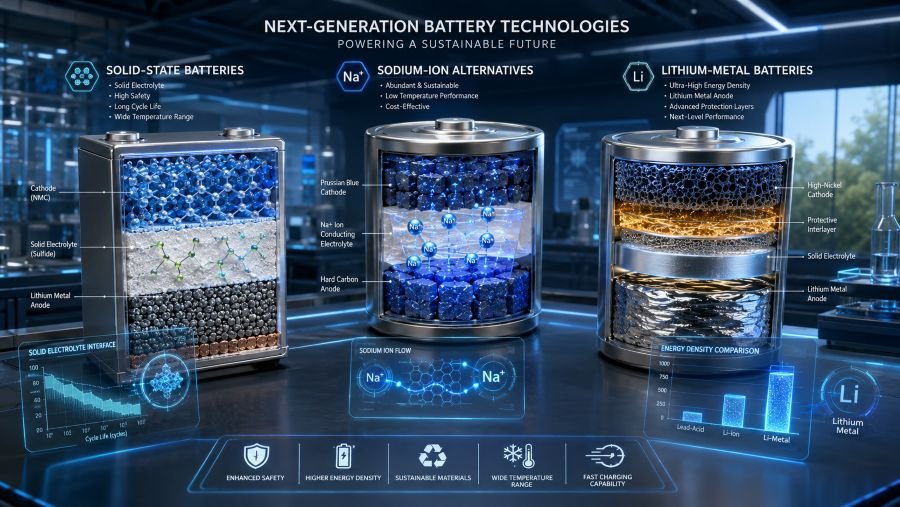
While LFP and NMC dominate current production, the landscape continues to evolve, and researchers worldwide are developing next-generation technologies that may render this comparison obsolete within a decade. Solid-state batteries are the next frontier, promising energy densities even higher than NMC combined with the safety of LFP by replacing the liquid electrolyte with a solid material; commercial vehicles are expected in the 2030–2035 timeframe.
Sodium-ion batteries are emerging for cost-sensitive markets and fleets, using abundant sodium instead of lithium to trade some energy density for cost and supply-chain resilience — CATL and others have already begun producing them for certain applications. Lithium-metal batteries aim to bridge current and solid-state technologies, offering higher energy density than conventional lithium-ion while remaining compatible with existing manufacturing.
Key Takeaways
LFP batteries have emerged as the safer, longer-lasting choice for most buyers: superior safety, exceptional longevity (2,000–3,000+ cycles), abundant raw materials, and increasingly competitive pricing make them the practical pick for long-term ownership, while the modest cold-weather disadvantage has been largely addressed by modern thermal management. NMC batteries retain the edge for performance-oriented buyers and those chasing maximum range, with a 25–35% energy-density advantage that enables quicker acceleration and longer driving range. For most Chinese EV buyers — especially those planning 10+ years of ownership — LFP represents the superior overall choice, with safety and longevity advantages that outweigh the modest performance compromise for typical driving.