NIO ET5 vs BMW 3 Series: Can China Beat Germany?
The automotive world has been watching an intense rivalry unfold between established German luxury brands and emerging Chinese manufacturers. The NIO ET5 and BMW 3 Series represent this clash of cultures—tradition meets innovation, heritage meets disruption. Both sedans target premium buyers seeking performance, technology, and prestige, but they approach these goals from dramatically different perspectives.
What makes this comparison particularly compelling is that we’re witnessing a generational shift in automotive priorities. While BMW’s 3 Series emphasizes heritage, driving dynamics, and refined combustion engineering, the NIO ET5 prioritizes innovation, software sophistication, and the promise of a battery-electric future.
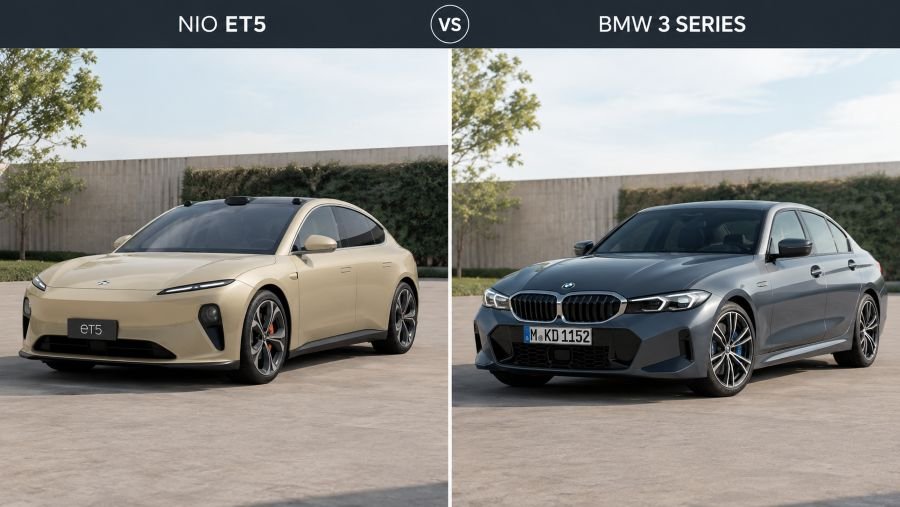
The NIO ET5 and BMW 3 Series occupy surprisingly similar market positions despite their vastly different origins. Both vehicles target affluent buyers aged 30-50 who value performance, technology integration, and a premium driving experience. The BMW 3 Series, launched in its current generation (G20) in 2019, represents over 50 years of continuous refinement in sport sedan engineering. The NIO ET5, introduced in 2021, symbolizes China’s rapid ascent in electric vehicle development, combining cutting-edge battery technology with sophisticated autonomous features.
Design and Aesthetics: Traditional Elegance vs Modern Boldness
BMW 3 Series Design Language
The BMW 3 Series maintains the marque’s signature design vocabulary—the iconic kidney grille, sharp-creased bodywork, and purposeful proportions that signal “sports sedan” from every angle. The G20 generation introduced larger grilles and cleaner surfaces, though purists debated whether these changes honored BMW’s heritage or diluted it. The 3 Series’ design feels evolved rather than revolutionary, offering timeless appeal that should age well in your driveway.
Proportionally, the BMW measures 4,829mm long and 1,852mm wide, with a 2,961mm wheelbase that creates classic premium sedan proportions. The design emphasizes horizontal lines, muscular fenders, and a sharply defined character line running the vehicle’s length. LED lighting technology is sophisticated, with pixel-style LED headlights available on higher trims.
NIO ET5 Design Philosophy
By contrast, the NIO ET5 embraces minimalism and aerodynamic efficiency—essential considerations for battery-electric vehicles. Measuring 4,790mm long and 1,960mm wide, the ET5 appears more planted and spacious than the BMW. The absence of traditional grille openings creates a smoother, more futuristic face. Its “supercontinental” design language features seamless panels, flush door handles, and integrated lighting elements.
The ET5’s 0.22 coefficient of drag (Cd) represents a significant advantage over the BMW 3 Series at 0.28 Cd, directly translating to extended electric range and improved efficiency. Every design decision—from the wheel shape to the angle of the backlight—has been optimized for aerodynamic performance.
Performance and Powertrain: Tradition Meets Innovation
BMW 3 Series Engine Options
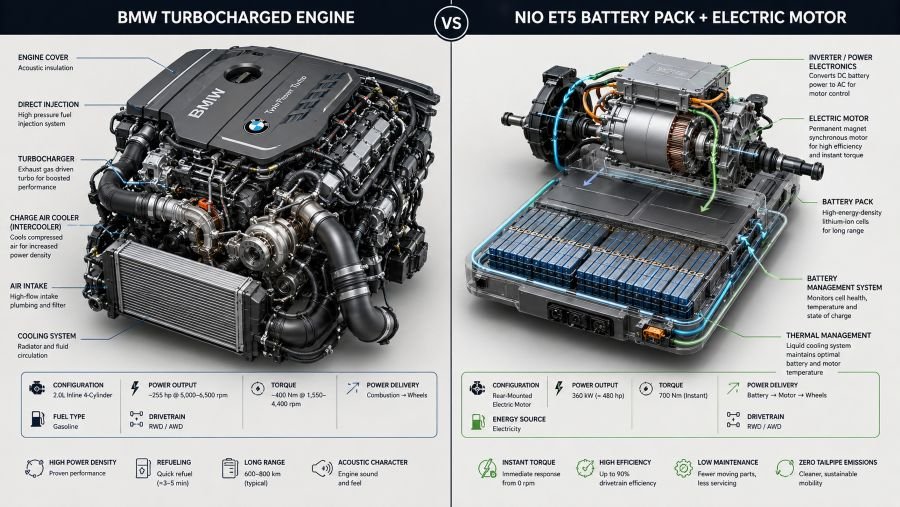
The BMW 3 Series offers a range of turbocharged options:
- 320i: 2.0L TwinPower turbo, 184 hp, 0-60 mph in 8.1 seconds
- 330i: 2.0L TwinPower turbo, 255 hp, 0-60 mph in 6.0 seconds
- 340i: 3.0L TwinPower turbo, 382 hp, 0-60 mph in 4.6 seconds
- 330e (Hybrid): 2.0L turbo + electric motor, 288 hp combined, 0-60 mph in 5.5 seconds
BMW’s engines deliver the raw visceral experience enthusiasts crave—turbo spooling, gear shifts, and a familiar powerband refined over generations. Fuel efficiency ranges from 25-32 mpg depending on engine and configuration, with the plug-in hybrid offering electric-only driving for short commutes.
NIO ET5 Electric Propulsion
The NIO ET5 offers multiple battery configurations:
- Standard Range (SR): 75 kWh battery, 217 hp, 355 Nm torque, 308 miles CLTC range
- Long Range (LR): 100 kWh battery, 322 hp, 385 Nm torque, 416 miles CLTC range
- Performance (ET5 Performance): Dual motor AWD, 612 hp, 900 Nm combined torque, 0-60 mph in 3.9 seconds
NIO’s electric propulsion delivers instant torque and linear acceleration free from gear shifting. The Performance variant’s 0-60 time rivals sports cars costing significantly more. NIO’s battery technology and thermal management systems enable consistent performance across varying climates and states of charge.
💡 Pro Tip: While BMW’s 340i reaches 0-60 mph in 4.6 seconds, the NIO ET5 Performance achieves it in 3.9 seconds—and does so repeatedly without thermal degradation, whereas the BMW requires cooldown between acceleration runs.
Interior Technology and Driver Experience
BMW 3 Series Infotainment: The iDrive System
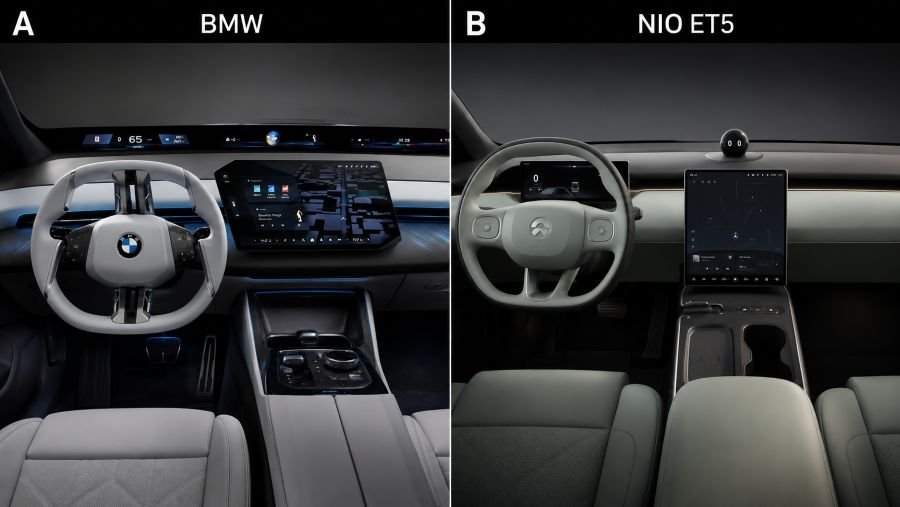
The BMW 3 Series features the latest-generation iDrive (8 or 8S depending on trim level). This represents BMW’s most aggressive interior redesign in recent memory—a fully digital cockpit with a curved display spanning approximately 14.9 inches. The system responds to voice commands in multiple languages, gesture control, and traditional iDrive controller inputs.
iDrive integration with Apple CarPlay and Android Auto is seamless. Navigation is powered by HERE Maps, and cloud connectivity enables dynamic traffic routing and real-time weather integration. Safety features include autonomous emergency braking, adaptive cruise control, lane departure warning, and optional adaptive lighting.
NIO ET5 Interior Tech: The Aquila Super Sensing Platform
The NIO ET5’s interior technology architecture differs fundamentally from BMW’s approach. Rather than merely integrating consumer technologies, NIO built its entire ecosystem from the ground up for autonomous capabilities. The ET5 features a 12.8-inch central infotainment screen running NIO’s proprietary operating system, alongside a 10.2-inch customizable driver display.
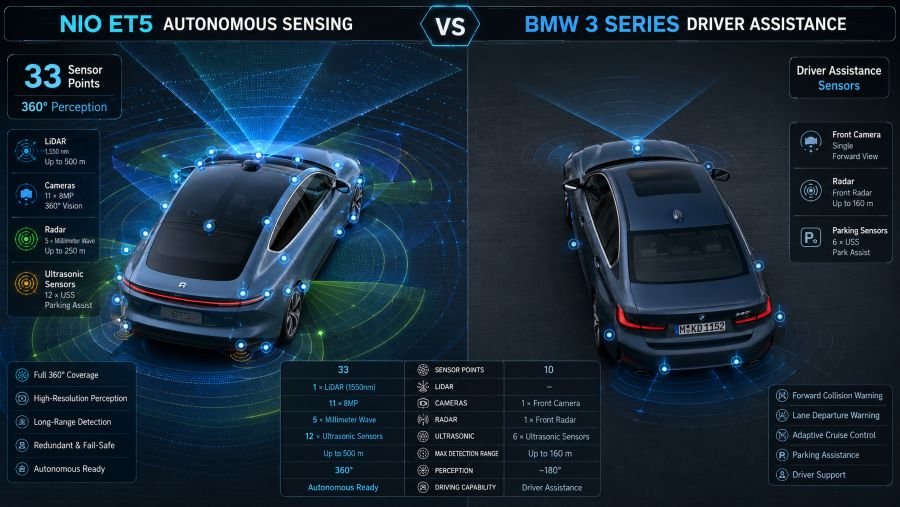
The Aquila Super Sensing platform comprises 33 high-precision sensors distributed throughout the vehicle’s exterior. This architecture enables NIO Pilot (autonomous driving) capabilities including:
- Adaptive traffic jam assist
- Highway autonomous driving (on supported roads)
- Automatic parking and garage guidance
- Blind-spot monitoring with predictive alerts
- Real-time object detection and trajectory prediction
The integration extends to voice control supporting conversational Mandarin commands—NIO’s AI can understand context-dependent requests. OTA (over-the-air) updates continuously improve capabilities, meaning an ET5 purchased today will gain features throughout its ownership without dealership visits.
Comfort and Interior Quality
BMW 3 Series Cabin Refinement
BMW excels at creating inviting, driver-focused interiors. The 3 Series offers optional Merino leather, contrast stitching in customer-selected colors, and ambient lighting with up to 64 colors. Noise insulation is excellent, with acoustic laminated glass and active noise cancellation.
Seating is firm yet supportive, clearly designed for engagement. The driver’s seat offers 18-way power adjustment, lumbar support with massage functionality, and heating/cooling. Rear passengers receive adult-proportioned legroom (33.5 inches) but may find headroom slightly tight for tall individuals.
NIO ET5 Cabin Comfort and Smart Interior
NIO takes a fundamentally different approach to interior comfort. The cabin prioritizes spaciousness. The rear seat offers 37.4 inches of legroom—significantly more than BMW’s offering—creating a genuinely first-class experience for passengers.
Climate control is sophisticated, with multi-zone temperature management, air purification with PM2.5 filtration, and “intelligent ventilation” that preemptively adjusts before occupants feel discomfort. The optional panoramic sunroof is larger than typical, with electrochromic (smart tint) technology reducing interior heating while maintaining views.
🎯 Smart Features: The NIO ET5 uniquely offers meditation and breathing exercise programs through the infotainment system, triggering synchronized lighting and aromatherapy diffusion—a wellness integration absent in traditional luxury sedans.
Driving Dynamics and Handling
BMW 3 Series: The Sports Sedan DNA
The BMW 3 Series inherited a 50-year legacy as “the ultimate driving machine.” The G20 generation features:
- Double-wishbone front suspension with forged aluminum controls
- Integral five-link rear suspension
- Optional adaptive M Sport suspension with continuously variable damping
- Front and rear anti-roll bars with electronic adjustment
This architecture delivers outstanding grip, minimal body roll, and responsive steering feel. The power steering provides genuine feedback, unlike many competitors’ numb systems. Turn-in is immediate, mid-corner grip is exceptional, and the suspension maintains composure over rough pavement without becoming punishing at city speeds.
NIO ET5: Comfort-Oriented Dynamics
NIO engineered the ET5’s suspension for comfort and safety over outright sportiness. The independent double-wishbone front and multi-link rear are tuned for compliance, prioritizing ride quality over handling agility. The ET5’s lower center of gravity (thanks to floor-mounted batteries) partially compensates, providing stable handling despite the comfort-focused suspension tuning.
Regenerative braking technology is sophisticated, allowing single-pedal driving. This technology reduces wear on conventional brake components while harvesting kinetic energy to extend range—a pure electric advantage over traditional vehicles.
Safety and Autonomous Capabilities
| Safety Feature | NIO ET5 | BMW 3 Series |
|---|---|---|
| Autonomous Emergency Braking | ✅ Standard (Pedestrian/Vehicle) | ✅ Optional |
| Adaptive Cruise Control | ✅ Standard (Stop-and-go) | ✅ Optional |
| Lane Keeping Assist | ✅ Standard | ✅ Optional |
| Autonomous Parking | ✅ Standard (360° assist) | ✅ Optional (Remote) |
| Level 2 Autonomy | ✅ NIO Pilot (Highway capable) | ⚠️ BMW Driving Assist (Limited) |
| OTA Safety Updates | ✅ Continuous improvements | ⚠️ Periodic updates |
| Crash Test Ratings | ⚠️ Not tested (Chinese focus) | ✅ 5/5 Euro NCAP |
The BMW 3 Series achieved five-star ratings across all Euro NCAP categories, representing the highest crash test standards globally. Its safety architecture prioritizes proven, tested technologies available across its global markets.
NIO’s approach emphasizes prevention over protection. The 33-sensor Aquila platform identifies hazards earlier than human perception, enabling predictive avoidance. While NIO Pilot hasn’t been formally tested by Euro NCAP, real-world usage data suggests exceptional safety performance.
Range, Efficiency, and Charging
BMW 3 Series Fuel Economy
The gasoline-powered BMW 3 Series achieves EPA-estimated fuel economy of:
- 320i: 26 city / 36 highway / 30 combined mpg
- 330i: 25 city / 34 highway / 28 combined mpg
- 330e Plug-in Hybrid: 75 MPGe (electric), 37 combined city/highway
At current US average fuel prices ($3.50/gallon), a 330i costs approximately $0.10 per mile to operate. The 330e plug-in hybrid reduces operational costs significantly, but the battery capacity limits all-electric range to approximately 35 miles.
NIO ET5 Range and Efficiency
NIO ET5 efficiency ratings (using CLTC standards):
- Standard Range (75 kWh): 308 miles CLTC range, 3.0 km/kWh efficiency
- Long Range (100 kWh): 416 miles CLTC range, 2.8 km/kWh efficiency
At current US average electricity costs ($0.14/kWh), the ET5 costs approximately $0.04 per mile—a 60% operational cost advantage over the 330i. Real-world range testing suggests CLTC estimates overstate actual range by approximately 15-20%, resulting in realistic ranges of 260-350 miles depending on driving conditions.
⚠️ Important Note: NIO’s battery swap technology (5-8 minutes for a full swap at 400+ stations in China) offers unique range advantages, but this infrastructure remains concentrated in China, limiting its value for European and North American buyers.
Pricing, Warranty, and Long-term Ownership
BMW 3 Series Pricing (2025-2026)
- 320i: Starting at $45,900
- 330i: Starting at $52,400
- 340i: Starting at $59,200
- 330e (Plug-in Hybrid): Starting at $56,400
- M440i xDrive: Starting at $67,550
BMW’s standard warranty covers 3 years/36,000 miles, with available extended coverage to 7 years/100,000 miles. Maintenance averages $400-600 annually after complimentary first services.
NIO ET5 Pricing (Chinese Market)
- Standard Range (75 kWh): 378,900 CNY ($52,000 USD)
- Long Range (100 kWh): 438,900 CNY ($60,500 USD)
- Performance (Dual Motor AWD): 498,900 CNY ($68,500 USD)
NIO’s warranty structure differs significantly—8 years/120,000 km battery warranty, 6 years/100,000 km powertrain warranty, and complimentary maintenance during the warranty period. NIO services (autonomous driving features) require ongoing subscriptions ($600-1,500 annually).
FAQ: NIO ET5 vs BMW 3 Series
Is the NIO ET5 available in the United States?
As of 2026, NIO has not launched in the US market. The ET5 is available in China and select European countries. BMW 3 Series is readily available globally. Interested US buyers may need to await future NIO expansion announcements.
What’s the real-world range difference?
NIO ET5 CLTC range ratings typically overstate real performance by 15-20%. A 416-mile CLTC estimate translates to approximately 330-350 miles in typical driving. BMW 330i achieves approximately 320-340 miles per 15-gallon fuel tank. Both are practical for long-distance driving with planning.
Which offers better value long-term?
The NIO ET5’s lower operational costs ($18,000 savings over 6 years on fuel/electricity) provide compelling financial logic. However, BMW’s established resale market and lower depreciation rates may offset this. Long-term value depends heavily on your location’s EV charging infrastructure maturity.
How do safety features compare?
BMW 3 Series has proven 5/5 Euro NCAP crash test ratings. NIO ET5 hasn’t undergone formal crash testing but offers more advanced collision-prevention technology. For crash protection specifically, BMW’s proven track record provides more assurance.
Can you drive both on long road trips?
Yes, but with different planning requirements. The BMW 330i requires one fuel stop on 500-mile journeys. The NIO ET5 requires two charging stops (utilizing 180 kW fast chargers for 25-minute recharges) or battery swaps where available, making journey times comparable with infrastructure.
Which is more reliable?
BMW 3 Series has decades of reliability data, with consistent ratings of 3/5 in reliability surveys. NIO ET5’s reliability track record is limited to 4-5 years, showing positive early data but insufficient long-term validation. Electric powertrains generally require less maintenance than turbocharged engines.
Final Verdict
The NIO ET5 versus BMW 3 Series comparison transcends simple vehicular comparison—it represents a fundamental philosophical divergence in automotive development. BMW’s approach refines proven engineering principles; NIO’s approach reimagines transportation from first principles.
The BMW 3 Series appeals to buyers seeking acknowledged excellence—a vehicle that has earned its premium positioning through generations of continuous improvement. Its handling dynamics, heritage craftsmanship, and global service infrastructure represent understood quantities. For traditional luxury buyers, the 3 Series remains the safer choice.
The NIO ET5 attracts early adopters and forward-thinking buyers convinced that electric propulsion represents not merely an alternative but a superior paradigm. Its autonomous capabilities, software sophistication, and operational efficiency suggest a different future—one where vehicles function as rolling computers prioritizing intelligent systems over mechanical feel.
Neither choice is objectively superior; the decision ultimately reflects your philosophy about automotive evolution, operational priorities, and how you envision personal transportation over the next decade. The question isn’t whether China can beat Germany—it’s whether you’re ready to embrace the future or prefer perfecting the present.