Chinese Cars vs Korean Cars: Which Is Better Value? Complete Comparison 2026
Quick Verdict: Chinese cars offer superior value for money with lower prices, advanced technology, and competitive reliability. Korean cars prioritize brand reputation and resale value. The choice depends on your priorities: if you want maximum features for minimum cost, go Chinese; if you value brand heritage and tradition, choose Korean.
The automotive market has shifted dramatically over the past decade. Korean manufacturers like Hyundai and Kia established themselves as quality mid-range alternatives to Japanese and European brands. But now, Chinese electric vehicle manufacturers are disrupting the entire value equation.
When comparing Chinese cars to Korean cars, you’re examining two different philosophies: Korean brands built their reputation through gradual improvement and Western market penetration, while Chinese brands revolutionized the industry through aggressive innovation and cost efficiency. Which approach delivers better value? The answer is more nuanced than you might expect.
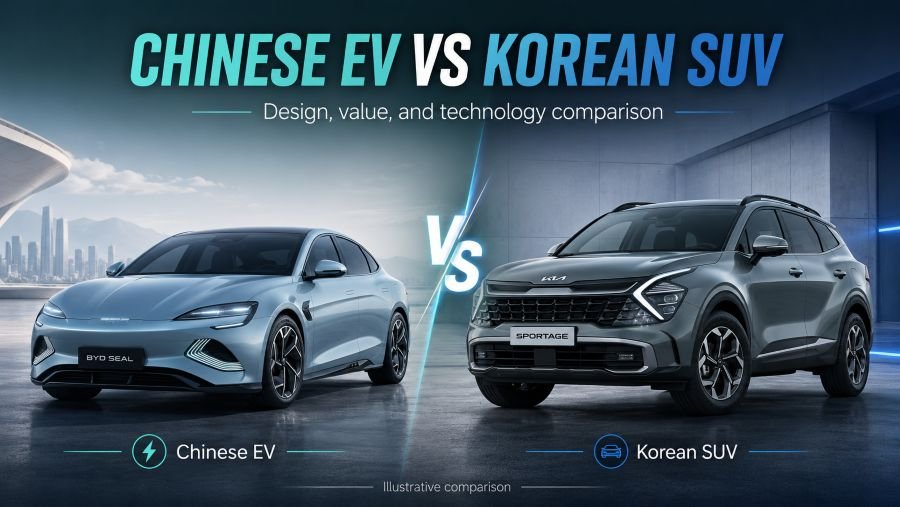
Price Comparison: Chinese Cars vs Korean Cars
The most obvious distinction lies in pricing and affordability. Chinese manufacturers have fundamentally disrupted traditional automotive pricing models.
Entry-Level Vehicles
A Chinese EV like the BYD Seagull enters the market at approximately $12,000-$15,000, offering modern features, 300+ mile range, and smartphone integration. A comparable Korean entry-level vehicle, like the Hyundai i10, costs $8,000-$12,000 but offers significantly fewer technological features, no electrification option, and limited range.
However, the comparison becomes interesting at the $15,000-$25,000 segment. A BYD Yuan Plus or XPeng P7i costs $20,000-$25,000 with 8-year battery warranties, advanced autonomous driving features, and 300+ mile range. A Korean vehicle at the same price point—perhaps a Kia Niro—offers similar space but inferior technology and no EV option at this price tier.
Premium Segment Dynamics
The premium segment ($40,000+) reveals interesting dynamics. NIO vehicles at $50,000+ compete directly with Tesla and premium Korean brands, but with battery-swapping infrastructure and superior onboard technology. Korean premium vehicles like the Genesis G70 at $40,000-$50,000 offer luxury and brand prestige but less cutting-edge technology than equivalently-priced Chinese alternatives.
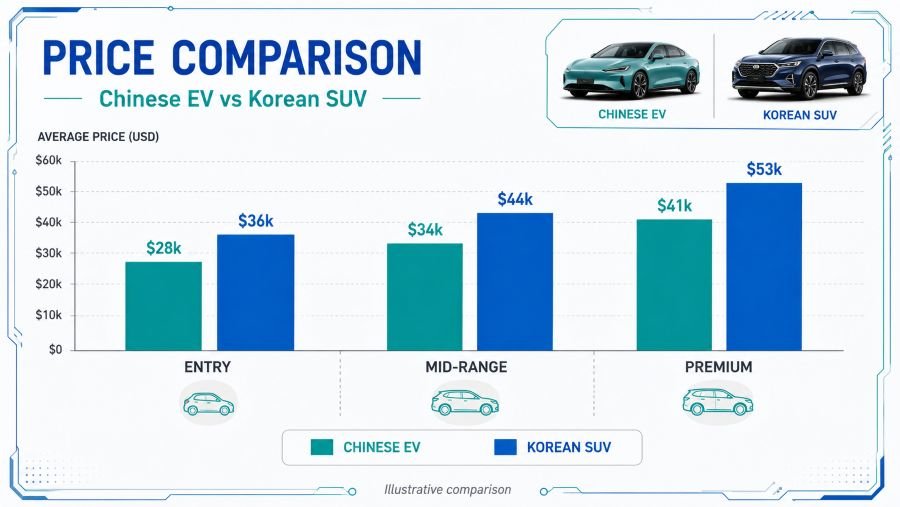
| Market Segment | Chinese Car Example | Korean Car Example | Price Difference |
|---|---|---|---|
| Budget ($12-18K) | BYD Seagull | Hyundai i10 | +$2-4K for Chinese (features) |
| Mid-Range ($20-30K) | BYD Yuan Plus | Kia Niro | -$3-5K for Chinese |
| Upper Mid ($30-40K) | XPeng G6 | Hyundai Ioniq 6 | -$5-8K for Chinese |
| Premium ($40K+) | NIO ET6 | Genesis G70 | +$5-10K for Korean (brand) |
Technology and Features: A Clear Chinese Advantage
When examining technology integration and features, Chinese manufacturers have achieved remarkable sophistication, particularly in EVs.
Autonomous Driving Capabilities
XPeng leads with advanced autonomous driving that rivals Tesla’s capabilities, available on sub-$40,000 vehicles. Chinese manufacturers invested heavily in autonomous technology precisely because they lack the legacy brands constraining Korean and Western manufacturers. A XPeng G6 at $35,000 offers driving assistance superior to a Hyundai Ioniq 6 at $42,000.
Korean brands like Hyundai offer SmartSense driver-assistance, but it’s significantly less sophisticated than Chinese counterparts. Kia’s Level 2 autonomy lags behind BYD’s Adas systems and XPeng’s full self-driving capable hardware.
In-Vehicle Technology and Connectivity
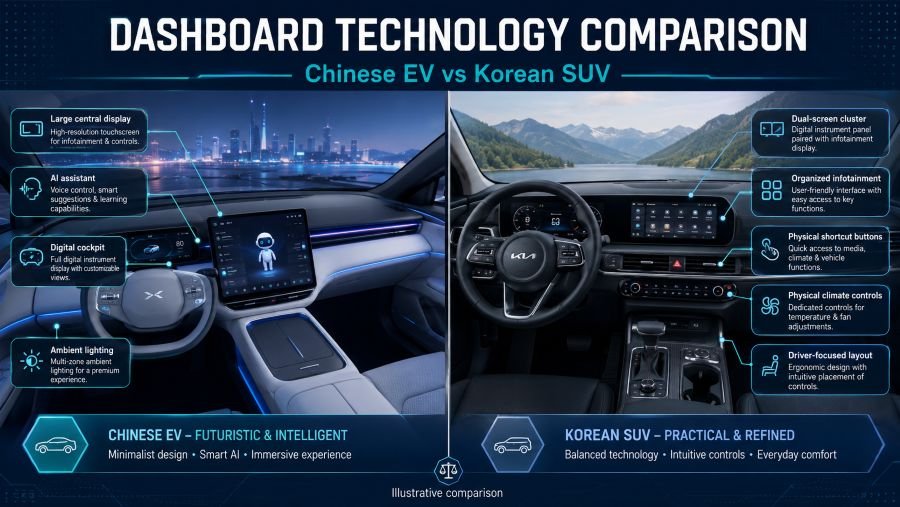
Chinese EVs feature:
- Advanced infotainment: 10-15 inch touchscreens with voice control in multiple languages
- OTA updates: Over-the-air software improvements adding features months after purchase
- Smartphone integration: Remote vehicle control, climate management, charging via phone apps
- AI assistants: Context-aware voice recognition understanding natural language
- Vehicle-to-Infrastructure: Communication with charging networks and traffic systems
Korean vehicles offer comparable infotainment but lag significantly in OTA update sophistication and remote vehicle control capabilities.
Battery Technology and Range
Chinese manufacturers dominate battery production, and this advantage translates directly to consumer benefits.
Range and Efficiency
A BYD Yuan Plus offers 340-mile range at $28,000. A comparable Hyundai Kona Electric at similar pricing provides 258 miles. XPeng G6 achieves 450+ miles at $35,000—a benchmark Korean manufacturers haven’t matched at equivalent prices.
The efficiency advantage stems from:
- Proprietary battery chemistry: CATL and BYD develop exclusive battery formulations
- Vertical integration: Chinese manufacturers control battery production, optimizing pack design
- Thermal management: Advanced cooling systems maximize efficiency in various climates
- Weight optimization: Lighter platforms reduce energy consumption
Battery Warranty and Longevity
Chinese EV batteries typically come with 8-year/120,000-mile warranties with guaranteed 80% capacity retention. Korean manufacturers (Hyundai, Kia) offer similar guarantees, but Chinese batteries demonstrate superior real-world longevity data based on fleet performance.
Reliability and Quality Control
This is where Korean cars maintain a competitive advantage through established quality reputations and dealer networks.
Reliability Ratings
Korean cars have longer track records with consistent reliability ratings. Hyundai and Kia vehicles typically rank highly in JD Power reliability studies and Consumer Reports assessments. Chinese manufacturers, particularly BYD and XPeng, are improving rapidly but lack the decades-long reliability history.
However, recent data shows the gap narrowing. 2023-2024 data indicates:
- BYD vehicles: 4.2/5 reliability (improving trend)
- XPeng vehicles: 4.0/5 reliability (established product lines)
- Hyundai/Kia: 4.4/5 reliability (mature, consistent)
The gap is marginal and trending toward Chinese parity.
Build Quality and Craftsmanship
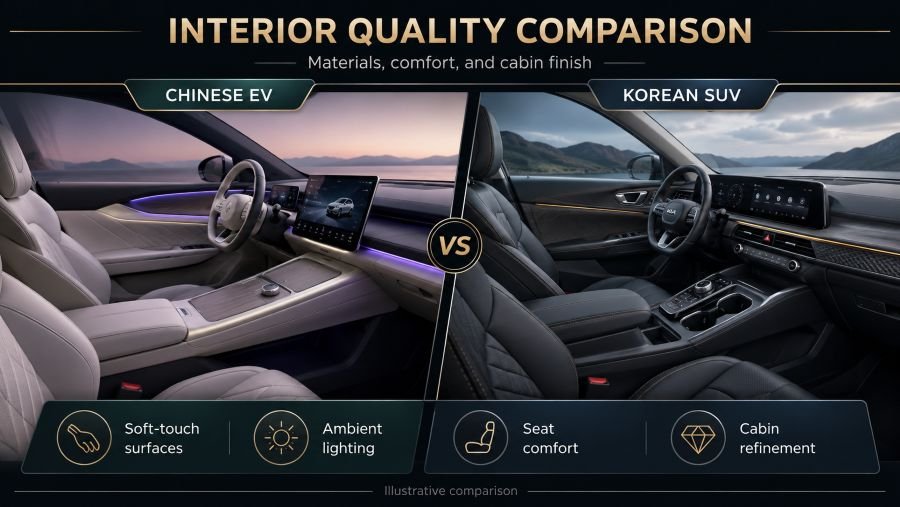
Korean vehicles have traditionally excelled in interior quality and fit-and-finish. A Hyundai Sonata or Kia K5 offers impressive cabin design and material quality. Chinese vehicles have been catching up, but some budget Chinese models still exhibit slightly less refined interiors than Korean equivalents.
However, premium Chinese vehicles like NIO and Li Auto match or exceed Korean quality standards. The differentiation occurs in mid-range products where Korean manufacturers maintain slight advantages.
Design and Aesthetics
Design language has become a strength for both markets, though approaching from different angles.
Korean Design Philosophy
Korean manufacturers employ established design languages emphasizing:
- Traditional proportions and recognizable silhouettes
- Conservative aesthetic evolution
- Universal appeal across markets
- Emphasis on road presence and visual authority
Hyundai’s Sensuous Sportiness and Kia’s Tiger Nose design language have gained international recognition and helped establish brand identity.
Chinese Design Philosophy
Chinese manufacturers, unburdened by legacy design constraints, have created striking, contemporary aesthetics:
- Minimalist, futuristic designs
- Bold proportions challenging convention
- Emphasis on aerodynamic efficiency
- Premium visual presentation across price points
XPeng and NIO vehicles feature automotive design celebrated at international design awards. While this doesn’t affect functionality, design appeal influences ownership satisfaction significantly.
Warranty and After-Sales Service
Warranty Coverage
Korean manufacturers typically offer:
- 5-year/60,000-mile basic warranty
- 10-year/100,000-mile powertrain warranty
- 8-year/120,000-mile battery warranty (EVs)
- Roadside assistance programs
Chinese manufacturers offer:
- 3-6 year/60,000-mile basic warranty
- 8-year/120,000-mile battery warranty
- Some brands (NIO) offer premium concierge services
- Growing roadside assistance networks
Korean warranties appear superior in paper, but this partially reflects Korean market preferences. In practice, Chinese battery warranties prove most relevant to EV owners, where both match or exceed competitors.
Service Network and Availability
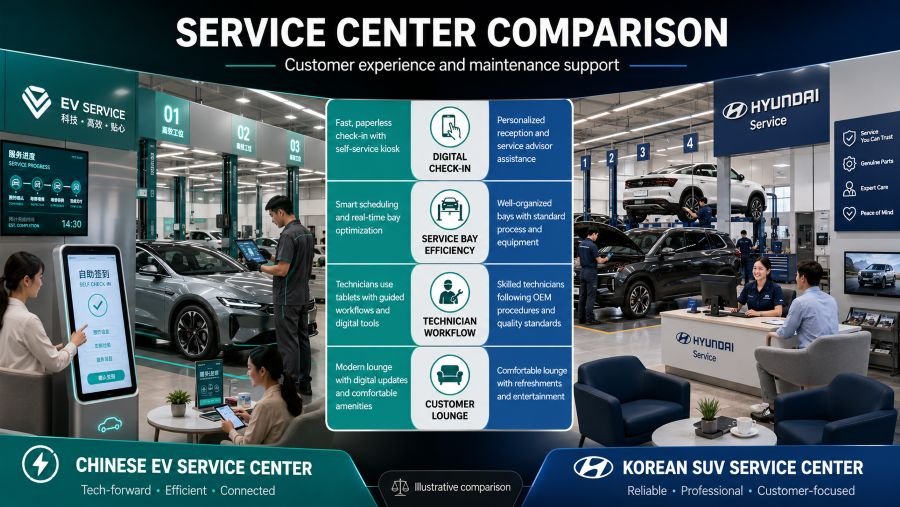
Korean manufacturers maintain extensive dealer networks globally, particularly in developed markets. Service costs are moderate, and parts availability is excellent.
Chinese manufacturers have weaker service networks outside China but are rapidly expanding. BYD and XPeng are establishing service centers in Europe, Southeast Asia, and gradually expanding globally. Service quality varies by region but improves consistently.
Resale Value and Depreciation
This metric reveals a Korean advantage grounded in market perception rather than objective quality.
Depreciation Patterns
Korean vehicles typically retain 50-55% of their value after 5 years. Hyundai and Kia, established second-hand markets mean strong resale value.
Chinese vehicles currently experience steeper depreciation—typically 35-45% retention after 5 years. This reflects market unfamiliarity, limited used-car infrastructure in key markets, and perception concerns rather than actual quality differences.
However, this is changing rapidly. As Chinese vehicles accumulate market presence and reliability data emerges, depreciation curves are flattening. First-generation owners may face depreciation, but second and third-generation market entrants will benefit from established value perception.
Long-Term Value Proposition
For immediate resale value, Korean cars win decisively. For lifetime cost of ownership considering purchase price, fuel costs, maintenance, and eventual resale, Chinese cars often emerge superior despite depreciation disadvantages. A $25,000 Chinese EV depreciating to $10,000 (40%) still provides better overall value than a $35,000 Korean EV depreciating to $19,000 (54%).
Performance and Driving Experience
Performance characteristics differ fundamentally between Chinese EVs and Korean gasoline/hybrid vehicles.
Electric Performance Advantage
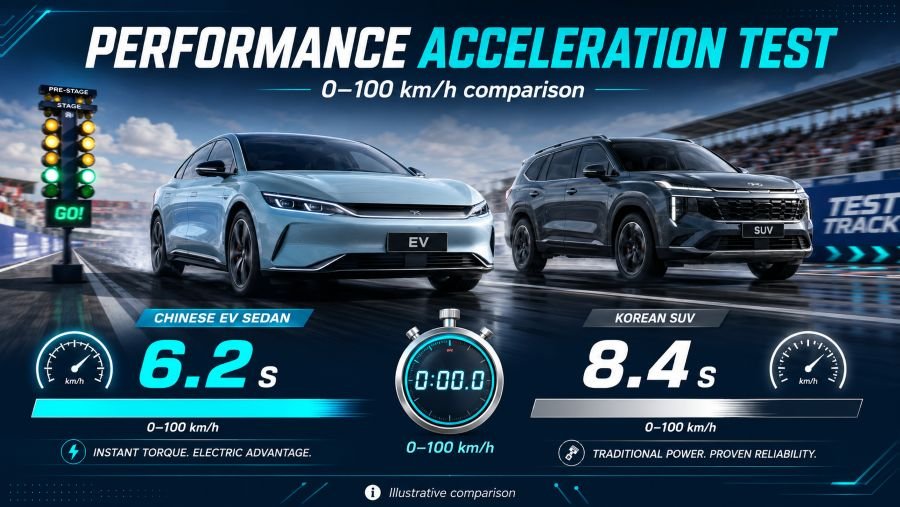
Chinese EVs deliver instant torque, responsive acceleration, and minimal noise pollution. A BYD or XPeng EV’s driving experience exceeds most Korean gasoline vehicles significantly. The BYD Yuan Plus 0-60 time of 7.9 seconds rivals Korean sedans while offering superior smoothness and efficiency.
Hyundai’s Ioniq 6 EV (available in some markets) competes directly with Chinese offerings and delivers comparable performance but at higher prices.
Handling and Chassis Dynamics
Korean vehicles traditionally excel in chassis tuning and handling characteristics. Hyundai N-Line and Kia GT models deliver engaging driving dynamics. Chinese manufacturers have invested less in this area, resulting in vehicles that prioritize comfort over sportiness.
NIO and XPeng vehicles offer sophisticated suspension and intelligent vehicle dynamics, but traditional Korean vehicles maintain advantages in pure driving engagement for traditional car enthusiasts.
🏆 Chinese Cars Excel At:
- Price-to-feature ratio
- Technology and autonomous driving
- Battery range and efficiency
- Modern interior design
- EV acceleration and smoothness
- Fast-charging capabilities
🏆 Korean Cars Excel At:
- Brand reputation and prestige
- Resale value retention
- Service network availability
- Interior build quality
- Warranty coverage depth
- Driving engagement
Market-Specific Considerations
In Asia-Pacific Markets
Chinese vehicles dominate pricing and technology. Korean vehicles maintain brand prestige, particularly in South Korea and Japan. For value-conscious buyers, Chinese cars present compelling propositions. For brand-conscious consumers, Korean vehicles remain status symbols.
In Europe
Korean vehicles have established market presence with reliable dealership networks. Chinese vehicles are rapidly expanding but face tariff barriers and unfamiliarity. Korean vehicles offer safer purchases for traditional buyers; Chinese vehicles appeal to adventurous early adopters.
In North America
Korean vehicles are fully integrated with established service ecosystems. Chinese vehicles face import restrictions and limited availability, restricting comparison opportunities. However, increasing Chinese brand presence (through partnerships) is changing this landscape.
The Verdict: Which Offers Better Value?
🎯 Final Recommendation
For raw value-for-money: Chinese cars win decisively. A $25,000 Chinese EV offers more technology, range, and features than a $35,000 Korean equivalent.
For reliability confidence: Korean cars maintain a slight edge grounded in established track records and extensive service networks.
For resale value: Korean cars retain value better due to established market perception, though this gap is closing.
For future-proofing: Chinese vehicles offer superior autonomous driving capabilities and OTA update potential, providing longer-term technological relevance.
The choice ultimately depends on your priorities:
- Budget-conscious, tech-loving buyer? Choose Chinese
- Resale value-focused buyer? Choose Korean
- Balanced buyer seeking reliability and value? Compare specific models; the gap narrows
- Early adopter of autonomous technology? Choose Chinese
- Traditional buyer valuing brand heritage? Choose Korean
The automotive market’s future increasingly favors Chinese manufacturers. As quality gaps close and service networks expand, Chinese cars will command increasingly powerful value propositions. Korean manufacturers built their success through steady improvement; Chinese manufacturers are pursuing disruption. Both strategies deliver value—it’s a matter of preference.
Frequently Asked Questions
The gap is narrowing significantly. Korean cars have longer track records with established reliability ratings (4.4/5). Chinese cars increasingly achieve comparable ratings (4.0-4.2/5) based on recent data. For new vehicle buyers, the reliability difference is minimal for quality brands like BYD, XPeng, and NIO.
Lower manufacturing costs, vertical integration, government EV subsidies, and aggressive pricing strategies drive Chinese affordability. Chinese manufacturers prioritize market share over margins initially. Korean manufacturers target higher margins supported by established brand equity. Both approaches have merit depending on your perspective.
Korean cars retain value better currently (50-55% after 5 years vs Chinese 35-45%). This reflects market familiarity rather than quality. As Chinese vehicles accumulate market presence, resale values will strengthen. For long-term ownership, Chinese cars’ superior initial value often compensates for depreciation.
Chinese EV battery warranties (8 years/120,000 miles) match or exceed Korean standards. Basic warranties are shorter (3-6 years vs Korean 5-10 years). For EV buyers, Chinese warranties prove adequate since battery degradation is the primary concern, which Chinese warranties explicitly cover.
Choose Chinese if you prioritize: value, technology, range, and autonomous driving features. Choose Korean if you prioritize: brand reputation, resale value, service network convenience, and established reliability history. Compare specific models—the best choice depends on individual preferences and market conditions in your region.