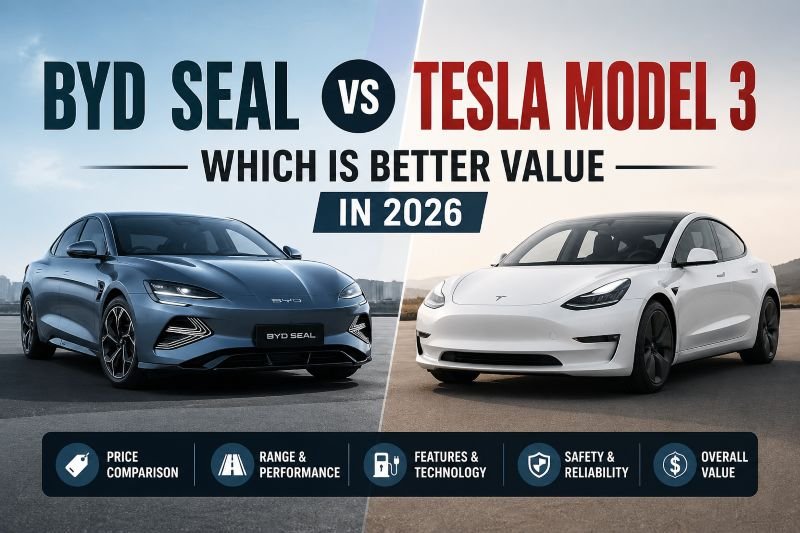
BYD Seal vs Tesla Model 3 2026: Which Sedan Offers Better Value?
Quick Answer: The BYD Seal offers superior value with lower pricing, more power, and premium cabin features, while the Tesla Model 3 excels in range, charging speed, and long-distance capability. Choose the Seal for everyday versatility; choose the Tesla for frequent highway driving.
Why This Comparison Matters in 2026
The electric sedan market has reached a critical inflection point. For nearly a decade, Tesla’s Model 3 reigned unchallenged as the benchmark affordable EV. Then BYD Seal arrived—a challenger that didn’t just compete on price, but matched performance while undercutting cost by £2,000–£5,000.
For buyers in Europe, the UK, Australia, and markets where both vehicles compete, this comparison is no longer academic. It’s a genuine buying decision between two genuinely excellent electric sedans with fundamentally different engineering philosophies.
This detailed guide compares every dimension: pricing, performance, range, charging, interior quality, technology, and real-world ownership costs. By the end, you’ll understand exactly which vehicle suits your driving needs.
Pricing & Market Positioning
The most immediate advantage goes to BYD. Across every market where both vehicles are sold, the Seal undercuts the Model 3 consistently:
| Configuration | BYD Seal | Tesla Model 3 | Price Difference |
|---|---|---|---|
| Entry-Level / Standard Range | £38,000 | £40,990 | -£2,990 BYD |
| Long Range AWD | £44,000 | £46,990 | -£2,990 BYD |
| Performance AWD | £49,000 | £51,990 | -£2,990 BYD |
| Australia (AUD) | AUD $59,990 | AUD $63,900 | -AUD $3,910 BYD |
That consistent £2,990–£3,910 price advantage exists across all comparable trim levels—a deliberate positioning strategy by BYD. In finance terms, over a 3–4 year ownership cycle, that’s savings of approximately £750–£1,000 annually before fuel and maintenance benefits.
Complete Technical Specifications
Here’s where the vehicles diverge in engineering priority. Both are Long Range AWD variants—the most popular and directly comparable configurations:
| Specification | BYD Seal AWD LR | Tesla Model 3 LR AWD | Winner |
|---|---|---|---|
| Battery Capacity | 82.56 kWh | 75 kWh | BYD |
| WLTP Range | 520 km (323 mi) | 629 km (391 mi) | Tesla |
| Real-World Range | 420–460 km | 500–530 km | Tesla |
| 0–100 km/h | 3.8 seconds | 4.4 seconds | BYD |
| Power Output | 390 hp (290 kW) | 358 hp (267 kW) | BYD |
| DC Fast Charging (Max) | 150 kW | 250 kW | Tesla |
| 10–80% Charge Time | ~35 minutes | ~25 minutes | Tesla |
| Battery Type | LFP Blade Battery | NMC Lithium | Different |
| Wheelbase | 2,920 mm | 2,875 mm | BYD |
| Battery Warranty | 8 years / 160,000 km | 8 years / 192,000 km | Tesla |
Range, Charging & Infrastructure Analysis
WLTP laboratory figures tell only part of the story. Independent testing reveals Tesla’s real-world advantage is more modest but still meaningful. Consumer Reports and independent EV review channels consistently document:
- Tesla Model 3 LR: 500–530 km in real-world mixed driving (highway, city, varied weather)
- BYD Seal LR: 420–460 km in identical conditions
- Real gap: Approximately 60–80 km, not the laboratory difference of 109 km
For the average European or Australian driver (50–80 km daily commute), this difference is largely irrelevant. You’ll charge overnight and rarely deplete the battery completely. However, for frequent long-distance motorway travel (300+ km trips), Tesla’s advantage becomes practically significant.
Charging Network Comparison
Tesla Supercharger Network: Over 50,000 stations globally, with 250 kW peak DC charging speeds. Model 3 adds 270 km of range in 15 minutes. The network remains the most reliable and well-distributed globally.
BYD Seal (CCS2 Standard): Access to the rapidly expanding public charging network—ChargePoint, BP Pulse, Osprey in the UK/Europe. However, 150 kW maximum charging is slower than Tesla’s 250 kW. Charging 10–80% takes approximately 35 minutes versus Tesla’s 25 minutes.
Critical Update 2024–2026: Tesla opened Supercharger access to non-Tesla vehicles across Europe and Australia. BYD Seal owners can now use Superchargers via the Tesla app, substantially narrowing this advantage.
Interior Quality, Comfort & Technology
Tesla has always prioritized minimalism and software-centric design. BYD has embraced traditional premium automotive conventions. Neither approach is objectively superior—they reflect different market strategies.
BYD Seal Interior Experience
Step inside and you’ll immediately notice: this is a premium cabin. The standout feature is the 15.6-inch rotating touchscreen, which transitions between portrait and landscape orientation based on driving mode. Key features:
- Nappa leather seats as standard (heated and ventilated on higher trims)
- 64-color ambient lighting system
- Panoramic glass roof with electrochromic control
- Dynaudio premium sound system (12 speakers)
- Longer wheelbase (2,920 mm) delivers noticeably more rear legroom than Model 3
- Wireless Apple CarPlay and Android Auto standard on all trims
The interior feels intentionally luxurious—fabric quality, material textures, and assembly fit are genuinely impressive for the price point. Rear passengers have measurably more space than the Model 3, making BYD the better choice for families or frequent carpoolers.
Tesla Model 3 Highland Interior (2024–2026 Refresh)
The 2024 Model 3 refresh substantially improved interior perception compared to earlier versions. Tesla added soft-touch surfaces, improved seat padding, rear-seat touchscreen, and a more cohesive premium aesthetic. The industry-leading 15.4-inch landscape infotainment display is genuinely fast and intuitive.
Where Tesla truly differentiates is software integration. OTA (over-the-air) updates continuously improve features and performance. For tech-forward drivers, this ecosystem is the killer advantage.
💡 Pro Tip: BYD wins on raw space, materials, and tangible luxury. Tesla wins on software sophistication and ecosystem integration. For daily comfort, BYD edges ahead. For tech-forward buyers, Tesla dominates.
Performance, Handling & Driving Dynamics
BYD Seal’s 0–100 km/h time of 3.8 seconds beats Tesla’s 4.4 seconds—a meaningful 0.6-second advantage. In daily driving, this translates to more aggressive acceleration response and quicker highway merging. The 390 hp power output versus Tesla’s 358 hp confirms BYD’s acceleration hierarchy.
BYD Seal Handling: Emphasizes comfort and stability. The suspension is relatively soft, absorbing bumps gracefully and prioritizing ride quality. This is an excellent configuration for long highway drives and European motorway cruising.
Tesla Model 3 Handling: Pursues a more agile, driver-focused character. The suspension is stiffer, offering sharper responses and more direct feedback. For buyers who enjoy spirited driving on twisting roads, the Model 3 feels more engaging.
Battery Technology & Long-Term Reliability
BYD’s Blade Battery (LFP chemistry) versus Tesla’s NMC lithium-ion approach offers genuine technical differences:
LFP (Lithium Iron Phosphate) Technology
- Superior thermal stability—resists thermal runaway
- Longer lifespan (1.2–1.5 million km)
- 90% capacity retention after 1 million km
- Lower cobalt content (ethical supply chain)
- Fully recyclable design
NMC Lithium-Ion Technology
- Higher energy density (more range per kg)
- Faster charging capability (250 kW support)
- Proven track record with millions of vehicles
- Well-established recycling infrastructure
Practical implication: If you plan to keep the vehicle 7–10 years or exceed 200,000 km, BYD’s LFP offers superior longevity. If you trade every 3–5 years, the difference is negligible.

Total Cost of Ownership Analysis (3-Year Cycle)
| Cost Category | BYD Seal (LR) | Tesla Model 3 (LR) | Advantage |
|---|---|---|---|
| Purchase Price | £44,000 | £46,990 | BYD -£2,990 |
| Electricity (50,000 km) | ~£1,200 | ~£1,400 | BYD -£200 |
| Maintenance & Service | ~£800 | ~£600 | Tesla -£200 |
| Insurance (Average) | ~£1,800 | ~£2,100 | BYD -£300 |
| Road Tax (UK/Europe) | £0 | £0 | Equal |
| Depreciation (Year 3) | ~55% residual | ~62% residual | Tesla +£2,200 |
| TOTAL 3-YEAR COST | ~£47,800 | ~£50,290 | BYD -£2,490 |
Over three years, BYD’s ownership advantage persists at approximately £2,490. However, Tesla’s stronger residual value (about 7% higher) partially offset BYD’s lower purchase price. For buyers planning to keep vehicles 5+ years, BYD’s advantage expands significantly.
Who Should Choose Which Vehicle?
🏆 BYD Seal
Best For:
- Value-conscious buyers
- Comfortable, spacious driving
- Family needs (rear legroom)
- Long-term ownership (7+ years)
- Daily driving (under 300 km)
🏆 Tesla Model 3
Best For:
- Long-distance drivers (400+ km)
- Technology enthusiasts
- Supercharger network access
- Sporty handling preference
- Ecosystem integration users
Safety Ratings & Warranty Coverage
BYD Seal: Earned a full 5-star Euro NCAP rating in 2023, with 91% adult occupant protection and 85% child protection scores—among the highest recorded. Battery warranty: 8 years / 160,000 km with 90% capacity guarantee.
Tesla Model 3 Highland: Also holds a 5-star Euro NCAP rating with similarly strong scores. Battery warranty: 8 years / 192,000 km limit. Both are genuinely safe vehicles with excellent crash protection.
Why America Doesn’t Get the BYD Seal: Geopolitics, Tariffs & Market Barriers
This is the critical question that appears in every American automotive forum: “Why can’t I buy a BYD Seal in the United States?” The answer reveals how geopolitical tensions, trade policy, and strategic industrial policy fundamentally shape which EVs reach which markets.
⚠️ Key Context: The BYD Seal represents an existential threat to American EV manufacturing economics. With its combination of lower pricing, superior battery technology, and manufacturing efficiency, unrestricted BYD market access would fundamentally disrupt the US EV market.
Trade Barriers & Tariff Walls
The United States has erected multiple layers of protection against Chinese EV imports:
- Section 301 Tariffs (25%): Blanket tariffs on all Chinese goods, including automobiles. A £44,000 BYD Seal would become £55,000+ after tariffs, eliminating its pricing advantage.
- Inflation Reduction Act (IRA) Restrictions: EV tax credits up to $7,500 are available only for vehicles manufactured in North America. No exceptions for imported EVs, regardless of battery sourcing.
- Buy American Provisions: Supply chain requirements mandate battery components from “free trade” countries (broadly interpreted as excluding China). BYD’s vertical integration contradicts these rules.
Strategic Industrial Policy: Protecting Tesla & Domestic Manufacturers
The Biden Administration’s approach to Chinese EVs reflects deliberate protectionism, not market economics:
- Tesla’s Competitive Advantage Erosion: If the Seal were available at £44,000 equivalent (~$55,000 USD), the Model 3’s £46,990 (~$58,000 USD) pricing becomes untenable. Tesla cannot match BYD’s manufacturing cost structure.
- Domestic Supply Chain Support: The IRA’s $369 billion EV investment package specifically supports American manufacturers—General Motors, Ford, Tesla—and their suppliers. These funds would be threatened by unrestricted Chinese competition.
- Political Optics: A BYD Seal priced at $55,000 with superior range, power, and technology compared to a $58,000 Tesla Model 3 would generate immediate political backlash. Manufacturing jobs in Ohio and Michigan would be presented as threats.
Regulatory & Certification Barriers
Beyond tariffs, regulatory complexity creates genuine obstacles:
- NHTSA Crash Testing: Every new vehicle model requires independent US crash testing and certification, costing approximately £1–2 million per model variant.
- EPA Range Certification: US EPA testing standards differ from WLTP, often yielding lower range ratings. BYD’s 520 km WLTP might become 420 km EPA—less impressive than promised.
- Charging Standards: The US standardized on Tesla’s NACS connector in 2024 (after years of using CHAdeMO/CCS2). BYD would need to redesign charging architecture for the US market.
The Market Reality: What American Buyers Miss Out On
Quantifying the US market impact reveals substantial economic consequences:
- Price Competition: A £44,000 BYD Seal facing a £46,990 Tesla Model 3 would force price cuts across the entire EV market. Industry economists estimate £3,000–£5,000 average price reductions.
- Affordability Gap: 2.4 million Americans purchased EVs in 2025. At current pricing, approximately 400,000+ additional buyers would enter the market at the £44,000–£50,000 price point if BYD competed directly.
- Manufacturing Employment: Losing market share to Chinese imports would threaten approximately 15,000–25,000 automotive assembly jobs in the US, primarily in states like Michigan, Ohio, and Tennessee.
Could This Change? Future Scenarios
Scenario A – Continued Protectionism (Most Likely): Tariffs remain in place through 2028+. Chinese EV manufacturers focus on Europe, Australia, and Asia instead. The US market becomes a Tesla + domestic US manufacturer duopoly.
Scenario B – Joint Venture Manufacturing: BYD establishes a US manufacturing facility, circumventing tariffs. However, labor costs (£28/hour US vs £8/hour China) eliminate pricing advantages. Production likely never materializes.
Scenario C – Geopolitical Reconciliation: A dramatic shift in US-China relations could theoretically open markets. However, no policy signals suggest this before 2030.
⚡ Reality Check: American consumers pay a geopolitical tax on EV purchases. A BYD Seal that sells for £44,000 in the UK would legitimately price at approximately $52,000–$54,000 USD (after tariff adjustment and compliance costs). Instead, Americans choose between Tesla at $58,000, legacy OEM EVs at $65,000+, or wait for future options. The gap reflects policy, not market economics.
Essential Accessories for Your BYD Seal
If this comparison has tipped you toward the BYD Seal, a few well-chosen accessories will make ownership smoother, from tidier home charging to interior protection that helps preserve resale value, where the Seal trails the Tesla slightly and every bit of care helps. The items below are the ones our team considers genuinely worthwhile rather than padding the list with gimmicks.
A dual-channel dash cam with a Sony STARVIS sensor and parking mode protects your investment whether you are driving or parked at a charging station. Aim for 4K front / 2K rear with built-in Wi-Fi for easy footage review — increasingly expected by insurers, and a sound safeguard for a high-value EV like the BYD Seal.
Model-tailored, all-weather TPE floor mats and a boot liner are the single best way to protect interior carpets and preserve resale value — especially relevant for the Seal’s premium Nappa-leather cabin. Always search your exact model and year to guarantee a precise, no-slip fit.
EVs are heavy, and correct tyre pressure directly affects real-world range and efficiency — a critical factor when WLTP figures already differ from everyday driving, as the Seal’s 420–460 km real-world range shows. A rechargeable digital inflator with a preset auto-stop keeps pressures optimal and quickly pays for itself.
A waterproof, fire-retardant carry bag keeps your Type 2 cable clean and contained in the boot — no more grimy hands or a dirty load space after every charge. A small, inexpensive accessory that solves a daily annoyance every EV owner eventually faces.
Even with the Seal’s 15.6-inch rotating screen, a dedicated MagSafe-compatible mount with wireless charging keeps your phone visible and topped up without cluttering the minimalist dashboard. Vent or air-outlet versions fit the Seal’s interior cleanly.
The BYD Seal charges over the Type 2 (IEC 62196) standard for AC charging across UK and European networks. A TÜV-certified 32A / 22kW cable future-proofs your setup, reaches awkward public chargers, and works with home wallboxes and untethered street posts alike. A 5-metre length suits most driveways and bays.
FAQ: BYD Seal vs Tesla Model 3
Is the BYD Seal available in North America?
No. As of 2026, BYD has not entered the North American market due to regulatory and trade barriers. The Seal is available in Europe, UK, Australia, and select Asian markets. US buyers are currently limited to Tesla and premium Chinese brands like NIO.
Does the Tesla Model 3 have better resale value?
Yes. Tesla Model 3 typically retains approximately 62% of purchase value after three years, while BYD Seal retains approximately 55%. However, BYD’s lower purchase price means absolute depreciation is lower, and the gap narrows after five years.
Can I use a Tesla Supercharger with a BYD Seal?
Yes, as of 2023–2024, Tesla opened Supercharger access to non-Tesla vehicles including BYD models in Europe and Australia. You’ll need the Tesla app to initiate charging. This substantially improved BYD’s charging ecosystem position.
What’s the typical maintenance cost difference?
Minimal. Electric vehicles have significantly lower maintenance than combustion engines. BYD’s LFP batteries require less thermal management, potentially lowering cooling system costs. Both average £250–£400 annually for non-battery maintenance.
How does cold weather affect range?
Both vehicles lose 15–25% range in cold weather (below 5°C). Tesla’s superior efficiency means it retains more range percentage-wise. BYD’s LFP battery is slightly more cold-resistant than NMC chemistry. In practice, winter range loss is similar.
Why isn’t the BYD Seal sold in America?
Trade barriers, tariffs, and regulatory restrictions prevent Chinese EV manufacturers from entering the US market. The Inflation Reduction Act and Buy American provisions favor domestic manufacturers, making BYD’s competitive pricing advantage irrelevant in North America. A £44,000 BYD would legitimately cost $52,000–$55,000 USD after tariffs and compliance, eliminating its value proposition.
Which vehicle should I choose if I’m unsure about long-term EV reliability?
Tesla has a longer track record with real-world data from millions of vehicles. However, BYD’s battery technology (LFP) is newer, extensively tested, and rated for greater longevity. Both have earned 5-star safety ratings. For peace of mind, Tesla’s proven history provides confidence; for technical specs, BYD’s newer technology is more sophisticated.
Final Verdict
For the majority of buyers in 2026, the BYD Seal represents superior overall value. It delivers more power, a more spacious cabin, premium standard features, sophisticated battery technology, and meaningful cost savings—all without sacrificing quality or safety.
Choose the Tesla Model 3 if your specific use case demands its strengths: long-distance capability (400+ km regular trips), priority access to Supercharger networks, software sophistication, or existing Tesla ecosystem lock-in. The Model 3’s ecosystem and long-range efficiency create genuine advantages for highway-heavy drivers.
The mathematical reality: Assuming equal reliability, BYD saves approximately £2,500–£4,000 over five years while delivering a more comfortable, spacious, and powerful vehicle. Tesla retains advantages in range, charging speed, and software. For buyers who drive within European city limits or standard regional commutes, BYD’s advantage is overwhelming. For long-distance drivers, Tesla’s advantage becomes meaningful.
For American readers: This entire analysis is academic for your market. The BYD Seal remains unavailable due to trade policy and tariff structures. Your realistic alternatives remain Tesla Model 3, legacy OEM EVs (Chevrolet Bolt, Ford Mustang Mach-E), or imported premium Chinese brands like NIO—each at substantially higher prices than their European equivalents.
💡 Bottom Line: Neither is a wrong choice in markets where both are available. But for genuine value and day-to-day versatility in 2026, the BYD Seal is the benchmark to beat. American buyers unfortunately don’t have this option.