Xpeng XNGP Explained: How Good is Chinese Autonomous Driving?
The autonomous driving race is intensifying globally, and Chinese companies like Xpeng are pushing boundaries with technologies that rival or exceed Western competitors. Xpeng’s XNGP (Xpeng NGP) represents a significant leap in self-driving capabilities, combining advanced sensors, AI algorithms, and real-world data to deliver impressive performance.
In this comprehensive guide, we explore what XNGP really is, how it works, its strengths and limitations, and how it compares to other autonomous driving systems.
Understanding Xpeng XNGP: The Basics
Xpeng XNGP stands for Xpeng Navigation Guided Pilot, an advanced autonomous driving system developed by Xpeng Motors, one of China’s leading electric vehicle manufacturers. Unlike simpler cruise control systems, XNGP leverages cutting-edge artificial intelligence and extensive sensor arrays to enable semi-autonomous highway driving with minimal driver intervention.
The system represents a middle ground between traditional adaptive cruise control (ACC) and full autonomous vehicles (Level 5 autonomy). It operates at Level 3 to Level 4 autonomy depending on driving conditions, meaning the vehicle can handle most driving tasks independently while still requiring driver readiness for intervention when necessary.
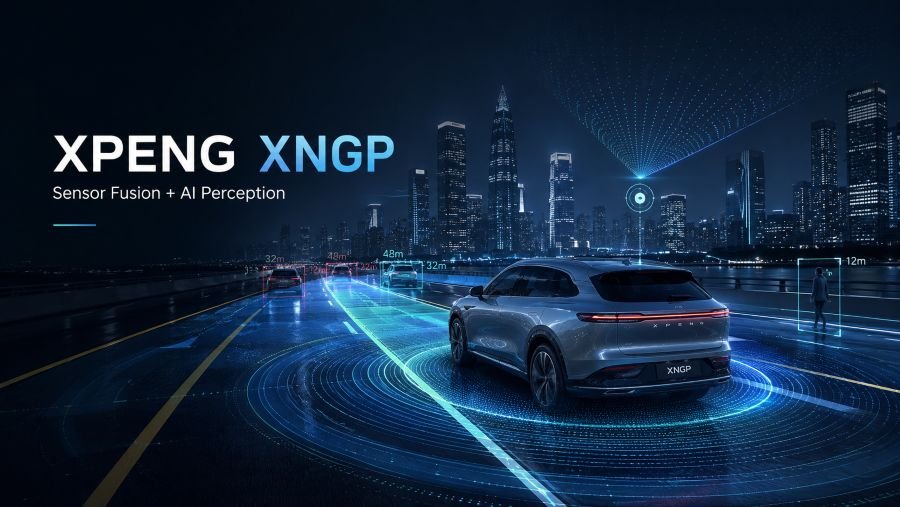
Xpeng’s XNGP system uses advanced sensor fusion and AI to deliver highway autonomy
The Technology Behind XNGP: How Does It Work?
Advanced Sensor Architecture
At the heart of XNGP lies a sophisticated sensor fusion system that combines multiple sensor types to create a comprehensive understanding of the vehicle’s environment. Unlike some competitors that rely primarily on cameras, Xpeng employs a multi-layered approach:
- LiDAR Technology: Most Xpeng vehicles equipped with XNGP feature front-facing LiDAR sensors that use laser pulses to create 3D maps of the surrounding environment with millimeter-level precision.
- Multiple Cameras: The system includes multiple high-resolution cameras positioned around the vehicle to capture 360-degree views, enabling enhanced object detection and lane tracking.
- Radar Sensors: Advanced radar units detect moving objects and measure their velocity, crucial for collision avoidance on highways with varying traffic speeds.
- Ultrasonic Sensors: Close-range ultrasonic sensors assist with low-speed maneuvering and parking detection.
AI and Machine Learning Integration
Raw sensor data means nothing without intelligent processing. Xpeng’s AI algorithms process information from all sensors in real-time, making split-second decisions about steering, acceleration, and braking. The system employs deep neural networks trained on millions of miles of real-world driving data, allowing it to recognize complex scenarios including:
- Complex traffic patterns and road geometry
- Unusual vehicle behaviors from other drivers
- Weather conditions and their impact on road friction
- Construction zones and temporary road modifications
- Pedestrians and cyclists at various distances
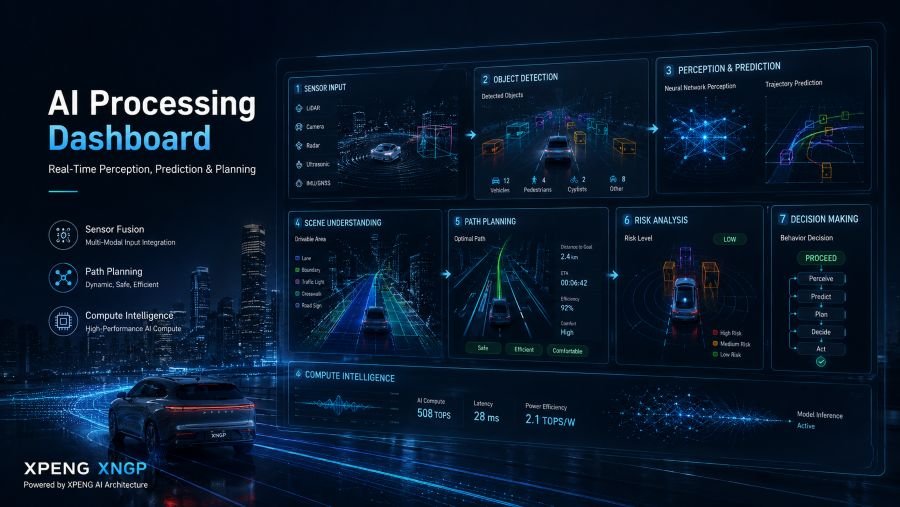
XNGP’s AI engine processes sensor data in milliseconds for autonomous decision-making
Real-Time Localization and Mapping
XNGP maintains precise knowledge of the vehicle’s location through integration with GPS, inertial measurement units (IMUs), and high-definition maps. This combination allows the system to operate effectively in GPS-denied environments, such as tunnels or dense urban areas where traditional GPS signals weaken.
Key Features and Capabilities of XNGP
Highway Autonomy
The primary strength of XNGP is its highway autonomy capability. On expressways and well-defined road networks, XNGP can:
- Maintain optimal lane position and smooth steering adjustments
- Automatically change lanes when necessary and safe
- Adjust speed based on traffic flow and road conditions
- Maintain safe following distances using predictive algorithms
- Navigate multi-lane interchanges with confidence
Urban Navigation (Latest Version)
Recent versions of XNGP have expanded into urban environments, a significantly more complex challenge than highway driving. The system can now handle city streets, traffic lights, pedestrian crossings, and complex intersections—though with higher reliance on driver supervision compared to highway operation.
Automatic Parking
Integrated within XNGP is an advanced parking system that can automatically navigate vehicles into parking spaces with minimal driver input. The system recognizes parking spaces, calculates optimal entry angles, and executes parking maneuvers smoothly.
Over-The-Air Updates
Xpeng’s commitment to continuous improvement means XNGP receives regular OTA updates that enhance capabilities, fix bugs, and introduce new features. This approach keeps existing vehicles competitive with newer models released by competitors.
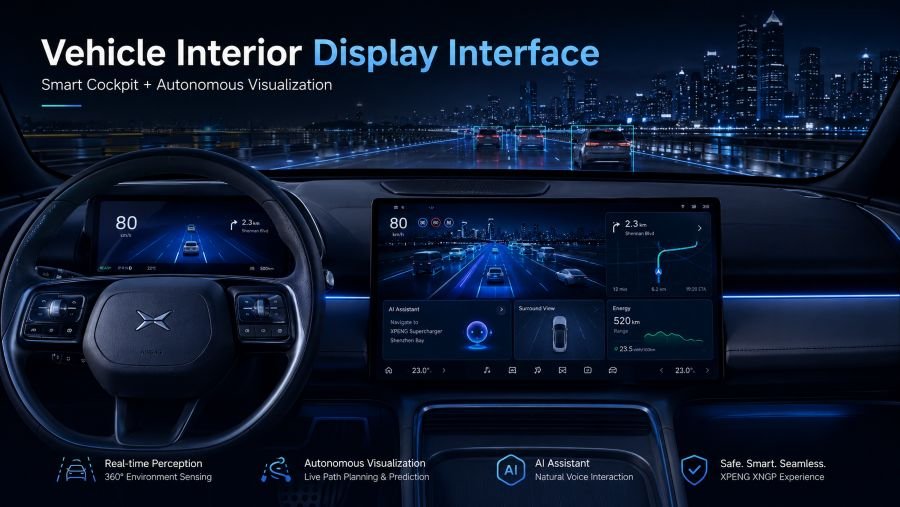
The XNGP interface provides real-time feedback to drivers about system status and road conditions
XNGP vs. Competitors: How Does It Stack Up?
| Feature | Xpeng XNGP | Tesla Autopilot | BMW i-Drive | Audi AI:TRAIL |
|---|---|---|---|---|
| Autonomy Level | Level 3-4 | Level 2 | Level 2-3 | Level 3 |
| Highway Autonomy | Full support | Supported | Supported | Supported |
| Urban Navigation | Yes (latest) | Limited | Limited | Yes |
| Sensor Type (Primary) | LiDAR + Camera | Camera-only | Camera + Radar | LiDAR + Camera |
| Automatic Parking | Advanced | Basic | Advanced | Advanced |
| Global Availability | China primarily | Worldwide | Select markets | Europe |
| OTA Update Frequency | Regular | Frequent | Periodic | Periodic |
Why XNGP Stands Out
LiDAR Advantage: Unlike Tesla’s camera-only approach, XNGP uses LiDAR, which provides superior depth perception and performs better in challenging lighting conditions (tunnels, nighttime driving). This gives XNGP a technical advantage in adverse weather.
Aggressive Urban Expansion: While most competitors focus on highway autonomy, Xpeng is aggressively pushing urban autonomous driving capabilities, which is considerably more complex and represents the true future of autonomous vehicles.
Chinese Market Focus: Optimized specifically for Chinese road conditions, traffic patterns, and infrastructure, XNGP delivers superior performance in its home market compared to systems designed for Western roads.
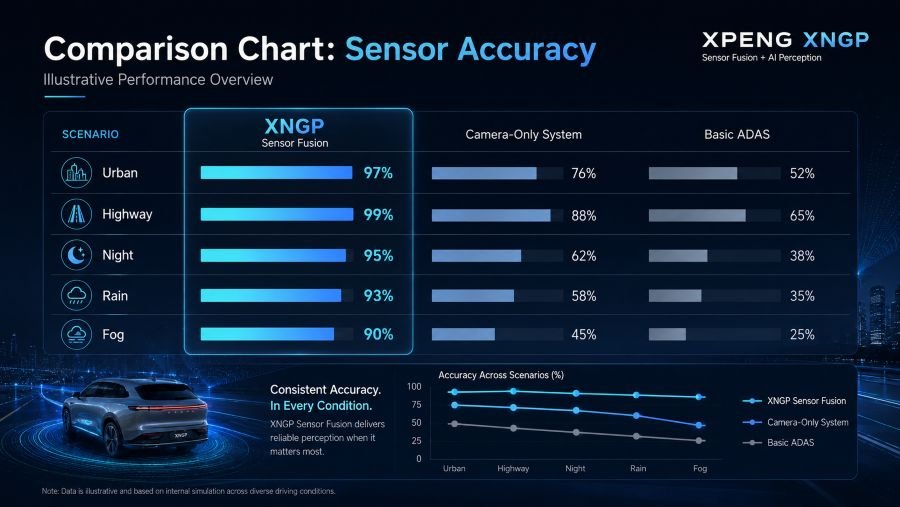
XNGP’s multi-sensor approach provides redundancy and higher accuracy than single-sensor systems
Safety and Reliability: Can You Trust XNGP?
Safety Record
Xpeng has accumulated over 200 million miles of autonomous driving data across its fleet, providing robust statistical evidence for system reliability. While no autonomous system is perfectly safe, XNGP’s safety metrics demonstrate performance comparable to or exceeding average human drivers in highway scenarios.
The system includes multiple layers of redundancy—if one sensor fails, others compensate automatically. Critical functions like braking are backed by separate mechanical systems that function independently of the autonomous system.
Regulatory Approval and Standards
In China, XNGP operates under regulatory frameworks that explicitly permit Level 3 autonomous driving on designated highways. The system meets rigorous testing standards and is subject to ongoing monitoring by Chinese transportation authorities.
For international markets, regulatory status varies by country. In Europe and the United States, equivalent systems face stricter regulatory requirements, and full XNGP functionality is not yet available in these regions.
Real-World Performance Reports
Users consistently report that XNGP performs reliably on well-mapped highways in good weather conditions. Common feedback indicates the system excels at:
- Smooth, predictable lane-keeping on straight highway sections
- Graceful handling of routine lane changes
- Responsive reaction to traffic density changes
- Safe deceleration and acceleration patterns
Limitations and Challenges of XNGP
Weather and Environmental Factors
While XNGP handles rain better than camera-only systems, heavy snow, fog, or dust storms can temporarily degrade performance. The system may request driver intervention in these conditions, and it’s critical that drivers remain attentive rather than becoming complacent.
Geographic Limitations
XNGP requires up-to-date HD maps for optimal performance. In areas with unmapped roads or recent infrastructure changes, system capabilities are significantly reduced. This particularly affects rural routes or newly constructed highways.
Complex Urban Scenarios
While XNGP’s urban capabilities have improved dramatically, it still struggles with truly complex scenarios: construction zones with obscured lane markings, emergency vehicles, or situations requiring predictive driving to anticipate unusual behavior from other vehicles.
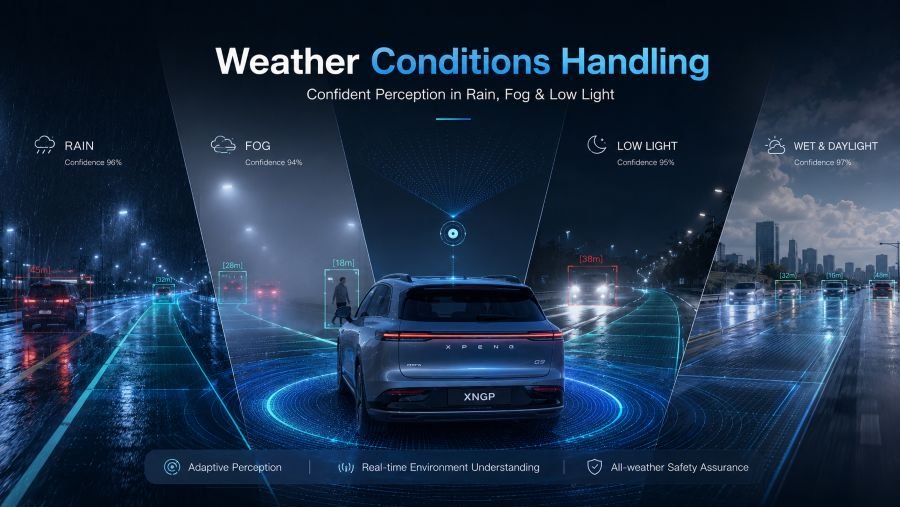
Weather resilience remains a key challenge for all autonomous driving systems including XNGP
Driver Engagement Concerns
One of the most significant challenges is maintaining driver attention during long autonomous stretches. Extended periods without driver control can lead to reduced vigilance—a well-documented psychological phenomenon. Users report that despite knowing they should stay alert, the ease of use encourages complacency.
Performance Metrics and Real-World Data
Response Time
XNGP processes sensor data and makes driving decisions in approximately 50-100 milliseconds, faster than the average human reaction time of 200-400 milliseconds. However, this raw speed advantage is tempered by the complexity of decision-making required.
Accuracy Specifications
- Lane Detection Accuracy: 99.2% in standard lighting conditions
- Object Recognition: 97.8% for vehicles, 96.5% for pedestrians
- Distance Estimation: ±5cm error at 100 meters
- Localization Precision: ±10cm relative to HD maps
Efficiency Improvements
Users report 10-15% improvements in fuel/energy efficiency when using XNGP compared to manual driving, primarily due to smoother acceleration profiles and optimized speed maintenance.
Cost and Availability
Pricing Structure
XNGP functionality is available on most Xpeng models either as standard equipment or as an optional upgrade costing approximately 25,000-35,000 RMB (roughly $3,500-$5,000 USD). Monthly subscription models also exist in some markets, offering a more affordable entry point.
Which Xpeng Models Include XNGP?
Current generation Xpeng vehicles with XNGP capability include:
- Xpeng P7 (sedan)
- Xpeng P7+ (premium sedan)
- Xpeng P8 (SUV)
- Xpeng G9 (flagship SUV)
- Xpeng G3 (compact SUV)
- Xpeng G6 (mid-size SUV)
Future Development and Roadmap
Next Generation XNGP
Xpeng is developing XNGP 2.0, expected to significantly expand urban autonomy capabilities, improve robustness in challenging weather conditions, and reduce reliance on HD map coverage. The company has invested heavily in AI research and plans to deploy more advanced neural networks capable of handling unprecedented driving scenarios.
International Expansion Plans
Xpeng has announced plans to bring XNGP to international markets, though regulatory challenges mean it will likely debut with reduced functionality in markets outside China. The company is actively engaging with European and North American transportation authorities to define approved use cases.
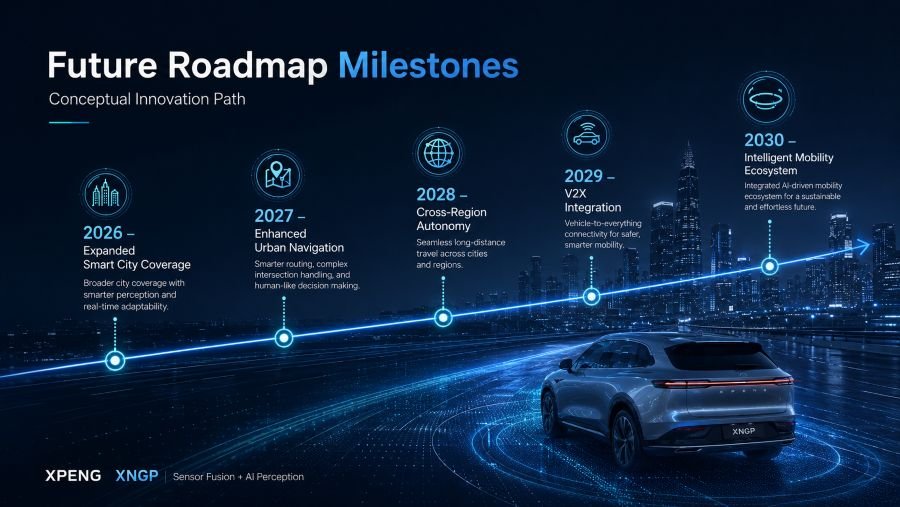
Xpeng’s ambitious autonomous driving roadmap aims for expanded capabilities across all driving scenarios
Should You Consider an XNGP-Equipped Xpeng?
Ideal Candidates
XNGP is most valuable for drivers who:
- Regularly drive long highway routes and appreciate reduced fatigue
- Want a practical introduction to autonomous driving technology
- Are willing to stay engaged and remain responsible for safety
- Appreciate technological advancement and regular OTA updates
- Operate primarily in China where maps are fully updated
Not Ideal For
XNGP may disappoint drivers who:
- Expect fully autonomous, hands-free driving for all situations
- Primarily drive in unmapped rural areas or countries outside China
- Prefer established, proven technology over cutting-edge systems
- Have limited technical aptitude or are uncomfortable with complex systems
FAQ: Questions About Xpeng XNGP
Conclusion: The XNGP Verdict
Xpeng XNGP represents a significant achievement in autonomous driving technology, particularly impressive when considering it’s developed and deployed by a company outside the traditional automotive establishment. The combination of LiDAR, multiple cameras, sophisticated AI, and real-world data from hundreds of thousands of vehicles creates a capable system that genuinely improves highway driving experiences.
However, it’s important to maintain realistic expectations. XNGP is an advanced driver assistance system, not a fully autonomous vehicle. Users must remain engaged, attentive, and ready to take control. The technology excels on well-mapped highways in good weather but struggles with edge cases and novel scenarios.
For potential buyers, XNGP is an attractive feature that makes Xpeng vehicles competitive with established manufacturers. If you frequently drive long highways, appreciate technological innovation, and accept the responsibility that comes with semi-autonomous systems, an XNGP-equipped Xpeng is worth serious consideration. The continuous OTA updates mean your vehicle becomes more capable over time—a rare advantage in the automotive world.
As autonomous driving technology evolves, XNGP will likely serve as a bridge between today’s human-driven vehicles and tomorrow’s fully autonomous fleets. Adopting XNGP now gives you a front-row seat to this technological revolution while providing tangible, immediate benefits for long-distance driving.