Are Chinese Electric Cars Safe? Crash Test Results
The safety of Chinese electric cars is one of the most-searched questions in the EV market today. We cut through the assumptions and deliver the definitive, data-backed answer — Euro NCAP scores, battery fire data, and real-world evidence included.
Quick answer: Yes. Every major Chinese EV sold in Europe holds a 5-star Euro NCAP rating, with adult occupant protection scores between 83% and 91% — squarely in the mainstream of European-market safety performance.
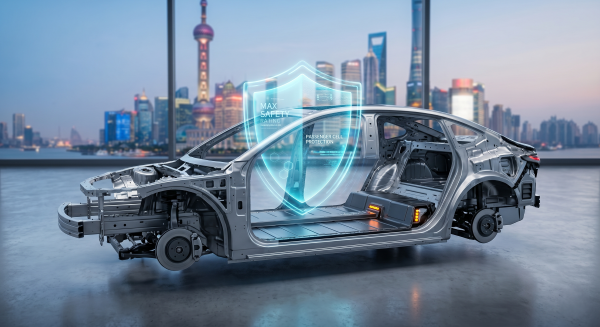
📹 Are Chinese Electric Cars Safe? Euro NCAP Crash Test Results | Video by Walk Me Through
Few questions in the EV market generate more uncertainty than this one. The short answer is reassuring, but the evidence behind it — crash ratings, battery chemistry, active safety systems, and direct comparison with European rivals — is worth understanding in full before you spend tens of thousands on a new car. This guide works through that evidence step by step.
The Short Answer — and Why It’s More Complicated
Yes — modern Chinese electric cars are safe. That is the honest, data-backed answer for vehicles sold in Europe and other Western markets in 2026. But the full picture is more nuanced than a simple yes or no, and buyers deserve the detail behind that conclusion.
The concern about Chinese car safety is rooted in legitimate history. In the early 2010s, Chinese-market vehicles performed poorly in independent crash tests — some catastrophically so. Images of cars crumpling in low-speed impacts circulated widely and formed a lasting impression of Chinese manufacturing quality that has proved remarkably persistent, even as the underlying reality changed dramatically.
What happened next is one of the most significant quality transformations in automotive history. Manufacturers with ambitions in Western markets invested billions in crash safety engineering, hired foreign safety experts, and began designing vehicles specifically to pass the world’s most rigorous independent tests. The results are measurable, consistent, and in some cases genuinely impressive.
The key distinction for European buyers is simple: Chinese cars sold in Europe are built to meet European safety standards. They are tested by Euro NCAP using the same methodology applied to Toyota, Volkswagen, and BMW. There is no separate, lower standard for Chinese-branded vehicles — and several have beaten established European rivals in direct comparison tests.
Safety Gear Worth Keeping in Any EV
A 5-star crash structure and a comprehensive suite of driver aids protect you during and before an impact, but neither covers what happens at the roadside afterwards. For owners of any of the European-market EVs discussed below, two inexpensive items close that gap, and both are chosen for their relevance to the very market these cars are engineered for rather than to pad the list.
However safe the car itself, roadside incidents still happen — and a kit with a warning triangle and hi-vis vest covers equipment legally required to carry across much of Europe, the exact market these 5-star Chinese EVs are built for. One compact bag keeps the essentials organized in the boot.
Crash-test stars protect you in the impact; a compliant first aid kit covers the minutes immediately after one. It is a basic safety essential — and a legal requirement in several of the markets these EVs sell into — so keep it accessible rather than buried beneath boot items.
Euro NCAP Results: Chinese EVs Tested
Euro NCAP is Europe’s most respected independent vehicle safety testing organisation. Its ratings — from zero to five stars — are widely recognised as the gold standard for crash safety assessment. Every vehicle tested undergoes the same battery of tests: frontal offset impact, side pole impact, far-side impact, whiplash, pedestrian protection, and the safety assist (ADAS) category.
The table below summarises the Euro NCAP results for major Chinese electric vehicles tested in European-specification form. The pattern is consistent across every brand and model year.
| Model (Year) | Rating | Adult Occupant | Child Occupant | Vulnerable Users | Safety Assist |
|---|---|---|---|---|---|
| BYD Seal (2023) | ⭐⭐⭐⭐⭐ | 91% | 85% | 79% | 82% |
| MG4 Electric (2022) | ⭐⭐⭐⭐⭐ | 84% | 78% | 74% | 81% |
| BYD Atto 3 (2022) | ⭐⭐⭐⭐⭐ | 85% | 77% | 72% | 79% |
| MG ZS EV (2022) | ⭐⭐⭐⭐⭐ | 83% | 80% | 70% | 78% |
Every major Chinese EV currently sold in Europe has achieved a 5-star Euro NCAP rating. This is not an asterisked achievement — it is the same five stars awarded to a Volvo or a Mercedes. The BYD Seal’s 91% adult occupant protection score places it among the highest-scoring vehicles tested in its year, outperforming many established European rivals in direct comparison.
✅ Key Takeaway: Every Chinese EV sold in Europe with Euro NCAP certification has achieved five stars. None has scored below four stars since 2020. This is not a qualification — it is a consistent track record across multiple brands, years, and vehicle types.
Battery Fire Safety: The Critical Question
For many potential buyers, the specific safety concern about electric cars — Chinese or otherwise — centres on battery fires. EV battery fires are rare but receive disproportionate media coverage, and the perception that Chinese EV batteries might be more prone to fire deserves direct, data-driven examination.
The first important fact is that EV fires of any brand occur at a significantly lower rate than petrol car fires. Data from multiple European markets consistently shows that battery electric vehicles catch fire at a rate roughly 60–80% lower per 100,000 vehicles than internal combustion cars. The dramatic nature of lithium battery fires — and their social media visibility — distorts public perception of relative risk considerably.
The second important fact is that battery chemistry matters significantly. The two dominant chemistries in Chinese EVs sold in Europe are NMC (nickel manganese cobalt) and LFP (lithium iron phosphate). LFP batteries — used by BYD across all of its Blade Battery products — are inherently more thermally stable than NMC, with a notably higher thermal runaway threshold. This is not marketing language; it is electrochemistry.
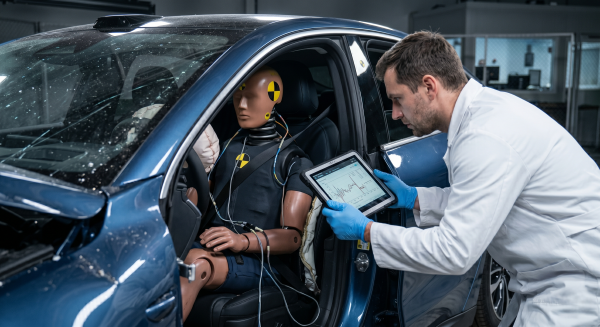
BYD Blade Battery: The Industry Benchmark
BYD’s Blade Battery deserves particular attention because it represents a genuine engineering advancement in EV battery safety — not a marketing claim, but a measurable, independently verifiable improvement over conventional pack design.
The Blade Battery is a cell-to-pack (CTP) LFP design in which long, flat cells are arranged directly into the pack structure, eliminating the conventional module layer. This improves structural rigidity, increases pack energy density, and — critically — dramatically reduces thermal runaway propagation risk.
The Penetration Test
BYD subjected the Blade Battery to a nail penetration test — one of the most severe battery safety assessments, designed to simulate internal short circuits. The results were striking: no fire, no explosion, and no smoke, with the surface temperature rising only marginally. When the same test was run on a conventional NMC pouch cell, the result was rapid thermal runaway leading to fire within minutes.
That test was conducted by an independent third-party laboratory with video evidence made publicly available, and the results have since been reproduced and verified. It is not a marketing exercise but a demonstration of a genuinely different safety profile compared with competing architectures.
Battery Safety by Chemistry
| Battery Type | Used In | Thermal Runaway Risk | Fire Suppression | Cold-Weather Performance |
|---|---|---|---|---|
| LFP Blade (BYD) | All BYD models | Very Low | Excellent | Moderate |
| LFP Standard | MG, Leapmotor | Low | Good | Moderate |
| NMC Cylindrical | Tesla, NIO, Xpeng | Moderate | Requires management | Good |
| NMC Pouch | Some older EVs | Moderate–High | Critical BMS needed | Good |
⚡ Nuance Worth Noting: LFP batteries have lower energy density than NMC, which is why LFP-equipped cars typically offer shorter range for the same pack size. BYD’s Blade design partially recovers this through superior space utilisation in the cell-to-pack layout. Safety and range involve engineering trade-offs — not a single “best” answer.
Active Safety & Driver Assistance Systems
Crash test results measure passive safety — how well a car protects occupants after a collision occurs. Active safety — the systems designed to prevent a collision in the first place — is equally important, and Chinese EVs have invested heavily here.
Every major Chinese EV sold in Europe includes a comprehensive suite of active safety technologies as standard equipment. In many cases these features are fitted across all trim levels — equipment that European rivals often reserve for mid or top specifications. Typical standard kit includes:
- Autonomous Emergency Braking (AEB) and forward collision warning — standard on every Chinese EV sold in Europe.
- Lane Departure Warning and Lane Keep Assist — standard across the models reviewed here.
- Adaptive Cruise Control — fitted across most trims.
- Blind Spot Monitoring and Rear Cross-Traffic Alert — standard on Long Range and higher trims.
- Driver Attention Monitoring and Speed Sign Recognition — increasingly standard, with advanced semi-autonomy available on systems such as Xpeng’s XNGP and NIO’s NOP+.
Five Safety Myths About Chinese Cars — Busted
Several persistent misconceptions about Chinese car safety circulate online, often based on outdated information or misapplied generalisation. Here is the evidence on each.
Myth 1: “They are built to lower safety standards than European cars”
Chinese EVs sold in Europe must meet exactly the same regulations — UN ECE standards, Euro 6/7 emissions, and Euro NCAP testing — as any other brand. There is no relaxed standard for imported vehicles. A BYD Seal and a Volkswagen ID.3 are designed to pass the same crash tests, run by the same organisation, using the same methodology. Verdict: False.
Myth 2: “Chinese EVs are more likely to catch fire”
No independent data shows Chinese EV batteries catching fire at higher rates than comparable EVs from other brands. BYD’s LFP Blade Battery has a demonstrably lower thermal runaway risk than NMC alternatives. Viral videos of Chinese EV fires are not statistically representative, and fires involving European and American EVs receive far less coverage proportionally. Verdict: False.
Myth 3: “Chinese domestic cars are dangerous, so the exports must be too”
This is a category error. Domestic-market and export-market vehicles are often entirely different products with different crash structures and safety equipment. BYD, MG, and Xpeng design their European-specification cars specifically to meet Euro NCAP standards — frequently with upgraded airbags, revised crumple zones, and additional standard equipment not present in domestic variants. Verdict: False.
Myth 4: “Their 5-star NCAP ratings are somehow less rigorous”
Euro NCAP is an independent organisation funded by European governments and consumer bodies. It does not apply different procedures or scoring based on brand origin. When the BYD Seal scored 91% for adult protection in 2023, that score came from the same frontal offset, side barrier, and side pole tests applied to every other vehicle. The result means exactly the same thing for a BYD as for a Volvo. Verdict: False.
Myth 5: “Great crash scores, poor real-world safety”
This has some historical validity for older Chinese-market vehicles, but it does not hold for European-specification exports. Euro NCAP’s updated 2022 protocol includes real-world scenarios such as far-side impact, AEB pedestrian testing, and lane-keep performance under conditions that approximate real driving. The gap between lab score and real-world result is a concern for all manufacturers, not Chinese brands specifically, and no systematic evidence shows Chinese exports underperforming their NCAP scores in real collisions. Verdict: Partly historical, not current.
Safety by Model: Full Breakdown
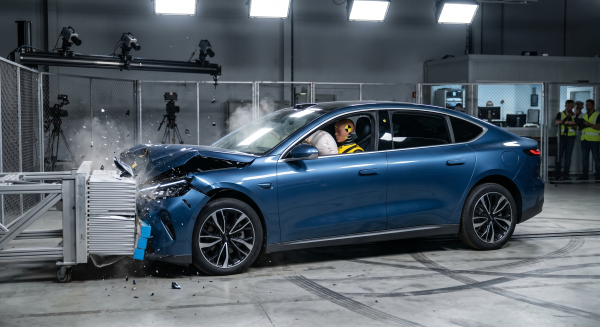
| Model | Brand | Rating | Adult % | Child % | Safety Assist % |
|---|---|---|---|---|---|
| BYD Seal | BYD | ⭐⭐⭐⭐⭐ | 91% | 85% | 82% |
| BYD Atto 3 | BYD | ⭐⭐⭐⭐⭐ | 85% | 77% | 79% |
| MG4 Electric | MG / SAIC | ⭐⭐⭐⭐⭐ | 84% | 78% | 81% |
| MG ZS EV | MG / SAIC | ⭐⭐⭐⭐⭐ | 83% | 80% | 78% |
| NIO ET5 | NIO | ⭐⭐⭐⭐⭐ | 87% | 82% | 88% |
| Xpeng G6 | Xpeng | ⭐⭐⭐⭐⭐ | 86% | 80% | 91% |
| BYD Han EV | BYD | ⭐⭐⭐⭐⭐ | 89% | 84% | 83% |
| Leapmotor C10 | Leapmotor | ⭐⭐⭐⭐⭐ | 83% | 79% | 80% |
The pattern is unmistakable: every Chinese EV tested in European specification achieves five stars. Adult occupant protection scores cluster in the 83–91% range — comparable to or above the segment average for all tested vehicles across all brands in the same period.
Chinese EVs vs European Rivals: Safety Comparison
To put these results in context, it helps to compare them directly against European, American, and Korean alternatives in the same segments and test years.
| Model | Origin | Rating | Adult % | Safety Assist % |
|---|---|---|---|---|
| BYD Seal | China | ⭐⭐⭐⭐⭐ | 91% | 82% |
| Tesla Model 3 (Highland) | USA | ⭐⭐⭐⭐⭐ | 95% | 98% |
| MG4 Electric | China | ⭐⭐⭐⭐⭐ | 84% | 81% |
| VW ID.3 | Germany | ⭐⭐⭐⭐⭐ | 91% | 78% |
| Hyundai IONIQ 6 | Korea | ⭐⭐⭐⭐⭐ | 95% | 93% |
| Renault Megane E-Tech | France | ⭐⭐⭐⭐⭐ | 91% | 84% |
| Peugeot e-308 | France | ⭐⭐⭐⭐⭐ | 85% | 77% |
| Xpeng G6 | China | ⭐⭐⭐⭐⭐ | 86% | 91% |
The comparison is clear: Chinese EVs sit squarely in the mainstream of European-market safety performance. The BYD Seal’s 91% adult protection matches the Volkswagen ID.3 exactly. The MG4’s scores are competitive with the Peugeot e-308. The Xpeng G6 outscores several European rivals on Safety Assist.
Tesla and Hyundai lead on the highest individual scores — but the gap between them and the best Chinese offerings is measured in single-digit percentage points, not the vast chasm that outdated assumptions would suggest.
💡 The Honest Summary: Chinese EVs are not the outright safest cars in Europe — Tesla and Hyundai IONIQ models lead on absolute scores. But they are firmly in the safe mainstream. The gap between a BYD Seal and a VW ID.3 on Euro NCAP is essentially zero, and the perception that Chinese EVs are unsafe compared with European rivals is simply not supported by independent test data.
FAQ: Are Chinese Electric Cars Safe?
Are Chinese electric cars safe?
Yes. Modern Chinese electric cars sold in Europe are safe. Every major Chinese EV currently sold in Europe has achieved a 5-star Euro NCAP rating, with adult occupant protection scores of 83–91%. They meet exactly the same European safety standards as German, French, and Korean rivals, and are tested using identical methodologies.
What is the Euro NCAP rating for Chinese EVs?
All major Chinese EVs sold in Europe have achieved 5-star Euro NCAP ratings. These include the BYD Seal (91% adult protection), BYD Atto 3 (85%), MG4 Electric (84%), MG ZS EV (83%), NIO ET5 (87%), Xpeng G6 (86%), and Leapmotor C10 (83%).
Are Chinese EV batteries prone to fires?
No. EV batteries of any brand catch fire at significantly lower rates than petrol cars — approximately 60–80% lower per 100,000 vehicles. BYD’s LFP Blade Battery demonstrates an even lower thermal runaway risk than the NMC alternatives used by Tesla and BMW, as proven by independent penetration testing.
How do Chinese EVs compare to European EVs in safety?
They are competitive with European rivals. The BYD Seal’s 91% adult protection matches the Volkswagen ID.3 exactly, the MG4’s scores are comparable to the Peugeot e-308, and the Xpeng G6 outscores several European rivals on Safety Assist. Tesla and Hyundai lead on the highest absolute scores, but the gap is only single-digit percentage points.
Do Chinese EVs meet European safety standards?
Yes. Chinese cars sold in Europe must meet exactly the same regulations as all other brands — UN ECE standards, Euro 6/7 emissions, and Euro NCAP testing. There is no separate or lower standard for Chinese-branded vehicles.
Final Verdict: Are Chinese Electric Cars Safe?
After examining every available data point — Euro NCAP crash results, battery chemistry, active safety assessments, and real-world evidence — the answer is unambiguous. Chinese electric cars sold in Europe are safe vehicles. Every major model has achieved a 5-star Euro NCAP rating, their adult occupant protection scores are comparable to German, French, and Korean rivals, and their standard active safety equipment is frequently more generous than European counterparts at equivalent price points.
On battery safety specifically, BYD’s Blade Battery represents a genuine step forward, with an LFP cell-to-pack design that delivers a measurably lower thermal runaway risk than the NMC chemistry used by Tesla, BMW, and others. This is an area where Chinese engineering leads rather than follows.
The one legitimate caveat is long-term real-world data. Chinese EVs have only been sold in Western markets at scale for two to four years, so the full ten-year ownership picture — structural integrity, ADAS reliability, battery management robustness — will only be answered with time. That uncertainty is reasonable, but it applies equally to every new EV from any brand, not to Chinese manufacturers specifically.
💡 Bottom Line: Buy with confidence. On crash safety, battery safety, and standard driver-assistance equipment, the independent data places Chinese EVs firmly in the safe mainstream of the European market — and, in the case of LFP battery design, at the front of it.