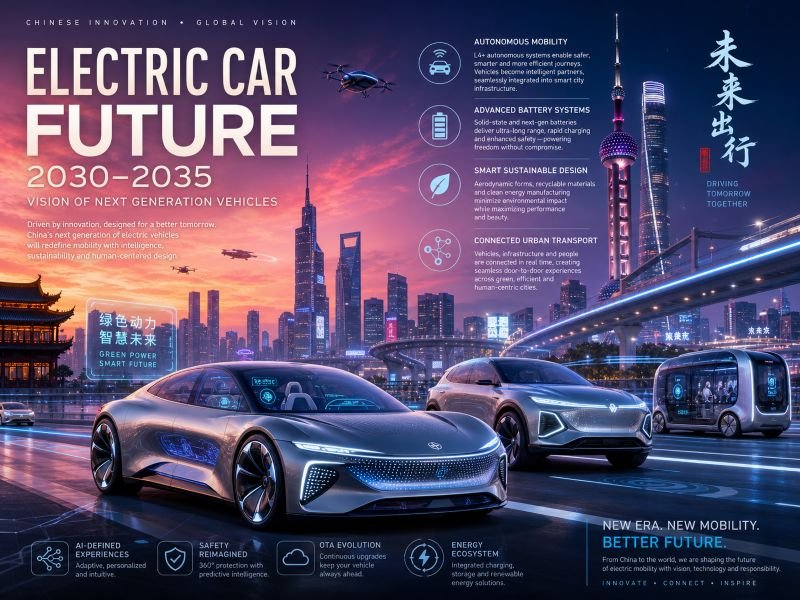
The Future of Electric Cars 2030: Complete Technology Roadmap
Quick answer: By 2030, electric cars are set to feature solid-state batteries with 1,000 km-plus range, Level 4 autonomous driving, prices competitive with petrol, and charging in around ten minutes. Petrol cars become phase-out targets, while hydrogen stays niche.
This roadmap walks through the technologies, market shifts and policy deadlines shaping the rest of the decade — and where the balance of power is heading as Chinese brands extend their lead.
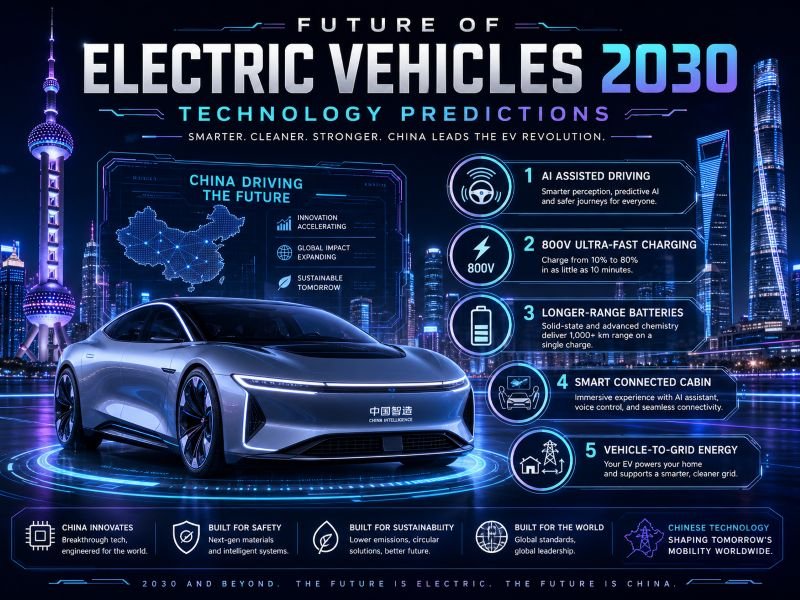
We are standing at an inflection point. Between now and 2030, electric vehicles are set to complete their transition from a forward-looking “alternative” to the default choice for new car buyers. The shift will be driven by a cluster of technologies maturing at once — and by policy deadlines that increasingly leave combustion engines with nowhere to go.
Before we map each development in detail, the short roadmap video below sets out where electric cars are heading by 2030. We then break down the batteries, autonomy, pricing and market dynamics that will define the decade.
The EV Revolution Accelerates: 2026–2030 Outlook
The pace of change in the EV world has a habit of outrunning forecasts. What looked like cautious projections a few years ago have been overtaken by reality, and the same is likely to happen again before 2030. Based on current development timelines and market trajectories, the rest of this decade will be defined by cheaper, longer-range, increasingly self-driving cars arriving faster than most buyers expect.
To make sense of it, it helps to group the change into a few clear themes: a battery breakthrough, the arrival of genuine autonomy, the collapse of the price gap with petrol, and a decisive shift in who leads the market. We will take each in turn.
Future-Proof Your EV: Two Tech Essentials Worth Owning Now
A dual-channel dash cam with a Sony STARVIS sensor and parking mode protects your investment whether you are driving or parked at a charging station. Aim for 4K front / 2K rear with built-in Wi-Fi for easy footage review — increasingly expected by insurers, and a sound safeguard for a high-value EV.
Even with the large AMOLED screens these SUVs offer, a dedicated MagSafe-compatible mount with wireless charging keeps your phone visible and topped up without cluttering the minimalist dashboards found in the Xpeng, Zeekr, and BYD cabins. Vent or air-outlet versions fit most interiors cleanly.
Technology Breakthrough #1: Solid-State Batteries (2028–2030)
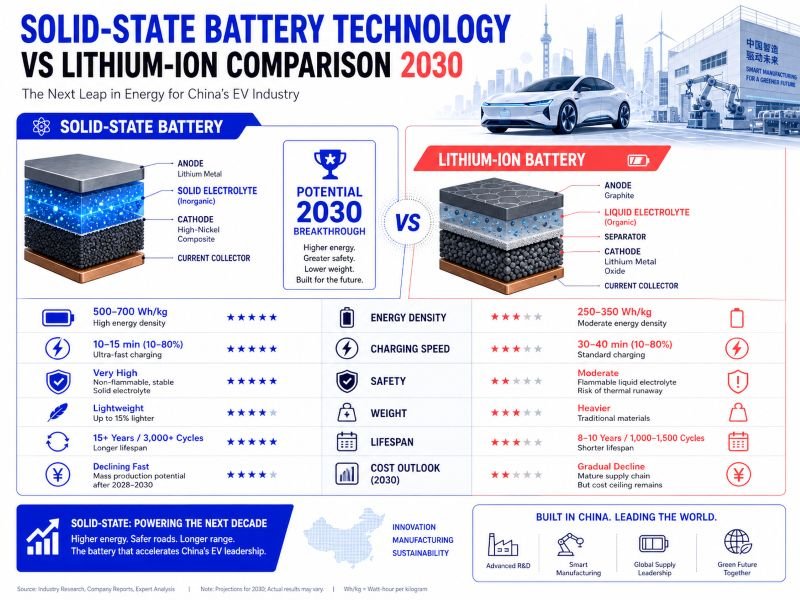
If one technology defines the next leap, it is the solid-state battery. By replacing the liquid electrolyte with a solid one, these cells promise dramatic gains across every metric that matters to drivers.
- Range: 800–1,200 km per charge — two to three times today’s typical figures
- Charging speed: around 10 minutes to 80%, versus today’s 25–35 minutes
- Cost trajectory: heading toward £50/kWh by 2030, down from today’s £100–150/kWh
- Safety: a solid electrolyte effectively removes the thermal-runaway fire risk
- Lifespan: 1.5–2 million km, up from roughly 1 million km today
- Energy density: 400+ Wh/kg, versus 250–300 Wh/kg now
On the timeline, Toyota has promised solid-state production around 2027–2028, with Samsung, CATL and BYD expected to follow between 2028 and 2030. By 2031, the first mass-market solid-state EVs should be on sale — and they will reset expectations of range and charging overnight.
Technology Breakthrough #2: Level 4 Autonomous Driving
Alongside batteries, autonomy is the second pillar of the 2030 car. Genuine Level 4 driving — where the car handles all aspects of the journey within defined conditions — is realistically achievable before the decade is out.
- Today (2026): Level 2–3 systems handle cruise, lane-keeping and limited hands-off driving
- 2028–2029: Level 4 begins rolling out in controlled settings such as motorways and mapped zones
- 2030 onward: Level 4 expands across most urban and suburban conditions
- Technology stack: fused LiDAR and camera data, neural networks and real-time processing
- Cost impact: sensor and compute hardware costs are set to fall 40–50% by 2030
The knock-on effect is significant: as the hardware becomes affordable, driverless taxi services scale up, and personal car ownership in dense cities begins to soften — a trend with consequences far beyond the vehicles themselves.
There is a safety dividend too. Because the majority of road collisions trace back to human error, widespread Level 4 adoption is expected to cut accident rates sharply once the systems mature and the regulatory framework catches up. For insurers, that prospect is already reshaping how they price cover, rewarding cars fitted with proven assistance and recording technology.
Market Predictions: The 2030 EV Landscape
Pulling the technology and economics together produces a striking picture of how different the market will look in just a few years.
| Metric | 2026 (Current) | 2030 Projection | Change |
|---|---|---|---|
| Global EV market share | 18% | 45–50% | +27–32 points |
| Annual EV production | 13 million units | 25–30 million units | +92–130% |
| Average EV price (USD) | $35,000–$45,000 | $25,000–$35,000 | −29% (petrol parity) |
| Average range (km) | 350–400 | 600–800 | +71–100% |
| Charging time (10–80%) | 25–35 min | 8–15 min | −57% faster |
| Battery cost (£/kWh) | £100–150 | £40–70 | −60% lower |
| EV-only car brands | 20–30 | 50–60 | +100% growth |
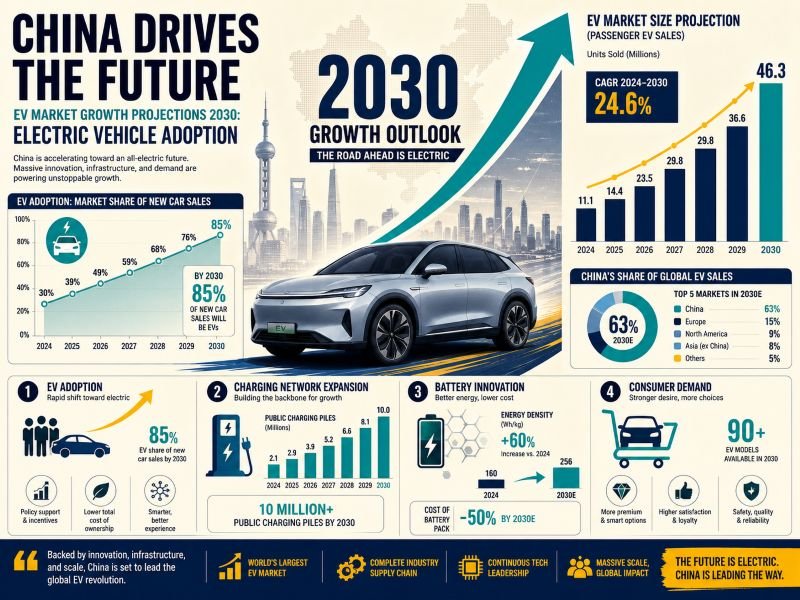
What stands out in these figures is that no single metric is moving in isolation. Prices fall while range and charging speed climb, and production scales just as the cost of every component drops. That compounding effect is exactly why the transition is expected to feel sudden rather than gradual — the moment EVs become cheaper, longer-range and quicker to charge all at once, the reasons to choose petrol simply evaporate for mainstream buyers.
Regional Policy Timelines: Petrol Car Phase-Out
Technology is only half the story — regulation is forcing the pace just as hard. A wave of phase-out deadlines is closing the window for new combustion cars across major markets.
- UK: new petrol car sales banned from 2030 (hybrids may run to 2035)
- EU: all non-EV new sales banned from 2035 (confirmed policy)
- California: new petrol car sales banned from 2035
- China: a new-energy mandate targets 60% by 2030, effectively phasing out combustion
- Japan: 100% electrified vehicles by 2035 (including hybrids)
- Canada: 100% zero-emission vehicles by 2035
It is worth being precise about what these bans mean: they stop the sale of new petrol cars, not the use of existing ones. A used petrol market will persist well into the 2040s, but new showroom stock in major markets will be electric-only.
What About Hydrogen? (Spoiler: It Stays Niche)
For years, hydrogen advocates predicted mainstream adoption by the late 2020s. The reality has been very different, and the gap with battery EVs has only widened.
- Fuel-cell vehicles: roughly 15,000 sold globally in 2026, against around 13 million EVs
- Infrastructure: about 500 hydrogen stations worldwide, versus over a million EV chargers
- Cost: hydrogen production remains 70–80% more expensive than grid electricity
- Efficiency: fuel cells are 40–50% efficient, against 85–90% for batteries
- 2030 outlook: hydrogen stays confined to heavy transport, buses and industry
For personal cars, battery EVs have won decisively. Hydrogen may yet complement freight and bus fleets, but it is not positioned to replace the battery-electric car.
⚡ Energy efficiency: Producing hydrogen and converting it back into electricity needs roughly 2.5–3 times more energy than charging a battery directly. From a renewable-energy standpoint, batteries win on physics alone.
Chinese EV Dominance Expands (2026–2030)
No discussion of the 2030 landscape is complete without China. Already the centre of gravity for EV manufacturing, Chinese brands are set to extend their lead in both volume and technology.
- Market share: Chinese brands grow from around 50% in 2026 to 60–65% of global EV sales by 2030
- Technology leadership: solid-state cells, autonomy and battery swapping are being pioneered in China
- Consolidation: today’s crowded field of startups narrows to five to seven major players
- Western response: Tesla, BMW and Volkswagen compete increasingly on brand, not raw technology
- Trade dynamics: local Chinese manufacturing inside the EU and Australia blunts the impact of tariffs
The implication for buyers is clear: more will choose Chinese brands for their blend of value and technology, while Western marques increasingly defend the premium end of the market.
Total Cost of Ownership in 2030
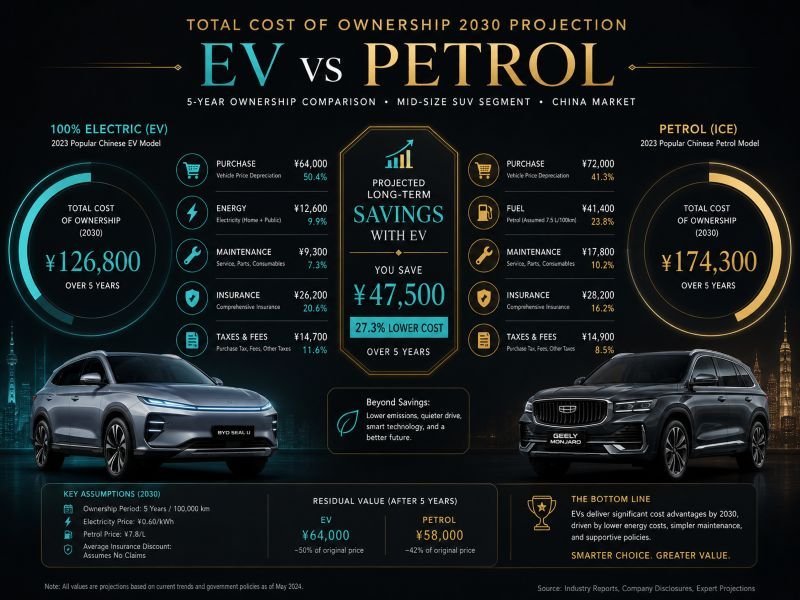
For most households the deciding factor is not the headline technology but the running cost. Modelling a five-year ownership scenario for 2030 shows just how lopsided the comparison becomes once price parity arrives.
| Category | Petrol (declining availability) | EV (mainstream) | Advantage |
|---|---|---|---|
| Purchase price | £28,000 | £24,000 (parity reached) | EV −£4,000 |
| Fuel / energy (60,000 km) | £8,500–£10,000 | £1,200–£1,800 | EV saves £6,700–£8,800 |
| Maintenance | £2,500–£3,500 | £600–£900 | EV saves £1,600–£2,900 |
| Insurance (equalised) | £7,000 | £7,000 | Equal |
| 5-year total | £46,000–£52,000 | £32,800–£36,000 | EV saves £9,000–£20,000 |
By 2030, EV ownership is projected to be 20–40% cheaper than petrol over five years — removing essentially any remaining economic argument for a combustion engine.
Challenges Remaining (And How They’ll Be Addressed)
None of this is to suggest a frictionless transition. Several genuine hurdles remain — but each has a clear path to resolution already underway.
- Grid capacity: managed through demand-response, vehicle-to-grid (V2G) and distributed generation
- Charging equity: dedicated programmes for apartment dwellers and rural residents
- Supply bottlenecks: scaling lithium output and recycling cut reliance on fresh raw materials
- Thermal management: refined active cooling normalises Arctic and desert operation
- Autonomy rules: legal and liability frameworks expected to be settled around 2029
⚠️ Important note: The 2028–2030 figures throughout this roadmap are projections based on current trends. Breakthrough timelines can slip, and raw-material prices, tariffs and policy shifts can all move the dates, so treat the longer-term numbers as informed estimates rather than guarantees.
FAQ: The Future of Electric Cars
Should I wait for solid-state batteries or buy an EV now in 2026?
Buy now. Solid-state batteries are still three to four years away, while today’s lithium-ion packs are mature and reliable. Waiting costs you years of fuel and maintenance savings, and current battery cars will still hold resale value rather than being stranded.
Will autonomous cars eliminate vehicle ownership?
Only partially. Shared autonomous services are expected to reduce personal ownership in cities by roughly 30–50%, but ownership will not disappear entirely. Rural drivers and enthusiasts will continue to own their vehicles.
Will 2030-era EV batteries need replacing?
Very rarely. Solid-state batteries are projected to last 1.5–2 million km, while typical ownership covers only 150,000–200,000 km. Battery replacement is unlikely to be necessary within a normal ownership period.
What will a budget EV cost in 2030?
Expect roughly £18,000–£22,000 for models with 400+ km of range, led by Chinese brands. Western brands are likely to stay above £25,000, with Chinese competition keeping overall prices keenly competitive.
The 2030 EV Future: Optimistic but Realistic
By 2030, electric vehicles are on course to become the clear default for new car purchases. Solid-state batteries, autonomous driving and price parity converge to make EV ownership superior to petrol across the dimensions buyers care about most: cost, performance, convenience and environmental impact.
This will not be a utopia — real challenges remain around charging equity, grid management and supply-chain resilience. But the direction of travel is unmistakable: within roughly four years, petrol cars become the exception rather than the rule.
The headline takeaways are worth holding onto: solid-state batteries bring 800–1,200 km range and ten-minute charging; Level 4 autonomy rolls out in controlled conditions; EVs reach price parity with 20–40% lower running costs; electric models climb toward half of all new sales; range anxiety fades into a footnote; phase-out bans take effect from 2030 onward; and Chinese brands command 60–65% of the global market. Taken together, they describe a market transformed.