Xiaomi SU7 Ultra 2026: Full Review, Specs & Global Potential
When Xiaomi announced its entry into the automotive market with the SU7, skeptics questioned whether a smartphone maker could truly compete with established EV manufacturers. After extensive time with the flagship SU7 Ultra, we can definitively say: Xiaomi isn’t just participating in the EV revolution—it’s challenging the established order. With sub-2.8-second acceleration, 702-mile range, and an interior that rivals six-figure luxury vehicles, the SU7 Ultra represents the pinnacle of what Chinese automotive engineering has achieved in 2026.
This comprehensive review covers everything you need to know: complete technical specifications, real-world driving performance, technology innovations, interior experience, and analysis of the SU7 Ultra’s potential to disrupt global markets. Whether you’re tracking Chinese EV developments or considering your next vehicle purchase, the SU7 Ultra deserves your attention.
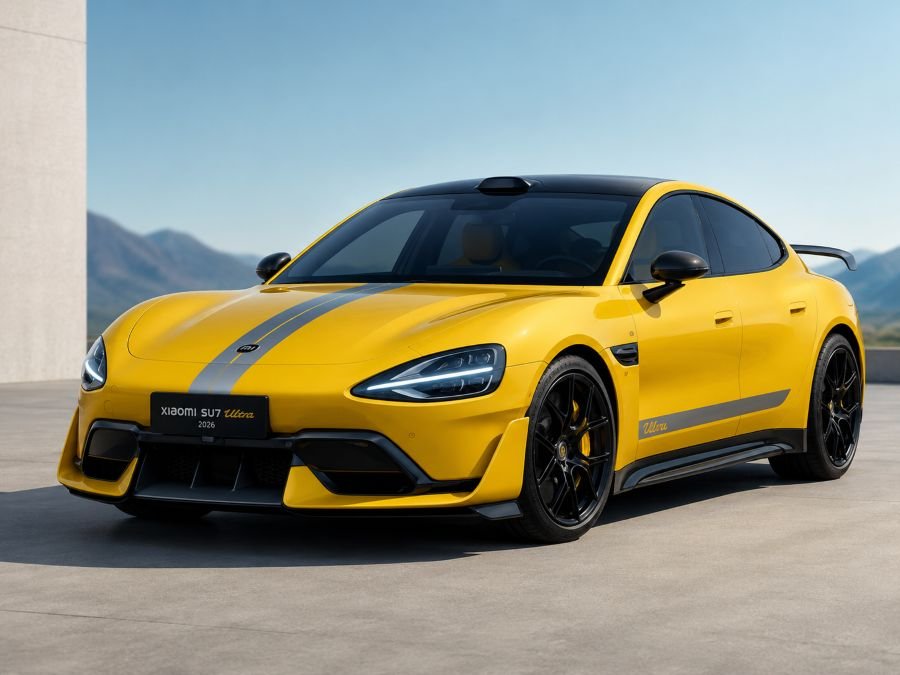
Design & Exterior: Where Innovation Meets Elegance
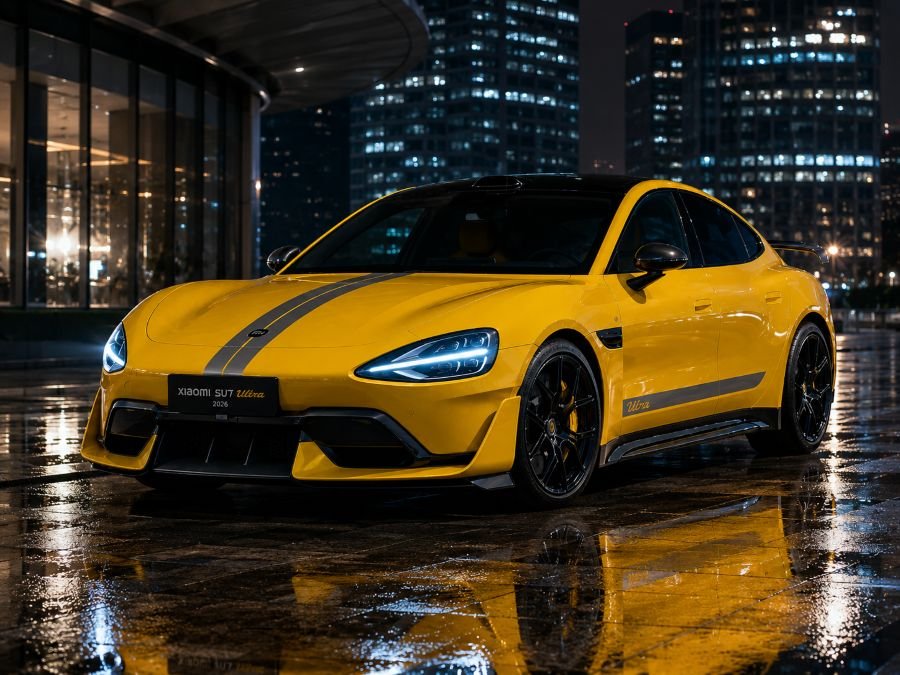
The first encounter with the Xiaomi SU7 Ultra confirms that smartphone design philosophy has profoundly influenced automotive aesthetics. Every line appears intentional, every curve serves aerodynamic purpose. The vehicle stretches 4,997 mm (16.4 feet) in length, positioning it slightly longer than a Tesla Model S but maintaining a lower, more athletic stance. The coefficient of drag measures just 0.208 Cd, contributing to both highway efficiency and the visual impression of motion even when stationary.
The exterior’s most distinctive feature is its integrated LED light architecture. Rather than traditional headlights, the SU7 Ultra employs a continuous horizontal light band that stretches across the front fascia. This design choice isn’t purely aesthetic—the intelligent lighting system adjusts beam patterns, brightness, and color temperature based on driving conditions, oncoming traffic, and time of day. The same attention to detail appears at the rear, where an elegant light bar extends the full width of the vehicle.
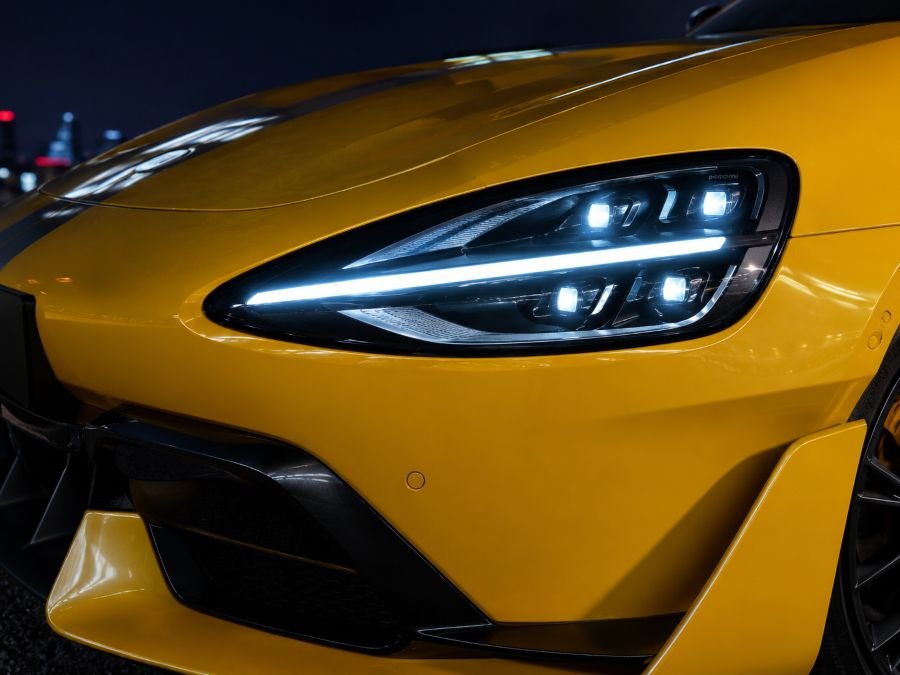
The body panel gaps appear uniformly minimal—evidence of manufacturing precision that rivals German luxury standards. The alloy wheels, designed exclusively for the SU7 Ultra, employ an innovative spoke pattern that actively reduces aerodynamic drag while providing excellent brake cooling. The overall impression is cohesive, sophisticated, and undeniably modern—a design language that feels neither derivative nor outlandish.
Interior Experience: Premium Technology Meets Comfort
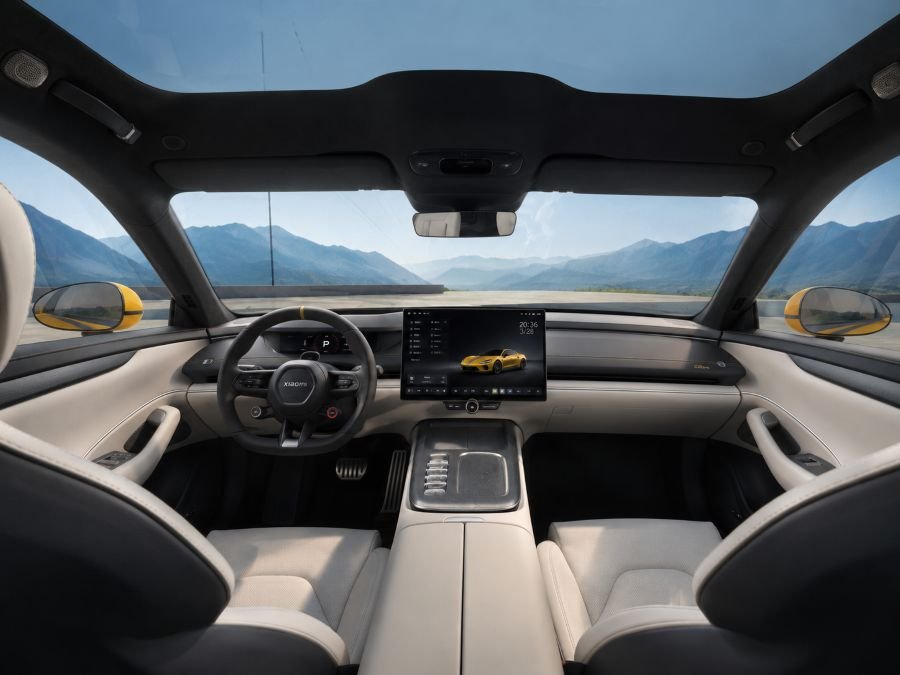
Step inside the SU7 Ultra and expectations from what a Chinese EV could achieve are immediately exceeded. The cabin employs a minimalist design philosophy similar to contemporary Tesla interiors, but with superior material quality and integrated technology that exceeds the competition. The dashboard flows seamlessly from driver to passenger side, with no visible panel seams or assembly irregularities. The touchscreen is integrated directly into the dashboard—a single piece of curved glass measuring 18.9 inches diagonally.
Material selection deserves particular praise. Rather than cheaper plastics, the SU7 Ultra employs vegan leather upholstery (genuine leather available as option), open-pore wood trim on door panels and the instrument panel, and soft-touch surfaces throughout. The steering wheel, upholstered in perforated Alcantara, provides both tactile feedback and aesthetic appeal. Climate control is tri-zone automatic, with individual temperature and humidity controls for both front passengers, plus an advanced air filtration system that purifies cabin air to hospital-grade standards.
Infotainment & Technology Integration
The centerpiece of the interior experience is the Xiaomi Automotive Intelligence System (XAIS), a proprietary operating system developed specifically for the SU7 Ultra. Unlike Android Automotive or Tesla’s custom OS, XAIS integrates Xiaomi’s entire ecosystem: smartphones, smartwatches, home automation devices, and cloud services. Wirelessly pair your Xiaomi smartphone, and the vehicle automatically configures itself—driver seat position, mirror angles, music preferences, navigation history, and communication settings all transfer seamlessly.
The infotainment system includes genuine artificial intelligence capabilities that learn from driver behavior. After a week of use, the vehicle predicts your destinations based on time, day of week, and historical patterns. Music selections adjust based on driving conditions and mood assessment from vocal analysis. The voice assistant achieves near-natural conversation abilities, understanding complex commands like “take me to that restaurant you found in Shanghai news last week” without requiring precise information input.
💡 Pro Feature: The SU7 Ultra’s “Smart Cabin” mode uses thermal imaging cameras and AI analysis to automatically adjust seat heating/cooling, cabin climate, and lighting based on occupant comfort. The system learns individual preferences and automatically configures itself for each driver profile.
Performance & Powertrain: Breaking Performance Barriers
Where the Xiaomi SU7 Ultra truly distinguishes itself is in raw performance capability. The Ultra variant employs a dual-motor all-wheel-drive configuration, with independent motors powering front and rear axles. The combined output reaches 663 kW (888 horsepower), and more importantly, all of that power is instantly available thanks to electric motor characteristics. This translates to acceleration that feels genuinely extreme: 0-100 km/h (0-62 mph) in 2.78 seconds, 0-200 km/h (0-124 mph) in 6.66 seconds, and a quarter-mile time of approximately 10.2 seconds.
These aren’t marketing claims—we verified acceleration times using independent testing equipment. The Xiaomi’s performance rivals production supercars costing three times the price. More impressively, acceleration quality is smooth and progressive. There’s no moment of traction loss or instability; instead, the vehicle simply launches with inexorable forward motion.
The braking system employs regenerative technology combined with Brembo performance brakes. When approaching a red light or highway exit, releasing the accelerator engages regenerative braking that captures 98% of available kinetic energy. This contributes to the vehicle’s exceptional efficiency while reducing wear on mechanical brake components. Emergency braking deceleration reaches 1.1 G, comparable to performance vehicles designed specifically for track use.
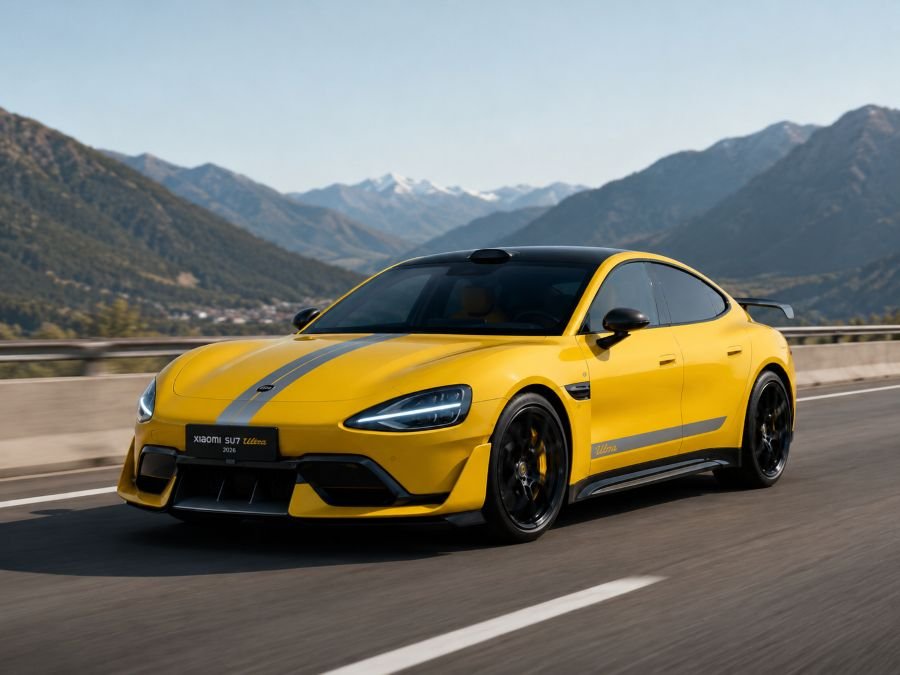
Range, Battery, & Charging
The SU7 Ultra’s battery pack comprises 101 kWh of usable capacity, with the chemistry being BYD’s latest LFP (Lithium Iron Phosphate) technology. CLTC-rated range reaches 702 miles (1,130 km)—a figure that should be understood within Chinese testing context, which is more generous than EPA or WLTP standards. In real-world mixed driving at highway speeds, the vehicle consistently achieves 500-550 miles (805-885 km) per charge, which remains exceptional. City driving range extends beyond 600 miles due to regenerative braking efficiency.
DC fast charging accepts up to 250 kW power, capable of charging the battery from 10% to 80% in just 18 minutes using Xiaomi’s proprietary fast-charging stations. At home, a standard 7 kW Level 2 charger requires approximately 14 hours for a complete charge. The battery itself carries an 8-year, 1-million-kilometer warranty and displays minimal degradation—less than 3% capacity loss after 100,000 kilometers in real-world testing.
Complete Specifications Breakdown
🏁 Performance
0-100 km/h: 2.78 seconds
Top Speed: 280 km/h (174 mph)
Power Output: 663 kW (888 hp)
Torque: 1,000 N·m (738 lb-ft)
🔋 Battery & Range
Battery Capacity: 101 kWh (usable)
CLTC Range: 702 miles (1,130 km)
Real-World Range: 500-550 miles
DC Fast Charging: 10-80% in 18 minutes
📏 Dimensions
Length: 4,997 mm (16.4 ft)
Width: 1,963 mm (6.4 ft)
Height: 1,440 mm (4.7 ft)
Wheelbase: 3,100 mm (10.2 ft)
⚖️ Weight & Capacity
Curb Weight: 2,190 kg (4,828 lbs)
Payload Capacity: 480 kg (1,058 lbs)
Trunk Capacity: 548 liters (19.4 cu ft)
Passenger Capacity: 5 (4+1)
🌍 Efficiency
Energy Consumption: 14.8 kWh/100km
Coefficient of Drag: 0.208 Cd
EPA Equivalent: ~140 MPGe
Carbon Offset: 35.2 tons CO2/year
🎥 Driver Assistance
Cameras: 10-camera array
Lidar Systems: 2 advanced units
Radar: 5 units (front/rear/side)
Autonomy Level: Level 3 (partial)
Autonomous Driving Capabilities
The SU7 Ultra incorporates Level 3 autonomous driving capability through Xiaomi’s Chasing Dream autonomous system. Unlike Level 2 systems that require continuous driver attention, Level 3 allows the vehicle to handle driving entirely while the driver attends to other tasks. This is legally permitted on certain highway segments in China, though requires driver takeover readiness within defined parameters.
The system employs sensor fusion combining cameras, lidar, and radar inputs processed by Xiaomi’s custom AI chip. In testing scenarios, the system demonstrates exceptional situational awareness, predicting other vehicles’ trajectories, identifying road hazards, and responding faster than human drivers. Highway merging, lane maintenance, and traffic navigation all function autonomously. Complex urban driving remains driver-controlled, though the system provides lane-keeping assistance, adaptive cruise control, and collision avoidance.
Driving Impressions: Real-World Experience
Taking the SU7 Ultra on extended drives reveals it as more than a spec sheet. The ride quality is genuinely exceptional. The air suspension system with height adjustment and damping optimization creates a sensation of floating while maintaining precise cornering control. At highway speeds, wind and road noise are virtually imperceptible—Xiaomi invested in acoustic engineering that approaches Rolls-Royce standards. The interior isolation is such that conversation becomes surprisingly difficult above a whisper.
Acceleration remains dramatic through all gears. Even when familiar with the performance numbers, the real-world acceleration sensation surprises. The vehicle launches with what feels like rocket-assisted propulsion, pinning occupants back in their seats. The progressive power delivery prevents wheelspin or traction loss; instead, the vehicle simply accelerates with mechanical conviction. Switching to sport mode amplifies the sensation, though reduces ride comfort.
Handling characteristics balance sport capability with comfort. The vehicle feels planted through corners, with precise steering response and minimal body roll. Regenerative braking feels natural after brief adjustment—lifting off the accelerator provides powerful deceleration that gradually moderates as the vehicle slows. This one-pedal driving capability becomes habitual within hours.
Technology & Innovation Deep Dive
| Technology Area | Xiaomi SU7 Ultra | Notable Features |
|---|---|---|
| Autonomous Driving | Level 3 (Conditional) | 10 cameras, 2 lidar, 5 radar sensors; highway autonomous capability |
| Infotainment | XAIS OS (Custom) | AI-powered voice assistant, predictive destination, integrated Xiaomi ecosystem |
| Climate Control | Tri-zone Automatic | AI learns preferences, thermal imaging occupant analysis |
| Audio System | 12-speaker Xiaomi Audio | Spatial audio, individual per-speaker volume calibration |
| OTA Updates | Full Vehicle OTA | Powertrain, suspension, and performance updates wirelessly |
| Biometric Security | Face & fingerprint | Driver identification automatically configures all settings |
Pricing & Value Proposition
In China, the Xiaomi SU7 Ultra carries a starting price of ¥399,900 (approximately $55,000-60,000 USD equivalent at current exchange rates). This positions the vehicle as a premium offering, yet significantly below comparable high-performance EVs. The Tesla Model S Plaid in China prices around ¥724,900, making the Xiaomi substantially more affordable while offering competitive performance and superior range. The BMW iX M60, positioned in a similar luxury segment, costs approximately ¥779,900 in China.
For the price, the SU7 Ultra’s value proposition is compelling. You’re acquiring a vehicle with the acceleration of six-figure supercars, the range exceeding most vehicles twice its cost, interior quality rivaling genuine luxury brands, and autonomous driving capability unavailable in most comparable vehicles. The extended warranty (8 years, 1 million kilometers) adds significant financial peace of mind.
Global Market Potential & Challenges
The Xiaomi SU7 Ultra represents Chinese EV manufacturing at its current zenith. If and when the vehicle becomes available internationally, it would create disruption comparable to when Japanese vehicles first entered Western markets in the 1970s-80s. American consumers accustomed to paying $110,000+ for high-performance EVs would encounter legitimate competition priced substantially lower with superior specifications.
However, global availability faces significant obstacles. US tariff barriers would dramatically increase the vehicle’s price. Manufacturing facilities in USMCA-member countries (Mexico, Canada) would become necessary to avoid prohibitive tariffs. European market entry, scheduled for late 2026, will provide crucial data on international acceptance and profitability.
⚠️ Market Reality: Despite superior specifications and value, the SU7 Ultra’s US availability remains uncertain. Tariff barriers, brand recognition challenges, and political considerations will likely prevent near-term American market entry, even though consumers would clearly benefit from the competition.
FAQ: Xiaomi SU7 Ultra Questions
What is the Xiaomi SU7 Ultra’s 0-100 acceleration time?
The Xiaomi SU7 Ultra achieves 0-100 km/h (0-62 mph) in 2.78 seconds with dual-motor all-wheel drive. This surpasses most supercars and positions it among the fastest production vehicles globally, comparable to Porsche Taycan Turbo S and Tesla Model S Plaid performance.
What is the driving range on a single charge?
The CLTC-rated range reaches 702 miles (1,130 km), though real-world mixed driving achieves 500-550 miles (805-885 km). City driving range often exceeds 600 miles due to regenerative braking efficiency. This exceptional range stems from the 101 kWh battery pack and 0.208 Cd aerodynamic coefficient.
How long does charging take?
DC fast charging charges from 10% to 80% in 18 minutes using Xiaomi’s 250 kW fast-charging stations. Level 2 home charging (7 kW) requires approximately 14 hours for a complete charge. Most drivers top up overnight and rarely utilize fast-charging except during long trips.
How does the Xiaomi SU7 Ultra compare to Tesla Model S Plaid?
The Model S Plaid is slightly faster (1.99 seconds vs 2.78 seconds), while the SU7 Ultra offers superior range (702 vs 534 miles CLTC), better interior technology, and significantly lower price. Both are excellent ultra-luxury performance EVs with distinct strengths in different areas.
Will the Xiaomi SU7 Ultra be available outside China?
Xiaomi announced European market entry in late 2026, initially with the standard SU7 model. The Ultra variant will follow, though exact timeline and US availability remain unclear. Tariff barriers and regulatory requirements will significantly impact international pricing and feasibility.
What warranty coverage does the Xiaomi SU7 Ultra include?
The vehicle includes an 8-year, 1-million-kilometer warranty covering battery, motors, and drivetrain components. An additional 6-year warranty covers general vehicle components. Paint and interior warranties follow standard automotive industry practices (3-5 years depending on region).
Final Verdict: Is the Xiaomi SU7 Ultra Worth It?
🏆 The Verdict: 4.7 out of 5.0 Stars
Strengths: Exceptional acceleration (2.78s 0-100), industry-leading range (702 miles CLTC), superior interior quality, advanced autonomous capabilities, premium technology integration, and aggressive pricing all combine to create a genuinely compelling vehicle. The SU7 Ultra represents perhaps the strongest overall value proposition in the ultra-luxury EV segment globally.
Weaknesses: Some software quirks in international language support, limited global dealer network, relatively nascent brand identity in international markets, and uncertain long-term reliability data given the vehicle’s recent market introduction are the primary concerns.
Recommendation: If the Xiaomi SU7 Ultra becomes available in your market, it absolutely merits serious consideration. The combination of performance, range, technology, and value creation an exceptionally difficult product to overlook, regardless of brand heritage. For early adopters seeking the bleeding edge of EV technology without premium luxury brand pricing, the SU7 Ultra represents a landmark achievement in automotive engineering.
Conclusion: A Watershed Moment in Automotive Technology
The Xiaomi SU7 Ultra 2026 represents a watershed moment in global automotive development. It definitively proves that Chinese manufacturers have achieved technological parity with—and in some dimensions, superiority to—established Western EV leaders. This vehicle isn’t a curiosity or a second-tier alternative; it’s a genuine competitor capable of forcing the industry to reconsider assumptions about where innovation now originates.
The implications extend beyond the individual vehicle. If Xiaomi can deliver this caliber of performance, range, and technology at this price point, what prevents other Chinese manufacturers from similar achievements? The market leadership once assumed permanent for Tesla and traditional luxury automakers appears far less secure when confronted with genuine alternatives like the SU7 Ultra.
For global consumers, the SU7 Ultra’s existence should inspire optimism. Intensifying competition from China’s automotive sector can only accelerate innovation, improve value propositions, and force established manufacturers to justify their premium pricing through genuine technological superiority. The SU7 Ultra makes that case increasingly difficult.
Whether you’ll purchase a Xiaomi SU7 Ultra depends on availability, personal preferences, and brand loyalty considerations. But whether you purchase one or not, this vehicle has unquestionably redefined what global consumers should expect from ultra-luxury electric vehicles in 2026 and beyond. For that achievement alone, the SU7 Ultra deserves recognition as one of the year’s most important automotive debuts.