Could Chinese Cars Enter the US Through Mexico?
For years, a single idea has circulated through boardrooms and trade columns alike: if Chinese automakers cannot sell directly into the United States, perhaps they can slip in through the side door — Mexico. Build the cars south of the border, the theory goes, qualify them under North American trade rules, and roll them onto American highways tariff-free. On paper, it sounds almost elegant.
In practice, that door has been bolted shut from three directions at once. This guide unpacks exactly why the “Mexico backdoor” has become one of the most misunderstood ideas in the global auto industry, what genuinely happened to BYD’s Mexican ambitions, and the one narrow path through which a handful of Chinese cars actually do reach US roads today.
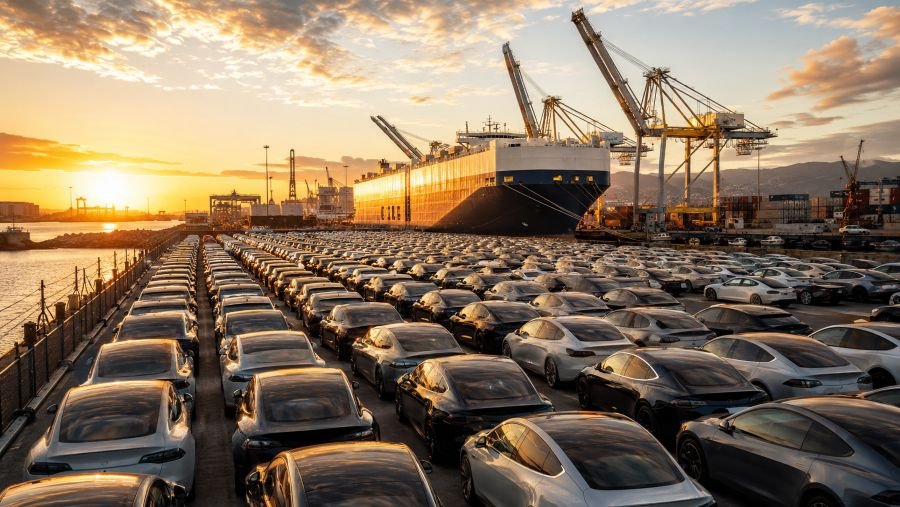
To understand why the question matters so much, start with the scale. China shipped roughly 445,000 finished vehicles to Mexico in 2024, making it the second-largest source of imported cars in the country by value, trailing only the United States itself. By late 2025, Mexico had become the single most popular export market on earth for Chinese electric vehicles. That volume created an obvious temptation: with so many Chinese cars already sitting on Mexican soil, surely some could continue north into the world’s most lucrative car market. The reality is far more complicated.
Before we dig into the trade rules, the short video below distills the core of the Mexico question — why Chinese automakers eyed the border, and why the so-called backdoor for importing Chinese cars into the USA has effectively closed. Watch it first, then read on for the full breakdown of tariffs, USMCA rules of origin, and the connected-vehicle ban.
As the video makes clear, the idea of routing Chinese cars through Mexico runs into far more than a single tariff. To see exactly how the door was sealed, it helps to start with the theory that made it look so promising in the first place.
The Theory: Why Mexico Looked Like the Perfect Backdoor
The logic behind the Mexico strategy rests entirely on one trade agreement: the United States-Mexico-Canada Agreement, or USMCA. Under its rules of origin, a vehicle assembled in Mexico can cross into the United States with zero tariff — but only if it meets demanding local-content thresholds, generally around 75% North American value content for passenger cars, alongside steel, aluminum and labor-value requirements. Clear those hurdles, and a “made in Mexico” badge becomes a passport into America.
This is precisely the calculation that drew Chinese manufacturers to consider Mexican factories in the first place. The country offered low labor costs, an established automotive supply base, deep-water ports, and that all-important duty-free access to North America. For a Chinese carmaker locked out of the US by punitive tariffs, building inside the USMCA bloc looked like the cleanest possible workaround. Nearshoring was the buzzword, and Mexico was supposed to be the bridge.
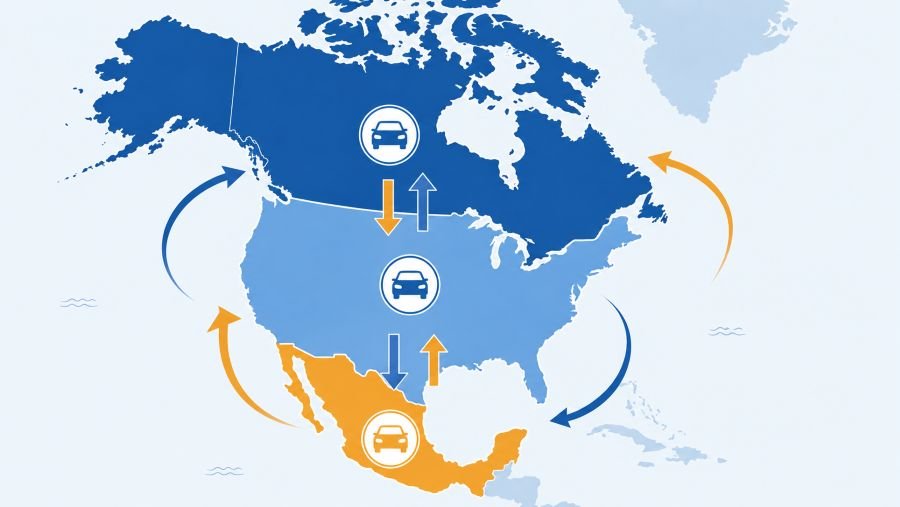
Yet the theory contained a fatal flaw from the very beginning. The architects of USMCA, and the US policymakers who have since reinforced it, anticipated exactly this maneuver. The agreement was never designed simply to reward assembly inside North America; it was designed to reward genuine North American manufacturing. A Chinese car shipped to Mexico in kit form and bolted together near the border would not magically satisfy a 75% regional-content rule. And as the political climate hardened, Washington added entirely new walls that have nothing to do with where a car is built.
The Reality Check: Three Walls Standing in the Way
The Mexico backdoor has not been closed by accident or by a single policy. Instead, three distinct barriers now overlap, and any one of them alone would be enough to stop most Chinese passenger vehicles. Together, they form a near-impenetrable wall.
Wall One: The Connected Vehicle Ban
This is the barrier most people overlook, and arguably the most decisive. In early 2025, the US Commerce Department finalized a sweeping rule prohibiting the import and sale of connected-vehicle hardware and software with meaningful ties to China or Russia. The rule took effect in March 2025, with software restrictions phasing in for the 2027 model year and hardware restrictions for 2029. Officials framed it as a national-security measure, arguing that modern cars are effectively rolling computers packed with cameras, microphones and constant internet connectivity.
Crucially for the Mexico question, the rule does not only target where parts come from. It explicitly bars manufacturers that are owned by or subject to the control of China from selling connected vehicles in the United States — even when those vehicles are assembled inside the US or Mexico. In other words, a Chinese automaker cannot escape the ban simply by relocating its assembly line south of the border. The moment a Chinese-controlled brand tries to sell a connected car to American consumers, the rule applies regardless of the factory’s address.
Because virtually every modern electric vehicle is, by definition, a connected vehicle, this single rule removes most of China’s automotive lineup from the American market in one stroke. Notably, the regulation carves out heavier vehicles above 10,000 pounds, which is why a Chinese firm has been able to continue assembling electric buses in California — but that exemption does nothing for ordinary passenger cars.
Wall Two: USMCA Rules of Origin and Circumvention Probes
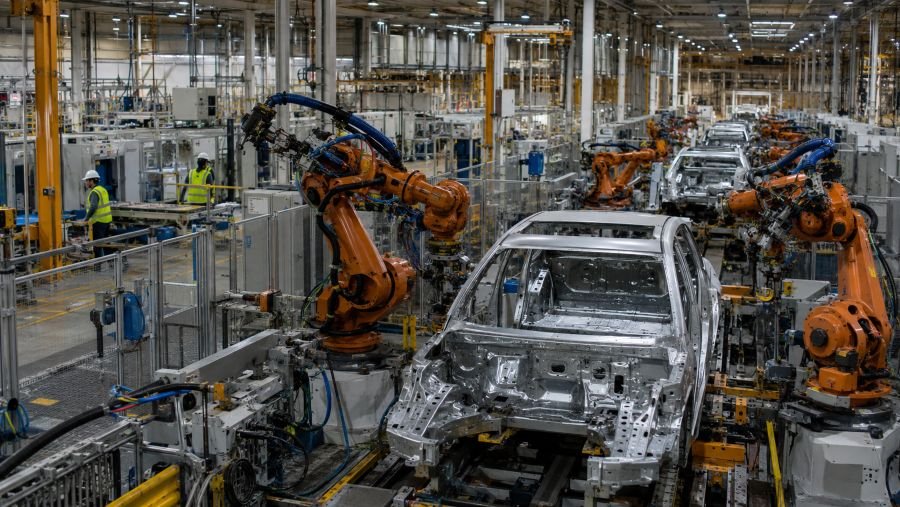
Even setting the connectivity rule aside, the trade-content barrier remains formidable. To benefit from USMCA’s duty-free treatment, a vehicle must demonstrate substantial transformation inside North America and meet the regional value-content thresholds. A car largely built from Chinese components and merely finished in Mexico would fail that test and face tariffs anyway.
Higher US tariffs on Chinese goods have created a powerful incentive to route products through Mexico and Canada, and trade officials are acutely aware of it. As a result, anti-circumvention scrutiny has intensified across North America. Companies are increasingly required to document genuine local sourcing and prove their supply chains, and Chinese-linked production faces particularly close inspection ahead of the 2026 USMCA review. The era of quietly slipping Chinese content through a Mexican label is closing fast.
Wall Three: Mexico’s Own 50% Tariff Wall
The final, and perhaps most surprising, barrier was erected by Mexico itself. On January 1, 2026, Mexico imposed sweeping new tariffs of up to 50% on cars and roughly 1,463 categories of goods imported from countries it has no free-trade agreement with — a list squarely aimed at China. That 50% figure is no coincidence: it represents the maximum passenger-car tariff Mexico is permitted to charge under World Trade Organization rules.
The effect was immediate and dramatic. Chinese-made car imports into Mexico fell about 45% year-on-year in January 2026, dropping to roughly 188 million US dollars, and plunged more than 80% compared with the November 2025 peak when importers had rushed to beat the deadline. By aligning its trade posture with Washington and Ottawa ahead of the USMCA review, Mexico signaled that it has no intention of serving as China’s launchpad into North America. The supposed bridge has, in effect, decided to raise its own drawbridge.
💡 Pro Tip: When you read headlines claiming Chinese cars are “flooding” into Mexico, remember the distinction between imports and sales. Even as imports collapsed under the new tariff in early 2026, showroom sales of Chinese brands kept climbing — because dealers were selling down inventory shipped in before the deadline. The two figures tell very different stories about the road ahead.
The BYD Mexico Plant Saga: A Cautionary Tale
No story illustrates the collapse of the Mexico backdoor better than BYD’s. In 2023, the Chinese EV giant announced plans for an ambitious 150,000-unit factory in Mexico, hailed at the time as the perfect embodiment of nearshoring. The expectation, at least among outside observers, was that such a plant could eventually feed the North American market. BYD itself was always more cautious publicly, insisting its focus was the domestic Mexican market rather than US exports.
The project never advanced past the theoretical stage. By early 2025, reports emerged that China’s own Ministry of Commerce was hesitating to approve the venture, reportedly worried that a factory so close to the United States could expose BYD’s battery and software technology to leakage or even reverse-engineering across the border. Beijing was said to be steering its automakers toward Belt and Road partner countries such as Brazil, Hungary and Thailand instead.
Then, in July 2025, BYD indefinitely shelved the Mexican plant. A senior executive cited “geopolitical issues” reshaping the entire automotive industry, adding that the company wanted more clarity before committing. The immediate trigger was the wave of US tariffs that had erased the export logic underpinning the project. Tellingly, around the same time BYD pressed ahead with a passenger-vehicle plant in Brazil, which began operations in mid-2025 — a clear sign of where China’s automotive capital is actually flowing.
By late 2025, BYD was once again hinting it might revisit a Mexican facility, with an official announcement possibly coming around the start of 2026. But even that revived interest was framed entirely around serving Mexican buyers, not exporting to the United States. The lesson is unambiguous: the people who would actually have to build the backdoor have concluded it leads nowhere worth going.
The One Door That Is Actually Open
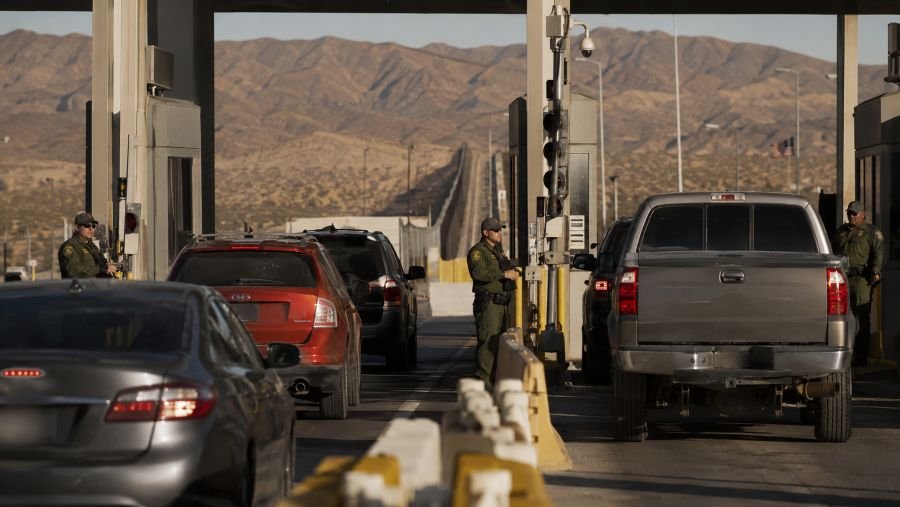
Despite all of this, sharp-eyed observers in California and Texas have spotted Chinese-made electric vehicles driving legally on American roads. How? Through a narrow personal-import provision in US customs law that allows non-US residents to drive their own foreign-registered vehicles across the border for temporary, personal use. A Mexican resident who buys a Chinese EV in Mexico can drive that car into the United States for a visit, just as any tourist might bring their own vehicle.
This is not a commercial channel, and it is essential not to confuse it with one. No dealer is importing these cars, no warranty network supports them, and they cannot be sold or registered to American buyers. The phenomenon is a curiosity — a reminder that individuals and corporations operate under entirely different rules — rather than a viable business model. For Chinese automakers eyeing the US market at scale, this “loophole” offers nothing.
US vs Mexico vs Canada: A Policy Comparison
To see the full picture, it helps to compare how each member of the North American bloc currently treats Chinese vehicles. The contrast is striking, and it explains why the regional door is closing rather than opening.
| Country | Tariff on Chinese Cars | Additional Barriers |
|---|---|---|
| United States | 100% on Chinese EVs; 25% on vehicles failing North American content rules | Connected-vehicle ban blocking China-controlled brands and Chinese software/hardware |
| Mexico | Up to 50% on cars from non-FTA countries (effective Jan 1, 2026) | Imports fell roughly 45% year-on-year within the first month of the new tariff |
| Canada | Reduced to 6.1% under a 2026 deal, capped at ~49,000 EVs per year | Replaced a previous 100% surtax; tied to a broader trade agreement with Beijing |
Canada’s recent pivot is the most interesting outlier. Rather than slam the door entirely, Ottawa negotiated a managed-access arrangement in early 2026, allowing a capped number of Chinese-built EVs in at a low tariff in exchange for relief on its own exports such as canola and seafood. But a controlled quota into Canada is a world apart from open access into the much larger US market, and Canadian-landed Chinese cars still face the same US connectivity rule if anyone tried to move them south.
⚠️ Important Note: Trade policy in this space is changing month to month. Tariff rates, quota arrangements and the outcome of the 2026 USMCA review could all shift the landscape quickly. Treat the figures here as a snapshot of mid-2026 conditions, and always verify the latest rules before making any cross-border purchasing or business decision.
What This Means for the 2026 USMCA Review
The single most important date on the horizon is the 2026 review of USMCA. Every actor in this drama — Washington, Mexico City, Ottawa and Beijing — is positioning ahead of it. Mexico’s new tariffs are widely read as a goodwill gesture to its northern partners, designed to prove that it will not become a conduit for circumventing US trade policy. Expect rules of origin to be tightened further, with even closer scrutiny of Chinese content embedded in “North American” vehicles.
For Chinese automakers, the strategic conclusion is becoming clear. Rather than chase the closing North American door, they are doubling down on markets where they are genuinely welcome: Latin America beyond Mexico, Southeast Asia, the Middle East, parts of Europe under negotiated terms, and Belt and Road partner nations. The center of gravity for Chinese auto exports is shifting decisively away from the United States, not toward it.
So could Chinese cars enter the US through Mexico? In theory, the geography and the trade agreement once made it conceivable. In practice, as of 2026, the answer is a firm no for any meaningful commercial volume. Three reinforcing walls — the connected-vehicle ban, USMCA rules of origin, and Mexico’s own steep tariffs — have turned the supposed backdoor into a dead end. The only Chinese cars crossing that border legally are personal vehicles driven by their owners, one at a time, going home after a visit.
FAQ: Chinese Cars, Mexico and the US Market
Can Chinese cars legally be sold in the United States today?
New passenger vehicles from Chinese-owned brands are effectively blocked. A 100% US tariff on Chinese electric vehicles, combined with a national-security rule banning Chinese connected-vehicle software and hardware, makes it commercially unworkable to sell Chinese-branded cars to American consumers — even if those cars were assembled outside China. The barriers are practical as much as financial.
Would a Chinese car built in a Mexican factory avoid US tariffs?
Not automatically. To enter the US duty-free under USMCA, a vehicle must satisfy strict rules of origin, including roughly 75% North American content. Even if a Mexico-built car cleared that bar, the US connected-vehicle rule separately prohibits China-controlled manufacturers from selling connected vehicles in the US, regardless of where they are assembled. Two independent obstacles must both be overcome.
What is the connected vehicle rule and why does it matter so much?
It is a US Commerce Department rule, in force since 2025, that prohibits importing or selling connected-vehicle hardware and software linked to China or Russia. Software restrictions phase in with the 2027 model year and hardware with 2029. Because it also blocks Chinese-controlled carmakers outright, it closes the Mexico assembly route for virtually all modern connected cars in a single move.
Why did BYD shelve its planned Mexico plant?
BYD announced a large Mexican EV plant in 2023 but indefinitely suspended it in July 2025, citing geopolitical pressures. Reports indicated that China’s own commerce ministry was reluctant to approve a factory so close to the US over fears of technology leaking across the border, while US tariffs erased the export rationale. BYD has since focused its new capacity on Brazil and other markets.
The Bottom Line
The notion of Chinese cars sneaking into America through Mexico makes for a compelling headline, but it does not survive contact with the actual rules. What looked like an open side door has been sealed by overlapping US, Mexican and even Chinese policy decisions, each pointing in the same direction. For now, the most realistic way most Americans will experience a Chinese car is by traveling abroad — not by buying one at home. As the 2026 USMCA review unfolds, that balance is far more likely to tighten than to loosen, and the smart money in China is already building its factories elsewhere.