BYD Shark vs Ford Maverick: Could a Chinese Plug-in Hybrid Truck Work in the US?
America loves pickup trucks, and America is finally warming up to electrified ones. The Ford Maverick hybrid has become one of the biggest surprise hits of the decade — an affordable, fuel-sipping compact truck that regularly sells out. Meanwhile, just across the southern border in Mexico, BYD is selling the Shark: a 430-horsepower plug-in hybrid mid-size pickup that American reviewers who have driven it describe as genuinely impressive.
So the question writes itself. If the BYD Shark could legally land in US showrooms tomorrow, how would it stack up against the Ford Maverick — and would American buyers actually choose it? In this comparison, we break down the powertrains, performance, towing, technology, pricing, and the very real political and regulatory walls standing between the Shark and the American driveway.
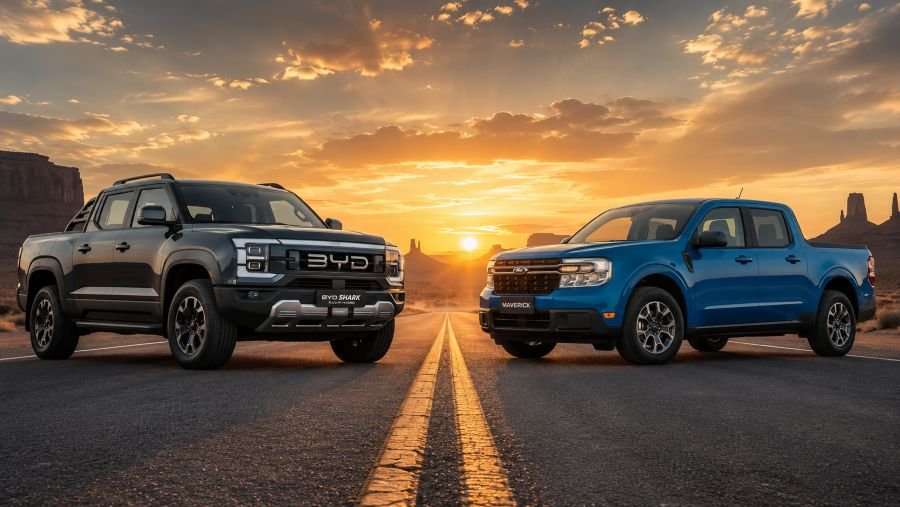
On paper, this matchup looks lopsided in ways that flip depending on which column you read first. The Maverick is smaller, cheaper, and available at thousands of Ford dealers nationwide. The Shark is bigger, far more powerful, packed with technology, and completely absent from the US market. Yet both trucks attack the same fundamental idea: that a pickup can electrify without losing its usefulness. Understanding how each one executes that idea tells us a great deal about where the global truck market is heading — and about how much pressure American manufacturers may soon face.
Two Philosophies: How the BYD Shark and Ford Maverick Approach Electrification
The Ford Maverick takes the conservative path. Ford’s compact truck is built on a unibody platform shared with the Escape crossover, and its standard powertrain is a 2.5-liter full hybrid paired with a power-split electronic CVT. There is no plug, no charging cable, and no electric-only commuting. The battery is tiny, recharged purely by the engine and regenerative braking, and its job is simple: cut fuel consumption to an EPA-estimated 42 mpg in the city. For a truck — any truck — that figure remains remarkable, and it is the single biggest reason the Maverick became a phenomenon.
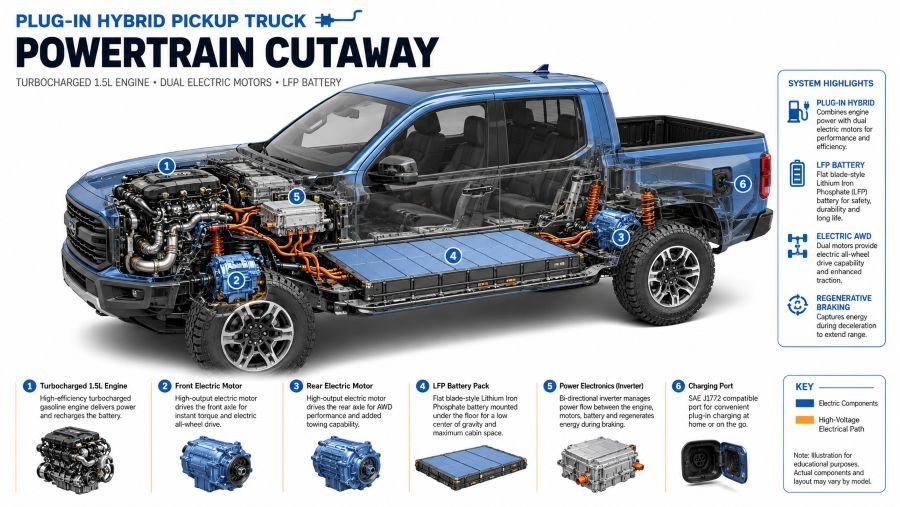
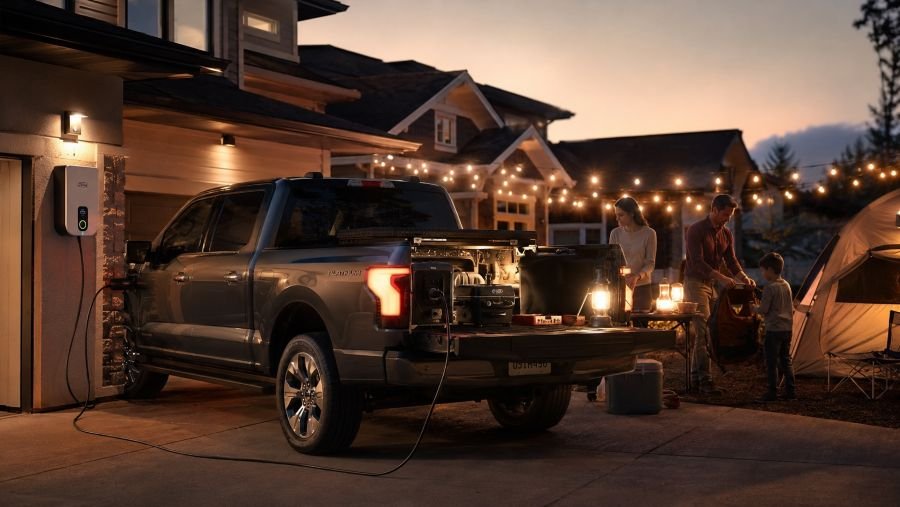
The BYD Shark takes the maximalist path. Built on BYD’s DMO (Dual Mode Off-road) super hybrid platform with a proper body-on-frame chassis, the Shark pairs a 1.5-liter turbocharged petrol engine with two electric motors — one on each axle — fed by a 29.58 kWh Blade LFP battery. Combined output reaches around 321 kW (430 hp), with roughly 650 Nm of torque, and the truck sprints from 0 to 100 km/h (62 mph) in about 5.7 seconds. Crucially, the Shark is a true plug-in hybrid: it delivers approximately 85-100 km (53-62 miles) of electric-only range, supports DC fast charging at up to 55 kW, and even offers vehicle-to-load (V2L) output at 6.6 kW — enough to run power tools, a campsite, or emergency home appliances from the truck bed.
In other words, the Maverick electrifies to save fuel. The Shark electrifies to dominate. These are not just different specifications; they are different visions of what an electrified pickup should be.
Why the Shark’s DMO Platform Matters
- Engine as generator first: in most driving, the 1.5L turbo engine acts primarily as a generator feeding the motors, which means instant electric torque delivery and near-silent cruising around town.
- True dual-motor AWD: with a 170 kW motor up front and a 150 kW motor at the rear, the Shark has permanent electric all-wheel drive with no driveshaft connecting the axles — torque is managed in milliseconds by software.
- Blade Battery durability: the LFP chemistry of BYD’s Blade pack is known for thermal stability and long cycle life, an important consideration for a work vehicle expected to charge daily for a decade.
Must-Have Pickup Truck Accessories for Daily Use
Whether you drive a compact hybrid like the Maverick or dream about a plug-in monster like the Shark, a couple of well-chosen accessories transform how useful a truck bed actually is on a daily basis. These two consistently rank among the most practical upgrades American pickup owners make first.
Heavy-Duty Truck Bed Cargo Net with Hooks
An adjustable heavy-duty cargo net keeps groceries, tool boxes, and loose gear from sliding around the bed under acceleration — especially relevant in quick electrified trucks where instant torque can send unsecured cargo flying. Fits compact and mid-size beds alike.
Check Price on AmazonWaterproof Truck Bed Tool Box Organizer
A lockable, weather-sealed bed organizer adds the secure storage that compact trucks like the Maverick lack from the factory. Keep straps, jumper cables, and recovery gear dry, organized, and out of sight without sacrificing usable bed space.
Check Price on AmazonAs an Amazon Associate, we earn from qualifying purchases at no extra cost to you.
BYD Shark vs Ford Maverick: Full Specifications Compared
Numbers settle arguments, so let’s put both trucks side by side. Keep in mind that the Shark figures below reflect the versions sold in Mexico, Australia, and other export markets, while the Maverick figures are official US specifications for the 2026 model year.
| Specification | BYD Shark (Shark 6) | Ford Maverick Hybrid (2026) |
|---|---|---|
| Segment | Mid-size pickup (body-on-frame) | Compact pickup (unibody) |
| Powertrain | 1.5L turbo PHEV + dual electric motors | 2.5L full hybrid (no plug) |
| Combined Power | ~321 kW (430 hp) | ~191 hp (250 hp EcoBoost optional) |
| 0–62 mph (0–100 km/h) | ~5.7 seconds | ~7.7–8.5 seconds (est.) |
| Electric-Only Range | ~53–62 miles (85–100 km) | None (self-charging hybrid) |
| Battery | 29.58 kWh Blade LFP | ~1.1 kWh NiMH/Li-ion buffer |
| Drivetrain | Dual-motor electric AWD | FWD standard, AWD optional |
| Length | 5,457 mm (214.8 in) | ~5,072 mm (199.7 in) |
| Towing Capacity | ~2,500 kg (5,500 lbs) | 2,000 lbs std / 4,000 lbs with 4K Tow Pkg |
| V2L Power Export | 6.6 kW vehicle-to-load | 400W–2kW Pro Power onboard (availability varies) |
| Starting Price | ~$47,000–$53,400 equivalent (Mexico/Australia) | $28,145 MSRP (US, incl. destination) |
| US Availability | Not sold in the US | Nationwide |
Reading that table, the pattern is clear. The Shark wins almost every performance and capability metric — power, acceleration, electric range, towing, power export. The Maverick wins on price, footprint, and the only metric that ultimately matters for American buyers right now: you can actually buy one. The roughly $19,000–$25,000 gap between their starting prices is enormous, but it shrinks fast once you spec a Maverick Lariat AWD with the 4K Tow Package, where transaction prices climb toward $40,000 — territory where the Shark’s value proposition would suddenly look uncomfortable for Ford.
Daily Driving, Towing, and Real-World Usability
Specifications only tell half the story, so consider how each truck lives day to day. The Maverick is the easier truck to live with in dense American cities. At roughly 200 inches long, it slots into parking garages and parallel spots that frustrate full-size trucks, and its 40+ mpg city economy means many owners fill up twice a month. The FLEXBED, while only 4.5 feet long, is cleverly designed with slots for DIY dividers and a multi-position tailgate for hauling plywood. For the suburban homeowner who occasionally visits the lumber yard, it is close to a perfect tool.
The Shark plays a different game. American reviewers who tested a Mexican-market Shark in Texas came away surprised: the cabin is quiet and genuinely premium, rear-seat space rivals larger trucks, and the bed comes with a factory spray-in liner at no extra charge. The rotating 15.6-inch touchscreen, head-up display, and reclining rear seats read more like a luxury SUV than a work truck. Add 53-62 miles of silent electric commuting — enough to cover the average American daily drive without burning a drop of fuel — and the Shark looks less like a curiosity and more like a preview of where the segment is going.
Towing is where the comparison gets interesting rather than one-sided. The Shark’s roughly 5,500-lb rating comfortably beats the Maverick’s 4,000-lb maximum, but it trails diesel mid-size rivals like the Ford Ranger. Furthermore, like many PHEVs, the Shark’s performance under sustained heavy towing depends on battery charge; once the pack depletes, the 1.5L generator must work hard to keep up. The Maverick’s simpler hybrid system, by contrast, behaves predictably — modestly — at all times. Neither truck is the right tool for hauling a large boat over mountain passes, and both are honest about it.
💡 Pro Tip: If you’re evaluating any plug-in hybrid truck, calculate your daily round-trip mileage first. If it falls under the EV range (roughly 50-60 miles for the Shark), you would effectively drive an electric truck Monday through Friday and only use gasoline on road trips — which is exactly the use case where PHEVs crush both conventional hybrids and pure EVs on total cost.
Could the BYD Shark Actually Be Sold in the US?
Now to the heart of the question in this article’s title. Mechanically and commercially, the Shark is arguably ready for America today. It was unveiled in Mexico — deliberately next door to the world’s largest pickup market — has been reviewed favorably on American soil, and at a $47,000–$53,000 price point it would undercut comparably equipped electrified mid-size trucks. The obstacles are not engineering problems. They are political and regulatory ones, and they are formidable.
First, tariffs. The United States imposes steep duties on Chinese-built electrified vehicles — layered on top of the decades-old 25% “chicken tax” that applies to all imported light trucks. Stacked together, these duties would push the Shark’s effective US price far beyond what any rational buyer would pay, eliminating its core value advantage before it ever reached a showroom.
Second, software rules. US regulations targeting Chinese connected-vehicle hardware and software effectively prohibit modern Chinese cars — which are deeply software-defined — from being sold in America regardless of where they are assembled, unless the entire electronic architecture is re-engineered. For a truck whose appeal rests heavily on its intelligent powertrain management and connected cockpit, this is a structural barrier, not a paperwork issue.
Third, politics and perception. The very fact that the Shark is good strengthens the case domestic manufacturers make for protection. Industry observers have noted that the rush to raise barriers against Chinese vehicles is itself evidence of how competitive they have become. A localized manufacturing path — building Sharks in Mexico under regional trade rules, or eventually in the US itself — is the only realistic route, and even that path faces scrutiny under current trade policy. BYD has explored Mexican production, but a US-market green light remains nowhere in sight as of mid-2026.
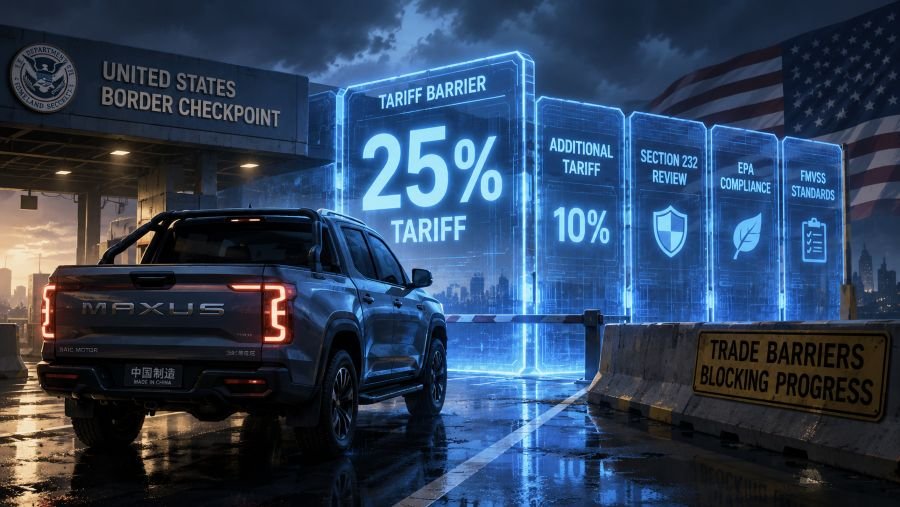
⚠️ Important Note: Some gray-market importers advertise Chinese vehicles to US buyers through third countries. These vehicles cannot be legally registered for road use in the United States, are not FMVSS-certified, carry no manufacturer warranty or parts support, and may be seized at the border. If you see a “US-ready BYD Shark” listing, treat it with extreme caution.
What the Shark’s Existence Means for the Ford Maverick — and American Trucks
Even if the Shark never sells a single unit in the United States, its existence is already shaping the American market in three ways. First, it raises the benchmark. When a Chinese brand demonstrates that a $50,000 truck can deliver 430 hp, 60 miles of EV range, exportable power, and luxury-grade cabin tech, every product planner in Dearborn and Detroit takes notes. The next generation of American electrified trucks will be measured — internally, if not publicly — against what BYD ships today.
Second, it pressures pricing. In markets where the Shark competes openly, such as Australia, it disrupted segments dominated by the Ford Ranger and Toyota Hilux within months, becoming one of BYD’s best sellers and forcing rivals to respond on price and equipment. American manufacturers watching that play out understand that tariff protection is a window, not a wall — a period in which to close the competitiveness gap before global market pressure inevitably finds another route in.
Third, it validates the PHEV truck formula itself. For years, the industry debated whether pickup buyers would accept plugs. The Shark’s success — alongside strong hybrid uptake in the Maverick and the F-150 — suggests the answer is yes, provided electrification adds capability rather than subtracting it. Expect plug-in hybrid versions of mainstream American trucks to multiply over the next few years, and remember that a Chinese mid-size pickup helped prove the demand was real.
Who Should Buy What (If Both Were Available)
- Choose the Ford Maverick if: you want the cheapest path into truck ownership, prioritize fuel economy and city-friendly size, and your hauling needs are light and occasional. It remains the best value pickup sold in America.
- You would choose the BYD Shark if: you want near-sports-car acceleration, genuine electric commuting, serious onboard power export for job sites or camping, and mid-size space — and you live in a market where it’s actually sold.
- Wait and watch if: you’re US-based and intrigued by the Shark. Domestic PHEV trucks inspired by exactly this formula are coming, and competition — even indirect competition — tends to benefit buyers.
FAQ: BYD Shark vs Ford Maverick
Can you buy a BYD Shark in the United States?
No. The BYD Shark is not officially sold in the US. Tariffs on Chinese-built vehicles, plus connected-vehicle software restrictions, currently keep BYD out of the American market. The closest place to see one is Mexico, where the Shark has been on sale since May 2024.
Is the BYD Shark more powerful than the Ford Maverick?
Yes, by a wide margin. The BYD Shark produces around 430 hp from its dual-motor plug-in hybrid system, while the Ford Maverick hybrid delivers roughly 191 hp and the optional 2.0L EcoBoost makes 250 hp. The Shark also offers about 53-62 miles of electric-only range, which the Maverick cannot match.
Which truck is cheaper, the BYD Shark or the Ford Maverick?
The Ford Maverick is cheaper, starting around $28,145 in the US. The BYD Shark sells for roughly $47,000-$53,000 equivalent in Mexico and Australia. However, the Shark offers nearly double the power, more electric capability, and a larger mid-size body for that price difference.
Why can’t Chinese trucks like the BYD Shark be sold in America?
A combination of steep tariffs on Chinese-built electrified vehicles, rules restricting Chinese connected-vehicle software and hardware, and the 25% “chicken tax” on imported trucks makes US sales commercially unviable for now. Local production would be required to change that equation.
Verdict: Could a Chinese Plug-in Hybrid Truck Work in the US?
The honest answer comes in two parts. Could the BYD Shark work for American buyers? Almost certainly yes. It offers the performance of a far more expensive truck, electric range that covers the typical American commute, power export features that genuinely change how a truck is used, and build quality that has impressed the American reviewers who managed to drive one. Against the Ford Maverick, it is not really a rival so much as a different class of machine — bigger, faster, more capable, and proportionally more expensive.
Could the BYD Shark work in the US market? Not today, and probably not for years. The combined weight of tariffs, the chicken tax, and connected-vehicle regulations forms a barrier that no spec sheet can climb. The Maverick, meanwhile, keeps doing exactly what it was designed to do: deliver honest, affordable, efficient truck utility to hundreds of thousands of Americans every year. Until policy changes or BYD builds trucks on North American soil under acceptable terms, the Shark will remain what it is right now — a tantalizing glimpse, parked just across the border, of how intense the competition would be if the door ever opened.