BYD Blade Battery Explained: Why It’s Safer
BYD’s Blade Battery represents a fundamental advance in electric vehicle safety, backed by independent testing that demonstrates measurably lower thermal-runaway risk than competing lithium-ion architectures. This is the complete technical breakdown of how it works and why it matters.
We cover the cell-to-pack architecture, the LFP chemistry behind its stability, the decisive nail-penetration evidence, a direct comparison with NMC, real-world safety data, and the honest trade-offs in range and cold-weather performance, so you can judge for yourself whether the safety story holds up.
For most of the past decade, the conversation about electric vehicle safety has focused on a single fear: battery fires. BYD’s Blade Battery was engineered specifically to answer that fear, and the evidence behind it is unusually clear. Below, we explain exactly how the technology works and where its real advantages and limitations lie.
Watch: Blade Battery Safety in 90 Seconds
Before the detailed breakdown, this short video shows the Blade Battery’s design and its behaviour in the nail penetration test, the single most decisive piece of safety evidence. It is the fastest way to see why the LFP cell-to-pack approach resists thermal runaway, and it pairs neatly with the technical explanation that follows.
📹 BYD Blade Battery Explained | LFP Safety & Nail Penetration Test | Video by Chinese Cars Asia
With the visual context in place, the sections below unpack the engineering: the architecture, the chemistry, the testing, and the trade-offs that every prospective BYD owner should understand before buying.
What Is the BYD Blade Battery?
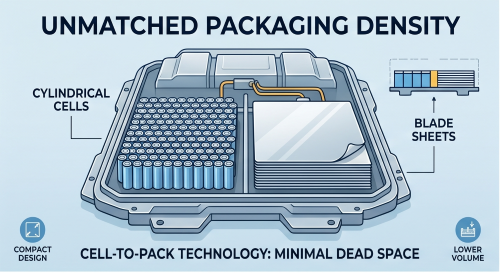
The BYD Blade Battery is not a new battery chemistry. It is a revolutionary cell-to-pack (CTP) architecture that combines long, flat lithium iron phosphate (LFP) cells directly into the battery pack, eliminating the traditional module layer that normally sits between individual cells and the overall pack structure. This seemingly simple design change delivers profound consequences for safety, energy density, and cost efficiency that have fundamentally altered the competitive landscape of electric vehicle technology.
Since its introduction in 2020, the Blade Battery has become the single most important competitive differentiator for BYD, used across its entire lineup from the budget-focused Dolphin hatchback to premium models like the Han, Tang, and Seal. Today, approximately 60 to 70 percent of BYD’s global EV production uses Blade Battery technology. The architecture has proven so successful that it has influenced battery design thinking across the entire industry, with competitors now investigating cell-to-pack approaches of their own in response.
The fundamental innovation is elegantly simple. Instead of assembling individual cells into modules, and then assembling modules into a pack, the Blade Battery places cells directly into the pack structure, where they themselves become structural elements of the overall system. This reduction in layers reduces wasted space, improves thermal management, increases structural rigidity, and, most importantly for this discussion, dramatically reduces the propagation speed of any thermal event within the battery.
The Cell-to-Pack Architecture: Engineering Elegance
Traditional lithium-ion battery packs follow a standardised hierarchy. Thousands of individual cells are first assembled into modules, complete with thermal-management material, busbars, and electrical connections between them. Those modules are then assembled into the larger pack, again with thermal management, structural supports, and a battery management system that monitors and controls everything. Each layer adds complexity, wiring, connectors, and thermal barriers that increase weight and reduce the proportion of the pack’s volume actually occupied by energy-storing cells.
The Blade Battery eliminates this intermediate module layer entirely. Long, flat cells, roughly 960mm long, are arranged directly within the pack structure and oriented to maximise both energy capacity and structural contribution. The cells themselves become the primary structural elements, with additional reinforcement added only where needed, and the spaces between cells are filled with engineered thermal-management material that conducts heat efficiently away from any cell experiencing an unusual temperature rise.
This architectural simplicity delivers measurable benefits across multiple dimensions. It increases energy density within the same physical space, because eliminating the module structure removes wasted volume. It reduces weight by removing redundant structural elements, cooling hardware, and connectors. It simplifies manufacturing, cutting the number of assembly steps and potential failure points. And, most critically here, it creates a structural configuration in which any thermal event inside one cell is isolated and prevented from cascading rapidly to its neighbours.
Why LFP Chemistry Matters for Safety
The Blade Battery uses lithium iron phosphate (LFP) chemistry rather than nickel-manganese-cobalt (NMC), and this choice is as important as the architecture itself. LFP and NMC are fundamentally different materials with profoundly different thermal and electrochemical characteristics, and understanding the difference is essential to understanding the Blade Battery’s safety credentials.
LFP cells operate with a significantly higher thermal-stability threshold than NMC. If an NMC cell experiences an internal short circuit, whether from a manufacturing defect, mechanical damage, or dendrite formation, it can enter thermal runaway within seconds, reaching temperatures above 200°C almost immediately, after which the process accelerates exponentially. An LFP cell undergoing the same short circuit enters thermal runaway more slowly, reaches lower peak temperatures of around 150 to 170°C, and the process can be interrupted by active thermal management before it becomes catastrophic.
This is not marketing language but measurable, reproducible electrochemistry demonstrated thousands of times across the industry. The iron-phosphate cathode releases less oxygen during thermal decomposition, which means less fuel to sustain a fire, and its structural bonding is stronger, so the cell holds together longer before failing. The result is a chemistry that, while not literally fireproof, is dramatically more resistant to the runaway thermal cascades that characterise NMC battery fires. The trade-off is lower energy density, which is why LFP vehicles typically have slightly shorter range for a given pack size.
The Nail Penetration Test: The Most Decisive Evidence
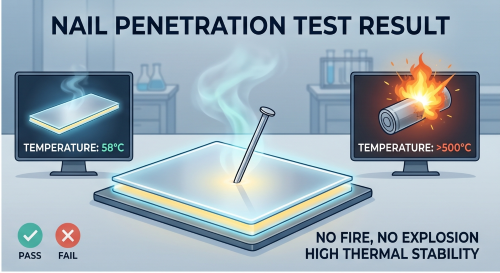
The most vivid demonstration of the Blade Battery’s safety advantage comes from the nail penetration test, one of the most severe battery safety assessments in existence. In this test, a steel nail is driven directly through the centre of a fully charged cell, creating an internal short circuit that forces immediate and severe thermal stress on the cell structure and chemistry.
When a traditional NMC pouch cell undergoes this test, the result is rapid and unambiguous. The cell enters thermal runaway within seconds, reaching temperatures that ignite the electrolyte, producing visible flames and a significant risk of explosion. When a Blade Battery LFP cell undergoes the identical test, the outcome is strikingly different. The nail penetrates cleanly, the internal temperature rises gradually rather than violently, and the cell does not ignite. No flame emerges, and the cell structure remains intact even though the short circuit has destroyed it as an energy-storage device.
BYD conducted this test publicly and released high-quality video evidence showing the contrast between a Blade cell and a conventional NMC pouch cell undergoing identical penetration. The footage is compelling precisely because it removes all abstraction: viewers watch a nail pierce each cell and then see the catastrophic consequence in the NMC case versus the controlled, non-ignition outcome in the Blade case. That visual evidence, combined with reproducible physical testing data, forms the core of the safety argument.
Thermal Stability and Runaway Prevention
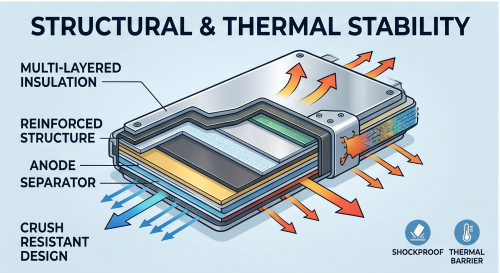
Beyond the single-cell response to the nail test, the cell-to-pack architecture contributes additional thermal benefits that prevent events from cascading across the whole pack. In a traditional module-based structure, when one cell enters thermal runaway the heat propagates to adjacent cells very quickly, because the cells are tightly packed in a confined space where heat accumulates rapidly. Neighbouring cells can reach their own runaway threshold within seconds of the first failure.
In the Blade Battery, cells are separated by engineered thermal-management material specifically designed to conduct heat away from a problem cell and distribute it across a larger volume, preventing local temperature concentrations. The pack structure effectively functions as a heat sink, dissipating energy from any local event before another cell can reach a critical temperature. Because the cells communicate directly with the central battery management system rather than through module-level intermediaries, anomalies are also detected sooner, allowing the system to activate cooling, adjust charging rates, or isolate an affected cell faster.
Blade Battery vs NMC: A Direct Comparison
To put the safety advantage in context, here is how Blade Battery LFP and traditional NMC compare across the dimensions that matter most to electric vehicle owners.
| Characteristic | BYD Blade (LFP) | Traditional NMC |
|---|---|---|
| Thermal runaway temperature | ~150–170°C (slower) | ~200°C+ (rapid) |
| Nail penetration result | No fire or explosion | Immediate ignition |
| Oxygen release in decomposition | Lower (safer) | Higher (more fuel for fire) |
| Heat propagation to adjacent cells | Slow (CTP limits spread) | Rapid (module concentrates heat) |
| Energy density (Wh/kg) | 140–160 (lower) | 200–220 (higher) |
| Real-world range (equal pack) | ~10–15% shorter | ~10–15% longer |
| Cold-weather performance | Reduced in extreme cold | Better in cold |
| Cost per kWh | Lower (manufacturing advantage) | Higher |
| Cycle life | Longer (2,000+ cycles) | Shorter (1,000–1,500 cycles) |
The comparison reveals a clear trade-off. The Blade Battery sacrifices some energy density and cold-weather range in exchange for dramatically superior safety, longer cycle life, and lower manufacturing cost. For most buyers, particularly those in temperate climates who are not regularly pushing range to its limit, that trade-off strongly favours LFP.
Real-World Safety in Production Vehicles
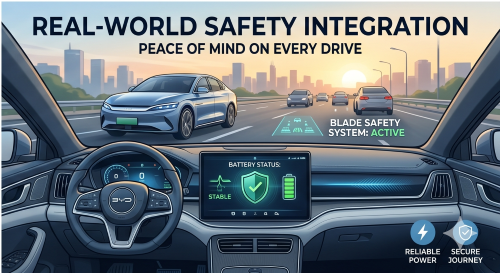
Independent lab testing and the nail penetration test provide compelling evidence of the architecture, but real-world data is the ultimate proof. Across roughly five years of production and millions of Blade Battery vehicles now in use globally, there has been no widely recorded case of a Blade cell experiencing thermal runaway in a production vehicle. That is not a coincidence; it reflects the genuine engineering advantage that the LFP chemistry and cell-to-pack design provide.
By contrast, NMC battery fires, while statistically rare, occur often enough to generate regular headlines, appearing in real-world accidents, manufacturing defects, and thermal events across numerous manufacturers. The absolute risk remains low, but it is measurably higher than for Blade Battery vehicles, which in practice have proven exceptionally resistant to such events.
💡 Data insight: Electric vehicles already have around 79% fewer drivetrain components than petrol cars, which removes many potential failure points. Layer the Blade Battery’s LFP stability on top of that, and BYD’s EVs sit among the lowest-risk options on the market for battery-related safety.
Trade-offs: What You Give Up
The Blade Battery’s safety advantage comes with real trade-offs worth acknowledging honestly. The lower energy density of LFP means vehicles typically have 10 to 15 percent shorter range for an equivalent pack size; BYD compensates mainly by fitting larger packs as standard, which adds cost. Cold-weather performance is another meaningful factor, as LFP loses more range in subfreezing temperatures than NMC, which matters most in northern climates and deep winter.
Charging performance is also slightly affected. LFP cells charge most efficiently at lower currents, which is why Blade Battery vehicles typically peak at around 88 to 110 kW DC fast charging rather than the 150 kW or more available on some NMC vehicles. In practice this adds a handful of minutes to a realistic motorway charging stop. These trade-offs are real and explain why not every manufacturer has switched to LFP, but for the majority of buyers in most climates the safety benefit clearly outweighs them.
⚠️ Important note: If you live in a consistently cold region or routinely drive long distances at the edge of the car’s rated range, factor in the larger winter range loss of LFP before assuming the official WLTP figure. Choosing a higher-capacity Blade pack is the simplest way to offset this without giving up the safety advantage.
Essential Accessories for Your BYD EV
If this deep dive has you considering a Blade Battery model such as the BYD Dolphin, Atto 3, or Seal, a few well-chosen accessories will make ownership smoother, from tidier home charging to interior protection that helps preserve resale value. The items below are the ones our team considers genuinely worthwhile rather than padding the list with gimmicks.
A dual-channel dash cam with a Sony STARVIS sensor and parking mode protects your investment whether you are driving or parked at a charging station. Aim for 4K front / 2K rear with built-in Wi-Fi for easy footage review — increasingly expected by insurers, and a sound safeguard for a high-value BYD like the Seal or Atto 3.
Model-tailored, all-weather TPE floor mats and a boot liner are the single best way to protect interior carpets and preserve resale value — especially relevant for the premium cabins of the BYD Dolphin, Atto 3, and Seal. Always search your exact model and year to guarantee a precise, no-slip fit.
EVs are heavy, and correct tyre pressure directly affects real-world range and efficiency — a critical factor when WLTP figures already differ from everyday driving. A rechargeable digital inflator with a preset auto-stop keeps pressures optimal and quickly pays for itself in saved range and longer tyre life.
A waterproof, fire-retardant carry bag keeps your Type 2 cable clean and contained in the boot — no more grimy hands or a dirty load space after every charge. A small, inexpensive accessory that solves a daily annoyance every EV owner eventually faces.
Even with the large rotating screens BYD fits, a dedicated MagSafe-compatible mount with wireless charging keeps your phone visible and topped up without cluttering the minimalist dashboards of the Dolphin, Atto 3, and Seal. Vent or air-outlet versions fit most interiors cleanly.
Every BYD EV charges over the Type 2 (IEC 62196) standard for AC charging across UK and European networks. A TÜV-certified 32A / 22kW cable future-proofs your setup, reaches awkward public chargers, and works with home wallboxes and untethered street posts alike. A 5-metre length suits most driveways and bays.
FAQ: BYD Blade Battery
What is the BYD Blade Battery?
The BYD Blade Battery is a cell-to-pack architecture that places long, flat LFP cells directly into the pack structure, removing the traditional module layer. This improves energy density within the same space, increases rigidity, and dramatically slows the spread of any thermal event between cells.
Is the Blade Battery safer than normal lithium-ion batteries?
Yes. Its LFP chemistry has a higher thermal-stability threshold than NMC, reaches lower peak temperatures of around 150–170°C, and releases less oxygen during decomposition. In nail penetration testing, Blade cells do not ignite, while comparable NMC cells reliably catch fire under identical conditions.
What is the nail penetration test?
It drives a steel nail through a fully charged cell to force a severe internal short circuit. A conventional NMC cell ignites within seconds, whereas a Blade Battery LFP cell’s temperature rises gradually but it does not catch fire or explode, demonstrating the chemistry’s safety advantage.
What are the downsides of the LFP Blade Battery?
The main trade-offs are lower energy density (roughly 10–15% less range for the same pack size), greater range loss in very cold weather, and slightly slower DC fast charging of around 88–110 kW. For most drivers in temperate climates, the safety and cycle-life advantages outweigh these drawbacks.
Which BYD cars use the Blade Battery?
Blade Battery technology spans most of BYD’s lineup, from the budget Dolphin to the Atto 3 SUV, the Seal saloon, and premium models such as the Han and Tang. Around 60–70% of BYD’s global EV production uses it.
How long does the Blade Battery last?
LFP cells typically deliver 2,000-plus charge cycles, well beyond the 1,000–1,500 common with NMC. BYD backs most Blade Battery vehicles with an 8-year battery warranty, reflecting confidence in long-term durability.
Final Verdict: The Safety Advantage Is Genuine
After examining the chemistry, the architecture, the independent testing, and the real-world record, the conclusion is clear: BYD’s Blade Battery represents a genuine and significant advance in electric vehicle safety. The combination of LFP chemistry and cell-to-pack architecture creates a system that is measurably, reproducibly, and verifiably more resistant to thermal runaway than the NMC architectures used by most other manufacturers.
That advantage does come with real trade-offs in range, cold-weather performance, and peak charging speed, which is precisely why not every manufacturer has switched to LFP. But for most buyers in most conditions, the safety benefit significantly outweighs the practical disadvantages. If battery safety is your primary concern, a Blade Battery BYD is among the lowest-risk options currently available, not through marketing claims but through reproducible evidence and a strong real-world track record.