Xpeng G6 vs Tesla Model Y: Complete SUV Showdown
The electric SUV market has become fiercely competitive. Two vehicles now represent very different sides of that competition: the Xpeng G6, a technology-rich Chinese electric SUV built around value, comfort, and smart driving systems, and the Tesla Model Y, the global EV benchmark with unmatched brand recognition, rapid performance, and one of the strongest charging ecosystems in the world.
This detailed Xpeng G6 vs Tesla Model Y comparison examines design, interior comfort, performance, range, charging, autonomous driving features, pricing, reliability, safety, and real-world ownership. The goal is simple: to help buyers understand which electric SUV offers the better overall package in 2026.
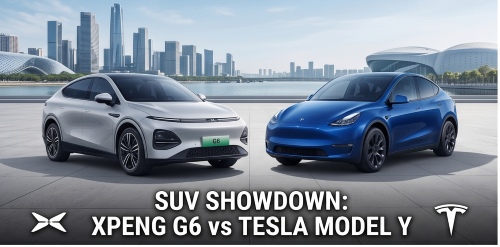
Xpeng G6 vs Tesla Model Y: Design and Exterior
Both vehicles look modern, but they communicate different design philosophies. The Tesla Model Y follows Tesla’s familiar minimalist approach. It has a clean body, simple lighting, smooth surfacing, and a shape that prioritizes aerodynamic efficiency over dramatic styling. It is instantly recognizable, but some buyers may find it too familiar because so many Model Y vehicles are now on European roads.
The Xpeng G6 takes a more expressive approach. Its coupe-SUV roofline, sharper lighting signature, and more sculpted body give it a stronger visual personality. It looks more like a challenger trying to make a statement, while the Model Y feels like the established benchmark. Buyers who want subtle design may prefer Tesla; buyers who want something newer and less common may prefer Xpeng.
Build quality is competitive in both vehicles. Tesla has improved manufacturing consistency over time, while Xpeng has made strong progress in material finish, paint quality, and panel alignment. Neither vehicle feels cheap, but the Model Y benefits from a longer global production history.
Interior Experience and Comfort
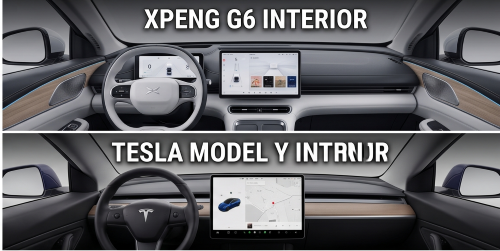
The Tesla Model Y interior is famous for extreme minimalism. A single central display controls almost everything, including climate settings, drive information, entertainment, navigation, and vehicle functions. This creates a clean cabin, but it also means drivers must interact with the touchscreen frequently.
The Xpeng G6 interior feels more conventional and more comfort-focused. It still uses a large central display and a digital-first layout, but the cabin has more visual layering, softer design details, and a stronger sense of separation between driver, passenger, and infotainment zones. For some buyers, the Xpeng cabin feels warmer and more premium.
Rear-seat comfort is one of the G6’s strongest advantages. The Xpeng generally feels spacious, with good legroom and a relaxed seating position. The Model Y is also practical and has excellent cargo space, especially with its front trunk and large rear load area, but its cabin feels more functional than luxurious.
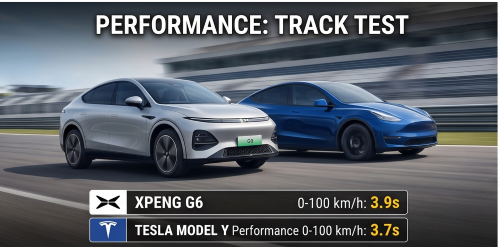
Performance Comparison: Which SUV Is Faster?
Performance is one of Tesla’s traditional strengths. The Tesla Model Y Performance delivers very quick acceleration and remains one of the fastest family SUVs in its price range. Even non-performance versions feel responsive because electric torque arrives instantly.
The Xpeng G6 is also quick, especially in dual-motor versions. It may not always match the Model Y Performance in pure acceleration, but it delivers more than enough speed for daily driving, overtaking, motorway use, and confident family transport. For most drivers, the difference between very quick and extremely quick will matter less than comfort, range, and charging access.
Handling slightly favors the Tesla. The Model Y feels stable, direct, and confidence-inspiring in corners. The Xpeng G6 is composed and comfortable, but its tuning leans more toward refinement than sportiness. If you enjoy sharp steering and rapid acceleration, the Model Y has an edge. If you prefer relaxed daily driving, the G6 is highly competitive.
Technology and Autonomous Driving
Technology is where the comparison becomes especially interesting. Tesla’s Autopilot and Full Self-Driving package remain among the most discussed driver-assistance systems in the world. Tesla’s system benefits from massive data collection, frequent software updates, and a clear identity as a software-led EV company.
Xpeng’s driver-assistance technology is also highly ambitious. Depending on market and specification, XPilot and XNGP-related systems may use advanced camera, radar, ultrasonic, and LiDAR hardware. Xpeng’s advantage is that it has built its brand around intelligent mobility, not just electric driving.
The key difference is maturity versus hardware ambition. Tesla has more global real-world experience and broader public awareness. Xpeng may offer richer sensor hardware in some configurations, but market availability and feature activation can vary. Buyers should always check what is actually enabled in their country before comparing brochure claims.
Watch: Xpeng G6 vs Tesla Model Y Video Comparison
Before moving into range, charging, pricing, and ownership, this video gives a useful visual summary of the Xpeng G6 vs Tesla Model Y comparison, including design, interior, performance, technology, and which electric SUV may offer better value for different buyers.
Range and Charging Capabilities
Range is one of the biggest decision factors in any electric SUV comparison. The Tesla Model Y offers strong real-world range, particularly in Long Range form, and it benefits from excellent energy efficiency. Tesla has spent years optimizing software, aerodynamics, battery management, and route planning.
The Xpeng G6 is also competitive, especially with larger-battery versions. In some configurations, the G6 can offer impressive claimed range, making it attractive for long-distance drivers. However, real-world results depend on speed, temperature, wheel size, driving style, payload, and charging habits.
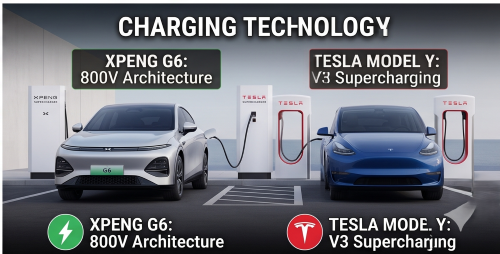
Charging is where Tesla still holds a major ecosystem advantage. The Supercharger network remains one of the strongest reasons to buy a Tesla, especially for drivers who regularly travel long distances. Xpeng supports fast charging, but public charging convenience depends heavily on local networks, roaming agreements, and country-specific infrastructure.
Pricing and Value Proposition
Price is where the Xpeng G6 can become extremely attractive. In many markets, Xpeng aims to offer strong technology and comfort at a lower price than a similarly equipped Tesla Model Y. This gives buyers a serious alternative if they want more features for the money.
The Tesla Model Y often costs more, but the premium buys more than acceleration. It buys brand strength, resale confidence, charging convenience, software maturity, and a proven ownership ecosystem. For some buyers, those advantages justify the higher price. For others, the Xpeng G6’s value package may be too strong to ignore.
Xpeng G6 vs Tesla Model Y: Feature Comparison Table
| Category | Xpeng G6 | Tesla Model Y | Practical Winner |
|---|---|---|---|
| Design | More expressive coupe-SUV styling. | Minimalist and instantly recognizable. | Personal preference |
| Interior | More comfort-focused and feature-rich. | Cleaner and more minimalist. | Xpeng G6 |
| Acceleration | Fast, especially dual-motor versions. | Very fast, especially Performance version. | Tesla Model Y |
| Charging Network | Depends heavily on local public charging. | Supercharger ecosystem remains a major advantage. | Tesla Model Y |
| Driver Assistance | Advanced sensor hardware in selected versions. | More proven global system and wider recognition. | Market dependent |
| Value | Strong equipment for the price. | Higher price but stronger ecosystem. | Xpeng G6 |
| Resale Confidence | Improving but still developing in many markets. | Stronger established used-market demand. | Tesla Model Y |
Reliability and Safety
Tesla has a clear advantage in long-term ownership data because the Model Y has been sold in large numbers globally. This gives buyers more information about reliability, resale value, service issues, software performance, and real-world battery behavior.
Xpeng’s reliability reputation is still developing outside China. Early impressions are positive, and the brand has strong engineering ambition, but European buyers should check local service coverage, warranty conditions, parts support, and owner feedback before committing.
Safety equipment is strong in both vehicles. Buyers can expect modern driver assistance, multiple airbags, active braking support, lane assistance, camera systems, and stability control. However, exact safety ratings and equipment can vary by market and production version.
Real-World Ownership Experience
Ownership experience depends heavily on location. In countries with a dense Tesla Supercharger and service network, the Model Y is extremely easy to live with. Road trips are simple, software updates are familiar, and many independent garages understand Tesla vehicles.
Xpeng ownership can be excellent in markets where the brand has strong local support, but more uncertain in regions where service coverage is still developing. This does not mean the G6 is a risky car everywhere. It means buyers should check their local dealer network before comparing it directly with Tesla.
Xpeng G6 vs Tesla Model Y: Pros and Cons
Xpeng G6 Strengths
- Strong value for money.
- Comfort-focused interior.
- Advanced sensor hardware in selected versions.
- Competitive range options.
- Distinctive design and modern cabin.
- Appealing alternative to common Tesla models.
Tesla Model Y Strengths
- Excellent acceleration.
- Supercharger network advantage.
- Stronger resale confidence.
- More proven global ownership data.
- Efficient drivetrain and software.
- Very strong brand recognition.
Which SUV Should You Choose?
Choose the Xpeng G6 if you prioritize value, comfort, equipment, interior richness, and advanced sensor technology. It is especially attractive if you live in a market where Xpeng has good dealer support and public charging access.
Choose the Tesla Model Y if you prioritize charging convenience, acceleration, resale confidence, software maturity, and proven ownership support. It remains the safer choice for many buyers in markets where Tesla infrastructure is strong.
The best decision depends on your local market. A Tesla Model Y may be the better ownership choice in one country, while an Xpeng G6 may be the better value choice in another. Test drive both, compare actual monthly payments, and check charging options near your home and regular routes.
External EV Research Resources
Buyers can compare official model details on the Tesla Model Y website and the Xpeng official website. Local specifications, prices, and available driver-assistance features can vary by country.
Internal Chinese Car Resources
For more electric SUV comparisons, Chinese EV reviews, charging guides, and buying advice, visit the Chinese Cars Asia homepage for related articles and future updates.
Final Verdict: Xpeng G6 vs Tesla Model Y
The Tesla Model Y remains the benchmark electric SUV because it combines performance, charging convenience, software maturity, resale strength, and a proven ownership ecosystem. It is the safer and more familiar choice for many buyers.
The Xpeng G6 is the stronger challenger than many people expect. It offers excellent value, a comfortable interior, competitive range, advanced technology, and a more distinctive ownership proposition. In markets where Xpeng support is strong, it can be a very serious alternative.
The winner depends on your priorities. Tesla wins on ecosystem and confidence. Xpeng wins on value and freshness. Either way, the competition is good news for EV buyers.
Xpeng G6 vs Tesla Model Y FAQ
Is the Xpeng G6 better than the Tesla Model Y?
The Xpeng G6 can be better for buyers who want strong value, comfort, and modern technology. The Tesla Model Y is better for buyers who prioritize charging network access, acceleration, resale confidence, and proven ownership support.
Which has better range, Xpeng G6 or Tesla Model Y?
Range depends on battery version, wheels, weather, and driving style. Higher-spec Xpeng G6 versions can be very competitive, while the Tesla Model Y remains highly efficient in real-world use.
Does the Xpeng G6 have better technology than Tesla?
The Xpeng G6 may offer advanced sensor hardware in selected versions, including LiDAR in some markets. Tesla has a more mature software ecosystem and broader real-world experience.
Which electric SUV is better for long trips?
The Tesla Model Y is usually better for long trips in markets with strong Supercharger coverage. The Xpeng G6 can also work well if local public charging is reliable and fast.
Which SUV is better value?
The Xpeng G6 often offers stronger feature value for the money, while the Tesla Model Y offers stronger ecosystem value. The better deal depends on local prices, incentives, and finance offers.