Chinese Electric Cars With the Best Real-World Range
The electric vehicle revolution is in full swing, and Chinese manufacturers are leading the charge — literally. But here is the uncomfortable truth that many buyers discover too late: the range a manufacturer claims on the spec sheet rarely matches what you actually achieve in real-world driving. A car advertised at 500 km might realistically deliver 350–400 km.
So which Chinese electric cars actually deliver on their promises, and which leave drivers stranded with inflated expectations? In this guide we explain why the gap exists, break down the five factors that drain range, and rank the models that come genuinely close to their official figures.
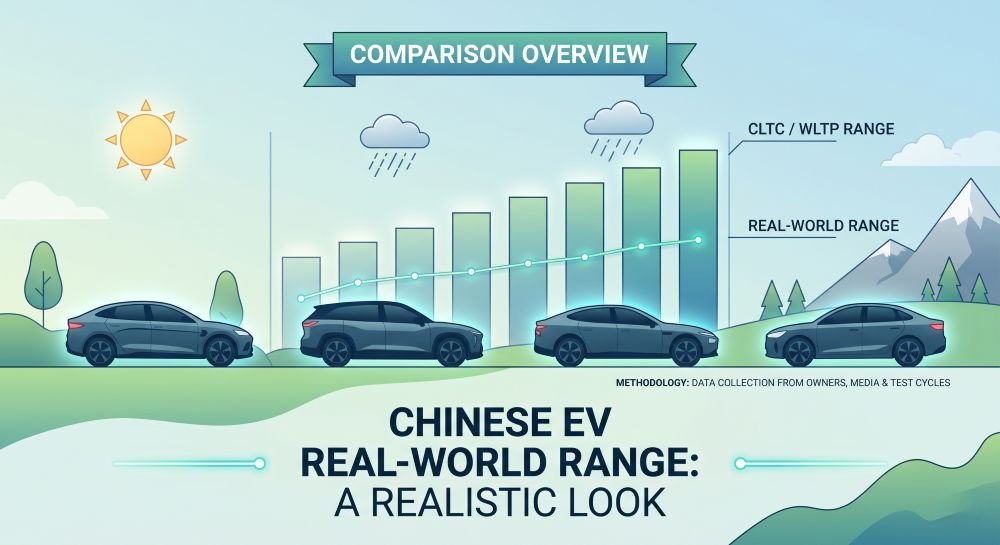
For years, EV shoppers have fixated on the single biggest number in the brochure: range. Yet that figure is also the most misleading, because it is produced in conditions almost nobody drives in. Understanding why, and learning which cars hold up best once you leave the lab behind, is the difference between a confident long-distance EV and one that disappoints. Before we dig into the detail, the short video below sums up the issue in under ninety seconds.
With that overview in mind, let’s start with the root of the problem: why the headline range number and the range you actually get are so often worlds apart.
The Gap Between Claimed Range and Reality
Before we look at specific models, it helps to understand why there is such a dramatic difference between official range ratings and real-world performance. The culprit is not deceptive marketing, though manufacturers certainly know how to maximise their numbers using favourable testing. The issue is more nuanced, and it comes down to how vehicles are measured in the lab versus how they are driven on the road.
Most Chinese electric vehicles use the CLTC (China Light-Duty Vehicle Test Cycle) standard for range certification. That methodology runs under optimised lab conditions: consistent temperatures around 23°C, moderate speeds, minimal climate-control use, and perfectly inflated tyres. Real-world driving, by contrast, involves highway speeds, temperature swings, air conditioning, and the countless unpredictable variables of actual commuting. The result is that CLTC-tested Chinese EVs often show 20–40% more range than drivers actually experience. Models tested under the stricter WLTP standard fare a little better, but the gap persists.
Two Accessories That Help Protect Your Real Range
Since tyre pressure and efficient charging both feed directly into the range you actually get, the two inexpensive extras below tie straight into this article’s theme. Each suits any electric car, whichever brand you drive.
As this guide explains, under-inflated tyres can quietly cost 10–15% of your range. A rechargeable digital inflator with a preset auto-stop keeps every tyre at its optimal pressure in seconds, directly protecting the real-world miles you paid for and extending tyre life at the same time.
Maximising range means charging often, and a water-resistant storage bag keeps your portable charging cable clean, dry, and tangle-free in the boot between top-ups. It is a simple way to protect an expensive cable and keep the load area tidy on long efficiency-focused trips.
Where Does the Range Actually Disappear?
If you are wondering where all those promised kilometres vanish, you are not alone. Range loss is not random; it is the result of five major factors that consistently impact EV battery efficiency. Let’s examine each one and understand how much it contributes to the gap between advertised and actual performance.
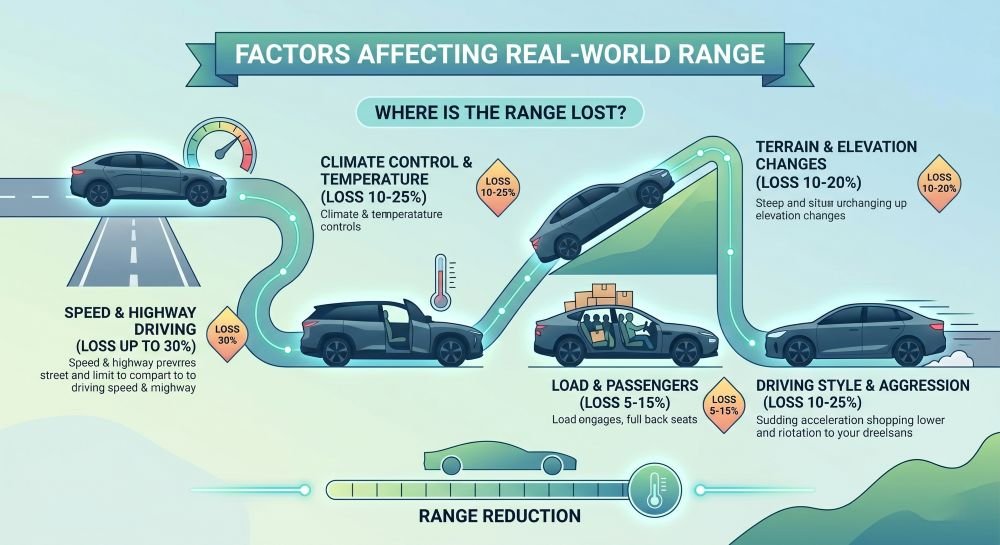
1. High-Speed Driving (Loss: 20–30%)
This is the single biggest culprit. Aerodynamic drag increases exponentially with speed, so highway cruising consumes far more energy than city driving. A Chinese EV claiming 560 km of CLTC range at modest speeds might deliver only 390–450 km at sustained motorway pace. The physics is brutal: at 120 km/h you are fighting air resistance roughly 40% greater than at 90 km/h.
2. Climate Control and Temperature (Loss: 10–25%)
Heating and air conditioning are energy vampires in electric vehicles. Winter driving with the heater running can cut range by 20–25%, while air conditioning in hot weather claims another 10–15%. Cold batteries are also less efficient, which is why cold-weather range tends to be markedly worse than summer figures. EVs with heat-pump technology fare better; traditional resistive heaters are particularly thirsty.
3. Terrain and Driving Conditions (Loss: 10–20%)
Hilly terrain demolishes range compared with flat driving. Constant elevation changes mean constant acceleration and braking, which dramatically raises energy use. A 480 km EV on flat roads might manage only 385–430 km in mountainous regions. This factor varies hugely by location, but it is worth weighing for your specific area.
4. Vehicle Load and Cargo (Loss: 5–15%)
Every additional 45 kg of cargo reduces range by roughly 1–2%. That seems minor until a family road trip with luggage, passengers, and supplies adds 180–270 kg to the car. Suddenly your 560 km EV is realistically delivering closer to 480–530 km. It is not dramatic, but it is measurable on longer journeys.
5. Driving Style and Efficiency (Loss: 10–25%)
This is the variable you actually control. Aggressive acceleration, hard braking, and inefficient energy management can cut range by up to 25%. Conversely, smooth acceleration, anticipatory driving, and strategic use of regenerative braking can preserve range and even beat conservative estimates. Driving style alone can swing real-world performance by 30 percentage points or more.
💡 The Math: For a 560 km CLTC-rated EV, a tough day might subtract 25% for high-speed driving, 15% for climate control, 10% for terrain, and 5% for cargo — leaving a realistic figure closer to 250–300 km. That is a worst-case stack, but it shows why understanding these factors matters before you buy.
Which Chinese EVs Deliver the Best Real-World Range?
Now that we understand what determines actual range, let’s look at which Chinese electric vehicles have earned reputations for honest performance. These are the cars that, while they do not perfectly match their optimistic CLTC ratings, come closer than rivals and genuinely impress owners with their efficiency.
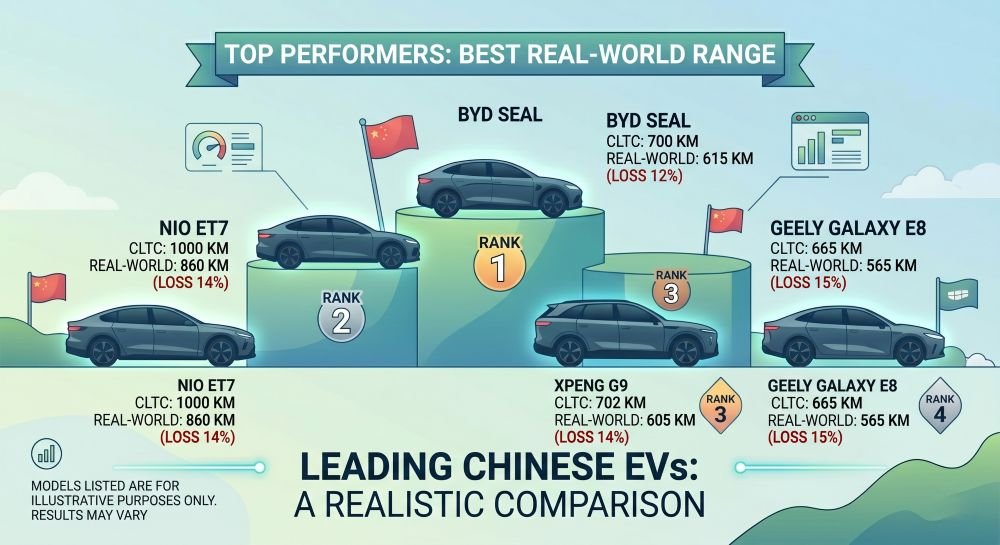
1. BYD Seal — The Range Champion
The BYD Seal consistently ranks as the Chinese EV that best approaches its claimed range in real-world testing. With CLTC ratings up to around 700 km depending on configuration, owners regularly report achieving roughly 90–95% of the figure in mixed driving. The Seal’s secret is a highly efficient drivetrain paired with BYD’s “Blade” battery, which offers excellent thermal management and longevity. Its slippery shape and lightweight construction only add to the efficiency advantage. If you want a Chinese EV that delivers on its range promise, the Seal is the gold standard.
2. NIO ET7 — Luxury Meets Efficiency
The NIO ET7 is a premium sedan that pairs luxury with respectable efficiency. With a claimed range up to around 1,000 km on the largest battery under CLTC, real-world testing typically shows roughly 81–89% of the rating in mixed conditions — excellent for a car this size. NIO’s strength lies in advanced battery technology and intelligent energy management, plus a climate system that prioritises efficiency without sacrificing comfort. Its battery-as-a-service model also lets owners upgrade packs over time, which matters for long-term range.
3. XPeng G9 — Performance and Practicality
The XPeng G9 is a midsize SUV that does not trade efficiency for capability. With CLTC ratings up to around 700 km, owners report 80–88% retention in real-world driving. XPeng’s particular strength is holding range steady even when driven harder, helped by some of the most sophisticated battery-management software in the market. The G9 handles motorway driving without the dramatic penalty some rivals suffer.
4. Geely Galaxy E8 — The Underrated Efficiency Leader
The Geely Galaxy E8 is often overlooked in global discussions, yet it deserves recognition for exceptional real-world range. With CLTC ratings up to around 700 km in top configurations, real-world testing shows strong retention among the best in the Chinese EV market. Geely’s focus on aerodynamics and weight optimisation pays clear dividends, and the E8’s size does nothing to dull its efficiency, a testament to the quality of its battery and drivetrain engineering.
| Model | Body Style | Real-World Retention | Standout Strength |
|---|---|---|---|
| BYD Seal | Sedan | ~90–95% | Blade battery efficiency |
| NIO ET7 | Luxury sedan | ~81–89% | Battery swap & energy management |
| XPeng G9 | Midsize SUV | ~80–88% | Strong highway retention |
| Geely Galaxy E8 | Large sedan | High | Aerodynamics & weight tuning |
How to Maximise Your Chinese EV’s Real-World Range
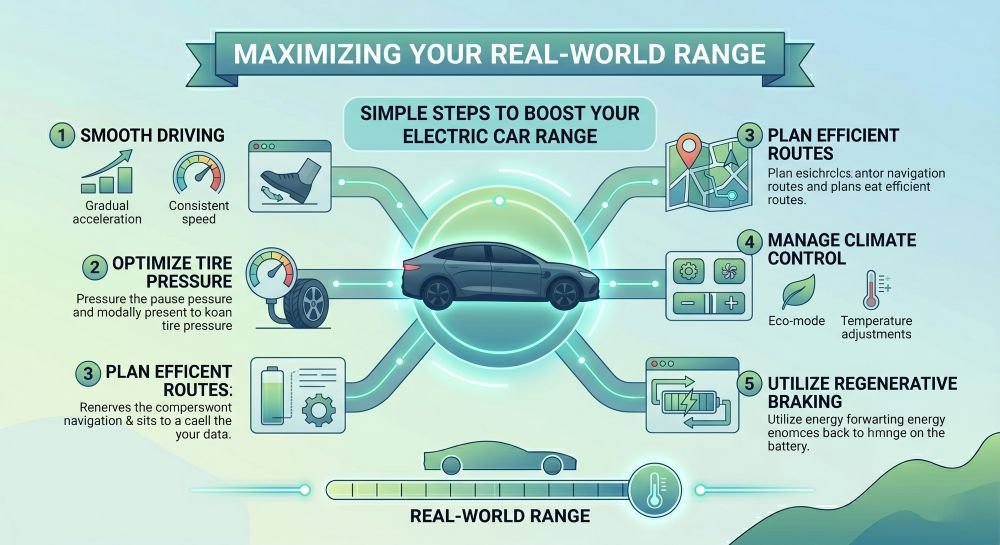
While vehicle selection matters, your driving behaviour matters just as much. Here are the most effective strategies for squeezing the maximum range out of any Chinese electric vehicle.
Master Smooth Driving Techniques
Smooth acceleration and gradual deceleration are your primary tools. Treat the accelerator like a volume dial — gentle pressure, not aggressive pressing — because hard acceleration drains charge rapidly and heats the battery. Anticipate stops and coast rather than braking hard at the last moment. Drivers who adopt these habits often improve range by 15–20%, while also extending battery life.
Maintain Moderate, Consistent Speeds
Cruising at 90–105 km/h is dramatically more efficient than 120 km/h-plus. The relationship is exponential: lifting speed from 95 to 120 km/h raises energy use by roughly 30–35%. Where conditions allow, trimming motorway speed by just 15 km/h can add meaningful range on a long journey, and steady cruise-control speeds beat constant variation.
Maximise Regenerative Braking
Regenerative braking is the most valuable efficiency technology in any modern EV. Every time you slow down, you convert kinetic energy back into charge, which is why city driving often returns better real-world range than you would expect. Most Chinese EVs let you tune regen strength through driving modes; find the setting that balances recovery with smoothness for your style.
Mind Your Tyres and Climate Control
Two final habits make a real difference. Keep tyres correctly inflated, since under-inflation raises rolling resistance and can quietly erode range over time. And use climate control intelligently:
- Precondition the cabin while plugged in, using grid power rather than the battery.
- Favour seat warmers over cabin heating where possible, as they use a fraction of the energy.
- Set climate control to a narrow comfort band rather than maximum heat or cool.
- Schedule pre-conditioning so the battery is at an ideal temperature before you set off.
What’s Coming Next for Chinese EV Range
Battery technology keeps improving at pace, and Chinese manufacturers are investing heavily in advances that promise to narrow the gap between claimed and real-world range. Several developments stand out:
- Solid-state batteries promising significantly higher energy density and better thermal stability.
- Refined LFP chemistry from BYD and others offering longevity and more realistic range claims.
- AI-optimised power management that distributes energy in real time based on driving patterns.
- Enhanced aerodynamics pushing drag coefficients down toward the 0.18–0.20 range.
Together these suggest future Chinese EVs will not only travel farther but also achieve a closer match between brochure figures and the distances drivers actually see.
⚠️ Important Note: When planning long drives, always factor in a 15–25% range reduction from the advertised figure, and more in cold weather or at high speed. Do that calculation and, if a car still meets your needs, you have found a genuine winner rather than a spec-sheet illusion.
FAQ: Chinese EV Real-World Range
Why is the real-world range of Chinese EVs lower than the claimed range?
Most Chinese EVs are rated on the CLTC test cycle, run under optimised lab conditions with mild temperatures and moderate speeds. Real driving adds highway speeds, climate control, terrain, cargo, and driving style, so actual range is typically 20–40% below the CLTC figure.
Which Chinese electric car has the best real-world range?
The BYD Seal is widely regarded as delivering the closest match to its claimed range, with owners reporting around 90–95% of its CLTC figure in mixed driving. The Geely Galaxy E8 also stands out for high real-world retention, while the NIO ET7 and XPeng G9 are strong premium options.
What reduces an electric car’s range the most?
Sustained high-speed driving is the single biggest factor, cutting range by roughly 20–30% because aerodynamic drag rises sharply with speed. Climate control, hilly terrain, heavy loads, and aggressive driving style each add further losses on top of that.
How can I get more real-world range from my EV?
Drive smoothly, hold moderate highway speeds of around 90–105 km/h, lean on regenerative braking, keep tyres correctly inflated, and precondition the cabin while plugged in. Together these habits can recover 15–20% of range compared with aggressive driving.
The Bottom Line: Real-World Range Matters More Than Specs
The gap between claimed range and real-world performance is one of the most important considerations when buying a Chinese electric vehicle. It is not about manufacturers being dishonest; it is about understanding how cars actually behave when you drive them in the real world. The BYD Seal, NIO ET7, XPeng G9, and Geely Galaxy E8 stand out precisely because they deliver genuine efficiency and a closer alignment between promise and performance.
Even with an exceptional car, though, your driving style, local climate, and road conditions will shape what you actually see. Plan around a realistic figure rather than the brochure number, and you will choose an EV that delights rather than disappoints. Chinese EVs have come tremendously far, and the distance between the best performers and the average ones is only widening.