EV Charging Adapters: Type 2 & CCS2 to GB/T Guide
If you own an imported Chinese electric vehicle, or are planning to buy one, understanding EV charging adapters is essential. The right adapter ensures compatibility with local charging infrastructure, unlocks faster charging, and keeps every session safe.
This complete guide explains Type 2 to GB/T and CCS2 to GB/T adapters: what they do, how the underlying standards differ, how to choose the correct one for your needs, and the safety practices that protect both your car and yourself.
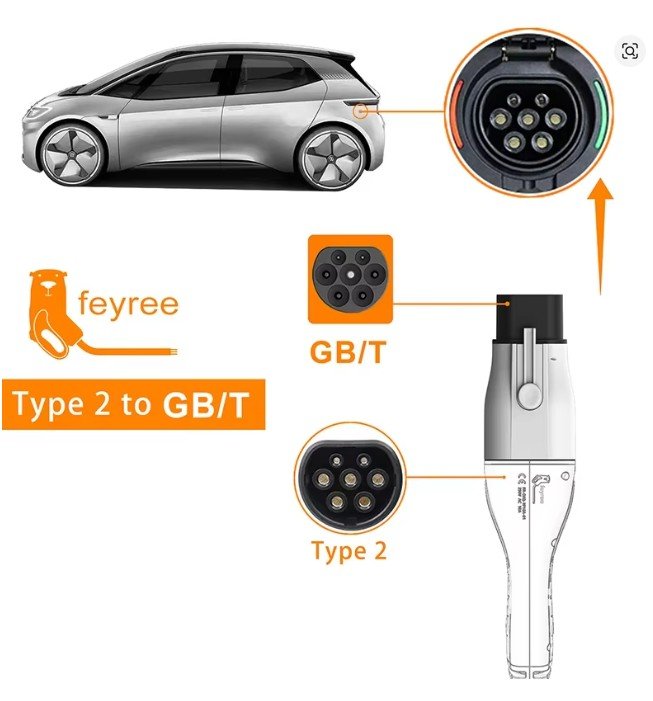
As Chinese EVs spread well beyond their home market, a practical wrinkle follows them: the charging port. A car designed for China’s network does not automatically plug into a European or Australian charger, and that mismatch can turn an otherwise brilliant vehicle into a frustrating one. Adapters solve the problem elegantly, but only if you understand the standards involved and choose the right hardware. Before we dig in, the short video below gives a quick visual overview.
With that overview in mind, let’s start with the standards themselves, because understanding them is the key to choosing the right adapter.
Understanding EV Charging Adapter Standards
Electric vehicle charging standards vary significantly across global markets. Chinese EVs predominantly use the GB/T (Guo Biao) charging connector, a uniquely Chinese standard optimised for the country’s charging infrastructure. Western markets, particularly Europe, primarily use Type 2 and CCS2 connectors. When a Chinese EV is imported elsewhere, that mismatch is exactly where a quality adapter becomes essential, bridging the gap between your vehicle and the chargers available around you.
⚠️ Important Note: For a Chinese EV owner outside mainland China, an adapter is not really optional, it is essential infrastructure. Without the correct adapter, your vehicle simply cannot access most local charging stations, which severely limits its day-to-day usability.
Charging Accessories Worth Having Alongside Your Adapter
An adapter solves the connector problem, but a couple of inexpensive charging accessories make living with an imported EV tidier and more secure. Both pair naturally with the home and public charging this guide covers.
If you charge at home, a wall-mounted holster gives the connector a clean, dry resting place and keeps the cable off the garage floor. It protects the plug your adapter mates with from grit and damage, and tidies an otherwise messy corner of the home setup.
When charging on a public Type 2 or CCS2 post, a cable lock deters opportunistic theft of an expensive cable and adapter combination while you are away from the car. A simple, weather-resistant lock adds real peace of mind for kerbside and car-park sessions.
GB/T: The Chinese EV Charging Protocol
The GB/T standard grew out of China’s specific requirements for electric vehicle infrastructure, and it is the connector you will find on virtually every Chinese-built EV. Its defining characteristics include:
- Optimised for both AC and DC charging.
- Compatible with China’s vast public charging network.
- Support for single-phase and three-phase power.
- Intelligent power management and built-in safety features.
- Near-universal availability across Chinese infrastructure.
Type 2: The European AC Standard
Type 2 connectors dominate European public charging, especially for AC. They support single- and three-phase AC charging, are standardised across EU member states, work seamlessly with residential charging solutions, and deliver faster charging than the legacy standards they replaced. For a Chinese EV abroad, a Type 2 to GB/T adapter is typically the first one owners buy.
CCS2: The DC Fast-Charging Standard
CCS2 (Combined Charging System 2) is the modern standard for high-power DC fast charging. It builds on the Type 2 base for AC and adds dedicated DC pins for rapid energy transfer, supporting ultra-fast networks up to 350 kW. A CCS2 to GB/T adapter is what unlocks genuinely quick top-ups on long journeys.
Key Benefits of a Quality Charging Adapter
A good adapter does far more than simply make a plug fit. It fundamentally expands where, and how quickly, you can charge.
Compatibility Across Multiple Standards
The headline benefit is access. A quality adapter lets your Chinese EV use charging stations built around different standards, opening up thousands of additional charging points. Instead of hunting for the rare GB/T station in your region, you can plug into almost any Type 2 or CCS2 charger. In practice that means:
- Access to public charging networks across Europe and many other regions.
- Standard AC charging at the ubiquitous Type 2 stations.
- Rapid DC top-ups via CCS2 fast chargers.
- An end to being stranded by incompatible infrastructure.
- Confidence to plan longer trips around real charging availability.
Safety and Reliability
Premium adapters build in serious protection. Intelligent power management detects available current and guards the battery, thermal sensors prevent overheating during high-current sessions, and electrical safeguards such as surge protection, ground-fault detection, and current limiting keep operation safe. Heavy-duty materials resist weather and repeated use, and reputable units pass rigorous safety certification before sale.
💡 Pro Tip: Match the adapter to how you actually charge. If you mostly plug in at home overnight, a Type 2 to GB/T adapter covers you. If you regularly take long trips, prioritise a CCS2 to GB/T adapter for fast DC charging. Owners who want total flexibility eventually buy both.
Type 2 vs CCS2 Adapters Compared
The two adapter types serve genuinely different purposes. The table below summarises how they stack up so you can match one to your charging habits.
| Feature | Type 2 to GB/T | CCS2 to GB/T |
|---|---|---|
| Charging type | AC (3–22 kW typical) | DC fast (50–350 kW) |
| Charging time | 4–12 hours for a full charge | 20–45 minutes to 80% |
| Infrastructure | Widespread public & home | Growing fast-charge network |
| Best use case | Overnight & workplace charging | Long trips & rapid top-ups |
| Setup needs | Works with standard wallboxes | Needs DC fast-charge stations |
How to Choose the Right Adapter
Step 1: Confirm Your Vehicle’s GB/T Port
Chinese EVs use GB/T connectors, but variations exist within the standard. Most modern models from BYD, NIO, Geely and others share the same connector, yet it is always worth verifying your specific car. Check the vehicle documentation or ask the manufacturer to confirm exact specifications before buying.
Step 2: Match the Adapter to Your Charging Needs
Be honest about how you will actually charge. If you do most charging at home, a Type 2 adapter enables comfortable overnight sessions on residential infrastructure. If you travel long distances often, a CCS2 adapter is the priority, cutting charging time from hours to minutes. And if you want maximum flexibility, owning both guarantees access to whatever station you encounter.
Step 3: Verify Safety Certifications
Quality matters enormously with electrical equipment. When choosing an adapter, look for CE certification for European safety, FCC certification for electromagnetic compatibility, a solid manufacturer reputation with genuine customer reviews, clear warranty coverage and support, and obvious build quality in the materials and construction.
Step 4: Judge Build Quality and Durability
Premium construction is what keeps an adapter safe over years of use. Favour heavy-duty, weather-resistant materials, shielded connectors that keep out dirt and moisture, reinforced cables that survive repeated bending, and professional-grade manufacturing rather than the cheapest option you can find.
Cost and Long-Term Value
Quality adapters represent excellent value rather than an expensive luxury. Instead of buying specialised, costly charging equipment, a reliable adapter simply unlocks the infrastructure that already exists all around you. A good Type 2 to GB/T adapter typically sits in the lower price band, while a CCS2 to GB/T unit costs more because of the high-power DC electronics inside it. Either way, the outlay is modest set against the freedom it buys.
It pays to view the adapter as part of the car’s total cost of ownership, not an afterthought purchased in a panic at the first incompatible charger. Spending a little more on a certified, durable unit up front avoids the false economy of a cheap adapter that overheats, charges slowly, or fails after a few months. A well-made adapter, looked after properly, should comfortably outlast several sets of tyres.
When You Might Not Need an Adapter
It is worth noting that not every Chinese EV abroad requires an adapter. A growing number of models built specifically for export, particularly those sold officially in Europe and Australia, already ship with native Type 2 and CCS2 ports rather than GB/T. For those cars, no adapter is needed at all, which is one more reason to confirm your exact model’s port before buying anything.
The adapter question therefore matters most for genuinely imported, China-spec vehicles, or for owners who bring a car across regions with mismatched standards. If you are buying a Chinese-brand EV through an official local dealer, check whether it is already configured for your market; if you are importing privately, assume an adapter will be part of the plan.
Safety Considerations and Best Practices
Even a high-quality adapter depends on correct use. Build these habits into every charging session:
- Inspect before use: check for physical damage, corrosion, or loose connections before plugging in.
- Keep it dry: ensure both the vehicle port and the station are dry before connecting.
- Seat it securely: confirm the adapter is firmly connected to avoid intermittent contact.
- Stay nearby: avoid leaving an adapter charging completely unattended for long periods.
- Store it protected: keep the adapter in a case when it is not in use.
Ongoing care matters too. Clean the connectors regularly with appropriate materials, protect the adapter from temperature extremes, avoid forceful insertion or removal that stresses the pins, inspect cables for wear, and replace any adapter showing signs of deterioration rather than risking a compromised connection.
FAQ: EV Charging Adapters
What is a GB/T charging connector?
GB/T (Guo Biao) is China’s national EV charging standard, used by virtually all Chinese-built electric vehicles for both AC and DC charging. It is optimised for China’s charging network and is largely incompatible with the Type 2 and CCS2 connectors common in Europe and other markets.
Do I need an adapter to charge an imported Chinese EV?
Usually yes. If your Chinese EV has a GB/T port and you live where public charging uses Type 2 (AC) or CCS2 (DC), an adapter bridges the gap so you can use local stations. Without one, your charging options are severely limited.
What is the difference between a Type 2 and a CCS2 adapter?
A Type 2 to GB/T adapter handles AC charging, typically 3–22 kW, ideal for home and destination charging over several hours. A CCS2 to GB/T adapter handles DC fast charging, potentially 50–350 kW, for rapid top-ups on long trips. Many owners eventually want both.
Are EV charging adapters safe to use?
Quality, certified adapters with proper temperature monitoring, surge protection, and current limiting are designed to charge safely. Choose certified products, inspect them before each use, keep connections dry and secure, and avoid cheap, uncertified units that can overheat.
The Bottom Line: Essential Kit for Imported Chinese EVs
For Chinese EV owners outside mainland China, charging adapters shift from optional accessories to essential infrastructure. Quality Type 2 and CCS2 to GB/T adapters unlock access to vast charging networks, extend the practical usability of the car, and provide genuine safety assurance when chosen carefully and used correctly.
Rather than treating adapters as an afterthought, think of them as integral to the ownership experience. Sorting out the right adapter early prevents the frustration of arriving at a charger you cannot use, and turns an imported Chinese EV into the genuinely usable everyday car it was designed to be.