Chinese EV Insurance Costs in the UK: Are Chinese Electric Cars More Expensive to Insure?
Chinese electric cars are becoming much more visible on UK roads. Brands such as BYD, MG, Omoda, Jaecoo, XPeng, Leapmotor, GWM Ora, NIO, and Zeekr are giving British buyers more choice, stronger standard equipment, competitive prices, and long warranties. However, one ownership cost is now attracting serious attention: insurance. The question many buyers are asking is simple: are Chinese EV insurance costs in the UK higher than expected?
The answer is not the same for every model, every driver, or every postcode. Some Chinese electric cars can be insured normally and may be competitive for the right driver. Others may receive fewer quotes, higher premiums, or more cautious treatment from insurers. The reasons are usually practical rather than political: limited claims history, repair complexity, parts availability, specialist EV training, battery replacement risk, and uncertainty around residual values.
Watch: Chinese EV Insurance Costs in the UK
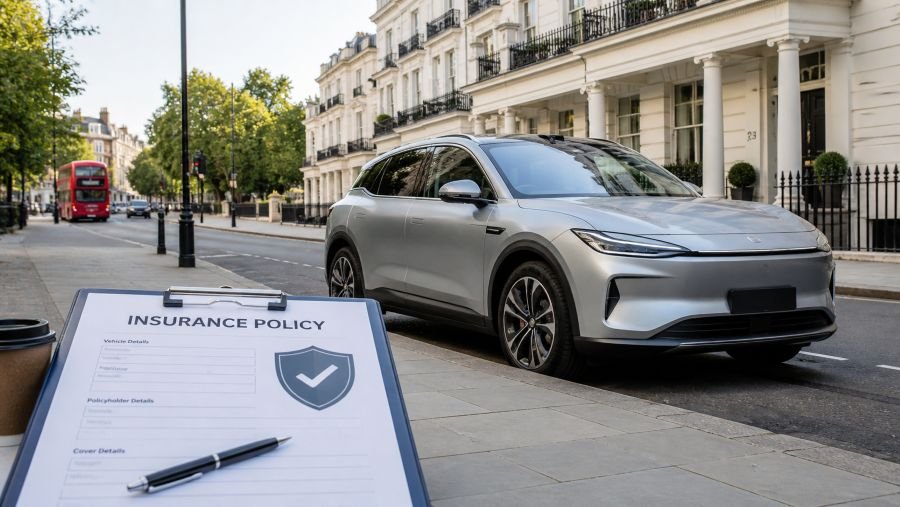
Are Chinese EVs More Expensive to Insure in the UK?
In many cases, Chinese EVs can be more expensive to insure in the UK than buyers expect, especially when the brand is new, the model has only recently entered the market, or the insurer has limited historical repair and claims data. That does not mean every Chinese electric car is expensive to insure. It means premiums can be inconsistent, and the quote spread between insurers may be unusually wide.
A familiar model from an established brand such as MG may be easier for insurers to price because it has more UK road presence, more service experience, and more historical data. A newer imported EV from a less familiar brand may create more uncertainty. Insurers price uncertainty conservatively, so a car that looks affordable in the showroom can sometimes generate a surprisingly high annual premium.
The most important point is that the issue is not only about the badge. It is about the insurance ecosystem around the car. If parts are easy to source, repair methods are clear, technicians are trained, and insurers have enough claim history, premiums may become more stable. If those factors are weak, insurance can become one of the hidden costs of ownership.
Why Chinese Electric Car Insurance Can Be Higher
Insurance pricing is based on risk. For a normal petrol or diesel car that has been sold in the UK for many years, insurers already know how often it crashes, how much repairs usually cost, how long parts take to arrive, and how often the vehicle is written off. With a newer Chinese EV, some of that data may still be thin.
This matters because electric cars are already different from traditional combustion cars. They often have expensive battery packs, high-voltage systems, complex software, advanced driver assistance sensors, camera arrays, radar units, and large digital modules. If a minor accident damages a bumper, grille area, battery tray, sensor pack, or charging component, the repair may be more expensive than the buyer expects.
For Chinese EVs, insurers may add another layer of caution. They may ask: are parts available quickly in the UK? Are bodyshops trained on this platform? Is the repair manual clear? Are replacement battery modules available, or does the full pack need replacement? Are there enough examples on UK roads to predict claim frequency? The more uncertainty there is, the more likely the premium will rise.
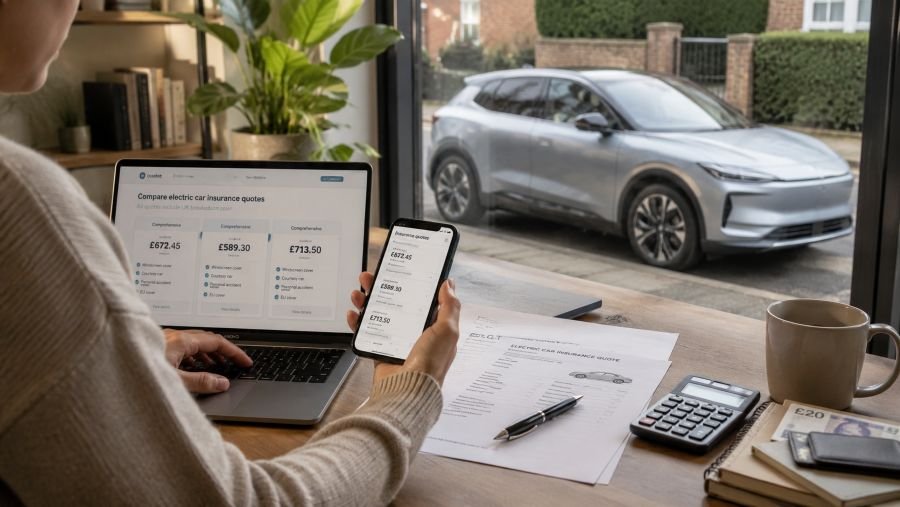
Key Factors That Affect Chinese EV Insurance Costs in the UK
Chinese EV insurance costs in the UK are shaped by a combination of normal insurance variables and EV-specific issues. Your age, driving record, postcode, annual mileage, no-claims discount, occupation, and parking location still matter. However, the car itself can make a bigger difference than expected when the model is new to the UK market.
| Factor | Why It Matters | How Buyers Can Respond |
|---|---|---|
| Limited claims history | Insurers may not yet have enough UK data for newer Chinese EV models. | Compare several insurers and check again before delivery because pricing can change quickly. |
| Parts availability | Longer parts delays can increase repair duration, storage costs, and replacement car costs. | Ask the dealer about UK parts stock, repair partnerships, and average parts lead times. |
| Battery damage risk | EV battery packs are expensive, and underbody damage can create major claim uncertainty. | Check whether the policy clearly covers battery damage, charging equipment, and accidental damage. |
| Specialist repair training | High-voltage systems require trained technicians and suitable repair facilities. | Choose brands with visible UK service networks and manufacturer-approved bodyshop support. |
| ADAS and sensor cost | Cameras, radar, lidar, parking sensors, and calibration work can make simple repairs expensive. | Review insurance group, excess, and repair terms rather than focusing only on list price. |
| Residual value uncertainty | Newer brands may have unpredictable depreciation, affecting total-loss calculations. | Research used values, finance terms, and guaranteed future value before buying. |
Is This a Chinese Car Problem or an EV Problem?
It is both, but not equally. The wider EV insurance problem affects many electric cars, including European, Korean, American, and Japanese models. EVs can be more expensive to repair because of battery systems, specialist labour, complex electronics, and high-value components. This is why electric car insurance has often been higher than equivalent petrol or diesel insurance in several markets.
The Chinese EV part of the issue is about newness and support infrastructure. A brand that has only recently entered the UK may not yet have a mature repair network, deep parts inventory, or enough claims history. A Chinese EV from a well-established UK seller may therefore be easier to insure than a newer model from a brand insurers barely recognise.
This distinction is important. Buyers should avoid assuming that all Chinese cars are treated the same. MG, BYD, Omoda, Jaecoo, XPeng, GWM Ora, Leapmotor, and NIO may all be viewed differently by different insurers. Even within the same brand, one model can be easier to insure than another.
Which Chinese EV Brands Should UK Buyers Check Carefully?
Every buyer should check insurance before purchasing, but the need is especially strong when considering newer brands or newly launched models. UK insurers may be comfortable with some Chinese-owned or Chinese-built cars and much more cautious with others. This can change over time as sales volume grows and more repair data becomes available.
MG
MG is one of the most familiar Chinese-owned brands in the UK. Its stronger market presence can help with insurer recognition, but premiums still depend on model, trim, driver profile, and repair cost.
BYD
BYD has strong global scale and a growing UK presence. Buyers should still compare quotes for models such as the Dolphin, Atto 3, Seal, Seal U, and Sealion 7 before ordering.
Omoda and Jaecoo
Omoda and Jaecoo are expanding quickly in the UK with value-focused SUVs. Insurance quotes should be checked early because these brands are still building long-term UK claims history.
XPeng, NIO, Zeekr and Leapmotor
These brands may appeal to tech-focused buyers, but newer market entry means insurance pricing can vary. Always test quotes across multiple insurers and comparison platforms.
Why Repairability Matters So Much
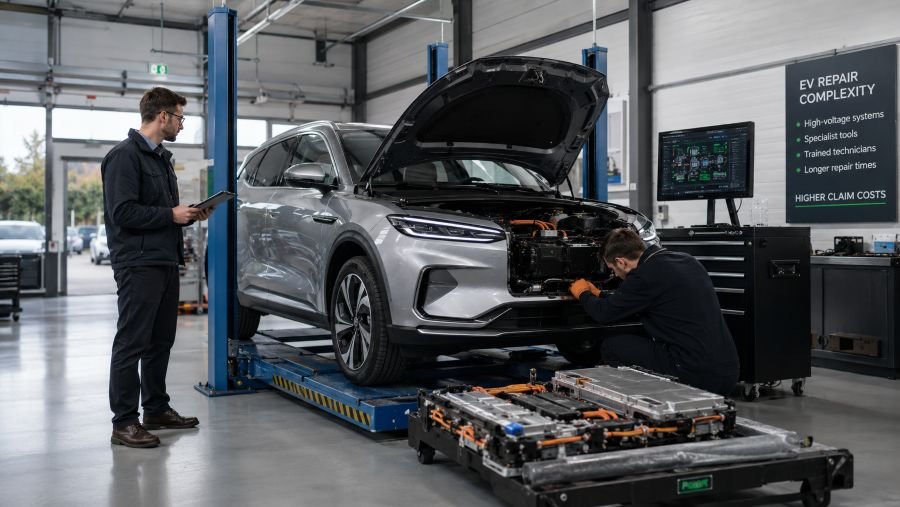
Repairability is one of the most important issues behind Chinese EV insurance costs in the UK. Insurers do not only care how often a vehicle crashes. They care how much it costs to put the car back on the road after a claim. If a repair requires specialist tools, high-voltage isolation, battery inspection, sensor calibration, imported parts, or manufacturer-only procedures, the claim can become expensive very quickly.
A simple-looking accident can involve hidden costs. A damaged bumper might require parking sensor replacement and calibration. A scraped underbody may require battery inspection. A damaged headlight or camera module may cost much more than expected. If parts are delayed, the insurer may also need to fund a replacement car for longer, which increases the total claim.
This is why a car can be affordable to buy but costly to insure. The purchase price is only one part of the ownership equation. Repair ecosystem maturity is often more important for insurance pricing than showroom value.
How UK Buyers Can Reduce Chinese EV Insurance Costs
The best way to reduce risk is to check insurance before making a commitment. This sounds obvious, but many buyers focus on list price, finance payments, range, charging speed, and warranty before checking insurance. With a newer Chinese EV, that order should be reversed. Get insurance quotes first, then compare total ownership cost.
Use more than one comparison site and try direct insurers too. Some insurers may not list a very new model immediately, while others may already support it. If the car is not recognised by a comparison tool, contact insurers directly or ask the dealer whether the manufacturer has preferred insurance partners.
- Check quotes before paying a deposit, especially for newly launched Chinese EVs.
- Try multiple comparison websites because insurer panels and model databases can differ.
- Ask the dealer about insurance partners or manufacturer-backed insurance schemes.
- Compare different trims because larger wheels, higher power, and extra sensors can affect premiums.
- Review the voluntary excess carefully; a lower premium may come with a higher claim cost.
- Check battery and charging equipment cover, including cables, wallbox-related damage, and accidental damage.
- Consider secure parking and approved security devices if they reduce your quote.
- Requote near delivery because insurer databases may update as new models become more common.
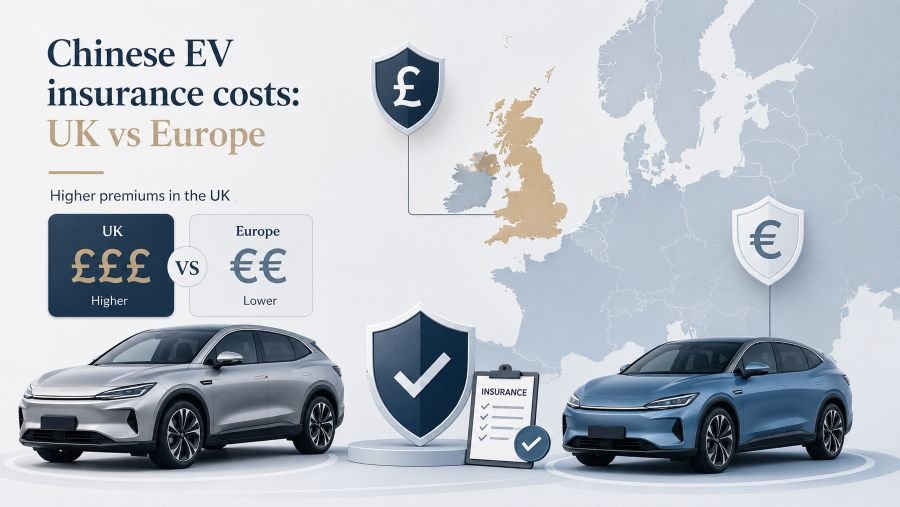
Chinese EV Insurance Costs: UK vs Europe
It is tempting to ask whether Chinese EVs are expensive to insure across all of Europe, but the answer is complicated. Insurance rules, repair networks, taxes, compulsory cover, labour rates, replacement car rules, and insurer data differ from country to country. A model that is costly to insure in the UK may not create the same issue in Germany, France, Spain, Italy, the Netherlands, or Norway.
The UK currently has a very visible discussion around Chinese EV insurance because many new Chinese brands are entering the market quickly, while the insurance and repair ecosystem is still adapting. In other European countries, costs may be shaped by different systems, including local repair networks, national insurance structures, and the availability of brand-approved service centres.
This means a Europe-wide answer would be too broad without country-specific data. For UK buyers, the most useful approach is to focus on UK quotes, UK repair support, UK insurance group information, and UK parts availability. For European readers outside the UK, the same logic applies locally: do not assume the UK result is identical in your country.
What to Ask the Dealer Before Buying
A good dealer should be able to answer practical insurance-related questions. If the salesperson cannot explain service support, approved repairers, parts supply, warranty process, or insurance partnerships, the buyer should be cautious. A long warranty is useful, but insurance claims are different from warranty repairs. Accident damage, battery inspection, paintwork, body panels, sensors, and replacement vehicles all depend on the repair ecosystem.
Before signing an order form, ask whether the brand has UK-based parts stock, how many approved repairers are available, whether independent bodyshops can access repair information, and whether battery repairs are modular or pack-level. These questions may sound technical, but they affect real ownership costs.
| Question to Ask | Why It Helps |
|---|---|
| Is this model already recognised by major UK insurers? | It reveals whether the car is easy to quote online or may require specialist underwriting. |
| Are there manufacturer-approved accident repair centres in my region? | Local repair access can reduce delays after a claim. |
| Are body panels, lights, sensors, and battery components stocked in the UK? | Parts availability can strongly affect repair time and total claim cost. |
| Does the brand offer an insurance partner or recommended broker? | Some new brands may have specialist partners that understand the model better. |
| What happens if the battery tray is damaged? | Battery inspection and replacement rules can be a major insurance cost factor. |
Are Chinese EV Insurance Costs Likely to Fall?
Some costs may fall as Chinese EVs become more common in the UK. More cars on the road means more claims data, more repair experience, more parts inventory, and more insurer familiarity. This can help premiums become more predictable. Brands that invest in strong UK service networks and fast parts distribution may become easier to insure over time.
However, insurance costs will not automatically fall for every model. If repairs remain expensive, if parts delays continue, or if claim frequency is high, premiums can stay elevated. The best outcome will likely be uneven: well-supported models from established brands may become more affordable to insure, while rare or poorly supported models may remain expensive.
The UK insurance market is also affected by wider repair inflation. Higher labour rates, expensive replacement parts, complex vehicle electronics, and increased accidental damage costs can affect all cars, not only Chinese EVs. Buyers should therefore look at total ownership cost rather than assuming that a cheaper purchase price guarantees cheaper running costs.
External References for UK EV Insurance and Repair Costs
For further reading on UK motor insurance and EV repair cost pressures, readers can review the Association of British Insurers update on motor premiums and repair costs, the Carwow report on insurance rates for new Chinese car brands, and the Auto Express coverage of insurer caution around some Chinese cars.
Internal Chinese EV Resources
For more Chinese electric vehicle analysis, buyer guides, and ownership advice, visit the Chinese Cars Asia homepage. You can also use this guide as a starting point before comparing specific models from BYD, MG, Omoda, Jaecoo, XPeng, Leapmotor, NIO, Zeekr, and other Chinese EV brands entering the UK market.
Final Verdict: Chinese EV Insurance Costs in the UK
Chinese EV insurance costs in the UK can be higher than expected, but the issue is not as simple as saying all Chinese electric cars are expensive to insure. The real problem is uncertainty. New brands, limited claims history, parts availability, repair complexity, battery risk, and specialist labour all influence how insurers price these cars.
For buyers, the smartest move is to compare insurance before choosing the car. A Chinese EV can still be a strong purchase if the price, range, warranty, equipment, dealer support, and insurance quote all make sense together. But if the premium is unusually high, the real cost of ownership may be very different from the advertised monthly payment.
Chinese EV Insurance Costs in the UK FAQ
Are Chinese electric cars more expensive to insure in the UK?
Some Chinese electric cars can be more expensive to insure in the UK, especially newer models with limited claims data, uncertain repair costs, or weaker parts availability. However, costs vary by model, driver, insurer, postcode, and repair support.
Why are some Chinese EV insurance quotes so high?
Higher quotes may be caused by limited UK claims history, expensive battery repairs, specialist EV labour, advanced sensor calibration, imported parts, longer repair times, and uncertainty around residual values.
Are Chinese EVs uninsurable in the UK?
Most Chinese EVs are not uninsurable, but some newer or less familiar models may receive fewer quotes or higher premiums. Buyers should try multiple comparison sites, direct insurers, and dealer-recommended insurance partners.
Which Chinese EV brands are sold in the UK?
Chinese or Chinese-owned EV brands in the UK include MG, BYD, Omoda, Jaecoo, GWM Ora, XPeng, Leapmotor, NIO, and others depending on current market availability.
How can I lower insurance costs on a Chinese EV?
Compare quotes before ordering, check different trims, increase voluntary excess carefully, use secure parking where possible, ask about manufacturer-backed insurance, and confirm that battery and charging equipment cover are included.
Will Chinese EV insurance get cheaper in the UK?
Insurance may become more stable as Chinese EVs become more common, parts networks improve, repairers gain experience, and insurers collect more data. However, premiums will still depend on repair costs, claims frequency, and model-specific risk.