BYD vs NIO vs Xpeng: Chinese EV Brands Comparison 2026
Three Chinese EV giants. Three very different visions. One buyer with a decision to make. In this BYD vs NIO vs Xpeng comparison we break down every dimension — lineup, technology, pricing, charging, and long-term ownership — so you don’t have to guess.
While dozens of Chinese automakers compete for market share, these three have established themselves as the leaders most likely to define what Chinese automotive means to Western buyers. Here is a clear, honest, head-to-head analysis of all three.
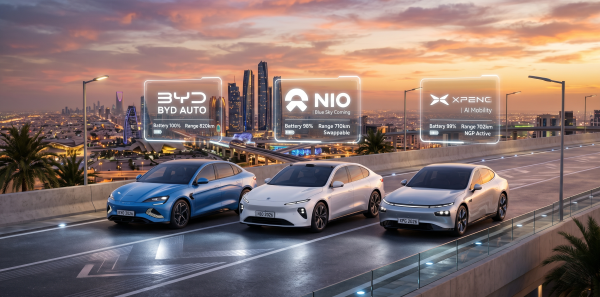
If you’ve followed the electric vehicle landscape over the past three years, you’ll have noticed the conversation about Chinese EVs increasingly revolves around three names: BYD, NIO, and Xpeng. Each represents a fundamentally different idea of what an EV brand should be — and choosing between them comes down to what you value most.
Before the deep dive, the video below offers a full visual walkthrough of how the three brands compare on value, technology, premium experience, and charging.
As the video shows, this is not a contest with a single winner — each brand is the best at something different. The at-a-glance table below frames where each one leads before we examine every dimension in detail.
| Brand | Positioning | Wins On | Overall Score |
|---|---|---|---|
| BYD | The Global Powerhouse | Best Value | 9.1 / 10 |
| NIO | The Premium Innovator | Best Premium | 8.6 / 10 |
| Xpeng | The Tech Visionary | Best Technology | 8.4 / 10 |
Why These Three Brands Define China’s EV Industry
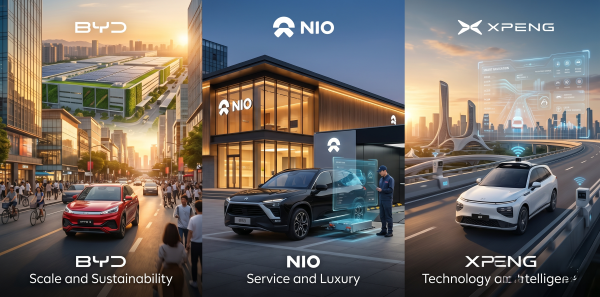
Each of these three represents a distinct vision of what an EV brand should be. BYD is the industrial titan — vertically integrated, mass-market-focused, and now the largest EV manufacturer on the planet by volume. NIO is the premium experience brand — the company that turned battery swapping from a novelty into a genuine competitive moat, backed by a service philosophy that rivals any luxury marque. Xpeng is the technology-first challenger — the brand that treated its vehicles as software platforms before most Western brands had even considered the idea.
Understanding these brands means understanding the range of choices available to European, Australian, and globally-minded EV buyers. All three are now available in Europe: BYD and NIO have the widest coverage across the UK, Germany, France, Netherlands, Norway, and Spain, while Xpeng is available in select markets including Norway, Sweden, Denmark, and the Netherlands, with expansion ongoing through 2026.
Recommended Accessories for New EV Owners
Affiliate disclosure: As an Amazon Associate, Chinese Cars Asia earns from qualifying purchases. The links below may earn us a small commission at no extra cost to you.
Type 2 to Type 2 Charging Cable (22kW, 5m)
Whichever brand you choose, a TÜV-certified 32A Type 2 cable lets you charge from home wallboxes and public AC posts across UK and European networks — a day-one essential for any new EV.
🛒 Check Price on AmazonCordless Digital Tyre Inflator
EVs are heavy, and correct tyre pressure directly affects real-world range and efficiency. A rechargeable inflator with an auto-stop preset keeps pressures optimal and quickly pays for itself.
🛒 Check Price on AmazonBYD: The People’s EV Giant
BYD — which stands for “Build Your Dreams” — is the unlikely story of a battery company that quietly became the world’s most consequential electric vehicle manufacturer. Founded by Wang Chuanfu in 1995 as a rechargeable battery maker, BYD pivoted to electric vehicles in the early 2000s and spent years building the manufacturing scale, supply chain integration, and battery expertise that now gives it an almost unassailable cost advantage over every rival.
In 2023, BYD surpassed Tesla in total EV sales for the full year — a milestone that sent shockwaves through the global automotive industry. By 2026, it operates the world’s largest EV manufacturing capacity and produces virtually every component of its vehicles in-house, from battery cells to semiconductors to electric motors. This vertical integration is the source of both its pricing power and its engineering consistency. In Europe, BYD currently offers the Seal, Atto 3, Han EV, Tang EV, Dolphin, and Seal U in various markets.
BYD’s Key Strengths
BYD’s primary advantage is simple: more car for less money. The Seal AWD delivers genuine performance comparable to cars costing £10,000–£15,000 more, and the Atto 3 packs a premium interior with extensive standard equipment at a price that genuinely embarrasses European rivals. The Blade Battery’s safety record is a secondary but meaningful advantage: in penetration tests that caused NMC batteries to ignite, BYD’s Blade remained stable — which matters enormously to family buyers.
💡 Pro Tip: The BYD Seal AWD remains the brand’s most compelling European offering — 520 km WLTP range, 3.8s 0–100 km/h, a premium rotating AMOLED interior, and competitive pricing. It is the model that most directly challenges Tesla on every dimension that matters to mainstream buyers.
NIO: Premium with a Twist
NIO was founded in 2014 with an explicit ambition: to be the premium Chinese EV brand that competes with BMW and Mercedes not just on specifications, but on the totality of the ownership experience. A decade later, it has delivered on that ambition in ways that have genuinely surprised the global automotive establishment.
NIO’s most distinctive innovation is its Battery-as-a-Service (BaaS) model and associated battery swap network. Rather than selling a car with a fixed battery, NIO lets customers subscribe to a battery service and physically swap a depleted battery for a fully charged one at a NIO Power Swap Station in under five minutes — faster than a petrol fill-up. By 2026, NIO operates over 2,300 swap stations globally, with more than 100 in Europe. In Europe it offers the ET5, ET5 Touring, ET7, EL6, and EL7, positioned firmly in the £45,000–£80,000 bracket, with interiors that challenge German luxury brands and NOMI, an in-car AI assistant with a physical presence.
NIO’s Key Strengths
The battery swap system is NIO’s genuinely irreplaceable differentiator. For drivers anxious about public charging reliability, who regularly cover long distances, or who want the flexibility to upgrade battery capacity as technology improves, no other brand offers anything comparable. The ability to swap to a 150 kWh ultra-long-range battery for a road trip and return to your standard 75 kWh pack exists nowhere else in the market. NIO’s community ecosystem — NIO Houses, app-based concierge services, and a strong owner community — gives it brand loyalty that justifies genuine premium pricing.
Xpeng: Where Software Meets Speed
Xpeng was co-founded in 2014 by He Xiaopeng — a former Alibaba executive — with the explicit goal of building an EV brand that thinks like a technology company, not a traditional automaker. That philosophy permeates every product decision: from the 800V silicon carbide powertrain in the G6 to the in-house development of XNGP (Xpeng Navigation Guided Pilot), one of the most capable highway and urban autonomous driving systems available outside of Tesla.
Xpeng’s European lineup focuses on the G6, G9, and P7 — models that consistently punch above their weight on technology specifications while remaining price-competitive with European rivals. The G6 in particular has earned recognition as one of the most technologically advanced SUVs available at its price point anywhere in the world, not just within the Chinese EV segment.
Xpeng’s Key Strengths
The 800V charging architecture in the G6 and G9 enables 280 kW peak DC charging — a figure that places Xpeng alongside Porsche, Hyundai, and Kia in the ultra-fast charging tier, adding 300 km of range in around 10 minutes. The XNGP driving assistance system, developed entirely in-house using proprietary AI and sensor fusion, has consistently impressed independent testers in European conditions. For buyers who prioritise autonomous-driving capability, Xpeng is the most serious Chinese contender in this space.
Model Lineup Comparison
Here’s a clear overview of each brand’s current European lineup — the models you can actually walk into a showroom and order today:
| Model | Brand | Type | WLTP Range | Starting Price |
|---|---|---|---|---|
| Seal AWD | BYD | Sedan | 520 km | ~£38,500 |
| Atto 3 | BYD | Compact SUV | 420 km | ~£36,990 |
| Han EV | BYD | Luxury Sedan | 600 km | ~€55,900 |
| Dolphin | BYD | Hatchback | 427 km | ~£28,490 |
| Tang EV | BYD | Large SUV | 530 km | ~£54,990 |
| ET5 Touring | NIO | Estate | 560 km | ~€47,900 |
| ET7 | NIO | Luxury Sedan | 590 km | ~€69,900 |
| EL6 (ES6) | NIO | Mid SUV | 513 km | ~€55,900 |
| EL7 (ES7) | NIO | Large SUV | 509 km | ~€72,900 |
| G6 | Xpeng | Mid SUV | 570 km | ~€44,900 |
| G9 | Xpeng | Large SUV | 520 km | ~€54,900 |
| P7 | Xpeng | Fastback | 562 km | ~€47,900 |
BYD clearly wins on lineup breadth, offering the widest range of body styles and the lowest entry price of the three. NIO occupies a clearly premium tier, with no model below €47,000. Xpeng sits in the mid-premium space, offering technology leadership at prices between BYD and NIO.
Technology & Innovation
Technology differentiation is increasingly the primary battleground between Chinese EV brands, and all three have staked out distinct positions. The table below scores each brand out of 10 across the dimensions that matter most.
| Technology Area | BYD | NIO | Xpeng |
|---|---|---|---|
| Battery Technology | 9.6 | 8.8 | 8.2 |
| Autonomous Driving (ADAS) | 7.6 | 8.8 | 9.4 |
| Infotainment & Software | 8.0 | 9.1 | 8.9 |
| Charging Innovation | 7.8 | 9.7 | 9.1 |
| OTA Software Updates | 7.4 | 8.8 | 9.3 |
BYD leads decisively on battery technology thanks to its Blade Battery, while Xpeng dominates autonomous driving and over-the-air software, and NIO takes the top spot for charging innovation and in-car software polish.
Charging Strategy: Three Very Different Approaches
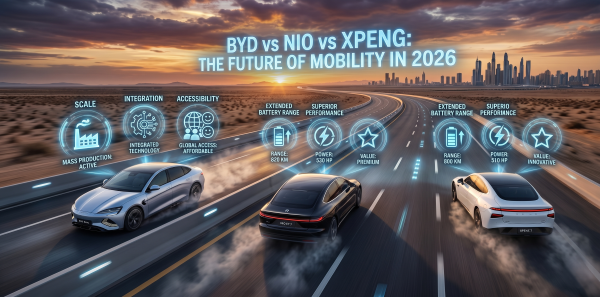
Charging infrastructure is one of the most practically important factors in EV ownership, and all three brands have taken meaningfully different approaches to solving the same problem.
| Charging Factor | BYD | NIO | Xpeng |
|---|---|---|---|
| Peak DC Charge Speed | 150 kW (Seal) | 130 kW | 280 kW (G6) ⚡ |
| 10–80% Charge Time | ~35 min | ~38 min | ~18 min ⚡ |
| Battery Swap | No | Yes — 5 min ⚡ | No |
| Proprietary Network | No (CCS2 only) | NIO Power Swap | Xpeng S4 Supercharger |
| Battery Architecture | 400V LFP Blade | 400V NMC | 800V SiC ⚡ |
| Home Charging (AC max) | 11 kW | 11 kW | 11 kW |
| Best For | Daily commuters | Long-distance drivers | Tech-first buyers |
This is genuinely a three-way split with no single winner. NIO’s swap technology wins for convenience — five minutes to full is faster than any charging solution. Xpeng’s 800V architecture wins for raw charging speed, with a class-leading 280 kW peak. BYD’s CCS2-only approach is the most universally compatible, working with every public charger in Europe without proprietary network dependency.
Pricing & Value for Money
On value for money, BYD is in a class of its own, scoring 9.7/10 thanks to the lowest entry prices and the widest lineup. Xpeng follows at 8.5/10, delivering high-tech specification at mid-premium prices, while NIO sits at 7.0/10 — not because it is poor value, but because its premium positioning commands a price that only makes sense if you genuinely value the experience. NIO does, however, lead on interior quality (9.5/10), with BYD and Xpeng close together around 8.2–8.6/10.
⚠️ Price Reality Check: NIO’s pricing model includes an optional Battery-as-a-Service (BaaS) subscription that lowers the upfront purchase price by €10,000–€14,000 but adds a monthly battery rental fee of roughly €150–€170. Over a four-year ownership period the total cost may be comparable — but buyers should calculate their specific use case before choosing the BaaS option.
Full Head-to-Head Scorecard
Bringing every dimension together, the scorecard below shows how the three brands rank across the categories that define ownership.
| Category | BYD | NIO | Xpeng |
|---|---|---|---|
| Value for Money | 9.7 | 7.0 | 8.5 |
| Battery Technology | 9.6 | 8.8 | 8.2 |
| Interior Quality | 8.2 | 9.5 | 8.6 |
| Charging Innovation | 7.8 | 9.7 | 9.1 |
| Autonomous Driving | 7.6 | 8.8 | 9.4 |
| Software & OTA | 7.4 | 8.8 | 9.3 |
| Range & Efficiency | 8.4 | 8.8 | 9.0 |
| Lineup Breadth | 9.5 | 7.5 | 7.0 |
| Aftersales Support | 8.0 | 9.0 | 7.5 |
| Brand Prestige | 8.0 | 9.2 | 8.0 |
| Safety Ratings | 9.2 | 8.5 | 8.8 |
| Overall Score | 9.1 | 8.6 | 8.4 |
Who Should Buy Which Brand?
The right brand depends entirely on what you prioritise. Here’s how to choose.
Choose BYD If…
- Value for money is your top priority
- You want the widest model choice and body styles
- Battery safety (the Blade Battery) matters to you
- You’re buying your first EV
- You want a lower list price without paying for extras you don’t need
- You don’t require cutting-edge driver-assistance
Choose NIO If…
- A premium experience is non-negotiable
- You frequently drive 300+ km in a day
- Battery-swap convenience matters most to you
- You want a luxury lifestyle brand and ownership ecosystem
- You can comfortably afford the €47,900+ price tier
- Interior quality that rivals BMW or Volvo is a priority
Choose Xpeng If…
- Technology is your primary buying criterion
- You want the fastest DC charging speed available
- Advanced ADAS and semi-autonomous driving matter
- You value regular software improvements via OTA updates
- You want a mid-premium price with a high-tech specification
- Long-range motorway driving is your core use case
FAQ: BYD vs NIO vs Xpeng
Which is better: BYD vs NIO vs Xpeng?
BYD wins overall value (9.1/10), NIO wins premium experience (8.6/10), and Xpeng wins technology (8.4/10). The right choice depends on your priorities — value, premium experience, or cutting-edge tech.
What is NIO’s battery swap technology?
NIO offers Battery-as-a-Service (BaaS) with more than 2,300 swap stations globally. You can swap a depleted battery for a fully charged one in under five minutes — faster than a petrol fill-up.
Which brand has the fastest charging?
Xpeng’s 800V architecture enables 280 kW peak DC charging (10–80% in about 18 minutes) — the fastest of the three brands, placing it alongside Porsche, Hyundai, and Kia.
Which EV brand offers the best value?
BYD offers the best value for money, with the widest model range, the lowest entry price, and industry-leading Blade Battery technology.
Is NIO available in Europe?
Yes. NIO is available across the UK, Germany, France, Netherlands, Norway, Spain, and other European markets, with an expanding dealership and Power Swap network.
Which brand has the best autonomous driving?
Xpeng leads with XNGP (Xpeng Navigation Guided Pilot) — one of the most capable highway and urban autonomous driving systems available outside of Tesla.
Final Verdict
BYD wins the overall crown for the majority of buyers. The combination of the widest model range, the best value-for-money ratio, superior battery safety technology, and a growing European dealer network makes it the most rational first choice for most people. The Seal and Atto 3 remain two of the best electric vehicles available at their respective price points in any global market.
NIO is the right answer for premium buyers who won’t compromise on interior quality, service experience, or charging convenience. If you can justify the price premium and prioritise the totality of ownership over specs-per-pound, NIO delivers something genuinely unique — and the battery swap system alone makes it irreplaceable for frequent long-distance drivers.
Xpeng is the technology purist’s choice. The G6’s 800V charging architecture is the most impressive charging hardware in any Chinese EV currently sold in Europe, and the XNGP autonomous driving system is the most capable. If you read the technology specifications first and the price tag second, Xpeng is your brand.
| Brand | Wins |
|---|---|
| BYD | Best Overall Value |
| NIO | Best Premium Experience |
| Xpeng | Best Technology |