XPeng G9 / P7+ vs Rivian R1T / R1S: Tech vs Adventure EV Showdown
Two car companies, two completely different ideas of what the future of driving should feel like. XPeng builds its G9 SUV and P7+ sedan around artificial intelligence — calling the P7+ an “AI-defined” car, not just a software-defined one. Rivian builds the R1T pickup and R1S SUV around rugged, American-engineered adventure capability, with water fording and trail hardware most rivals don’t even attempt.
This comparison puts the two philosophies side by side: specs, range, charging, interior tech and price. It is worth saying upfront that this is a comparison of ideas as much as cross-shopping — XPeng’s models are sold in China and across Europe, while Rivian sells only in North America, so the two rarely compete for the same driveway today.
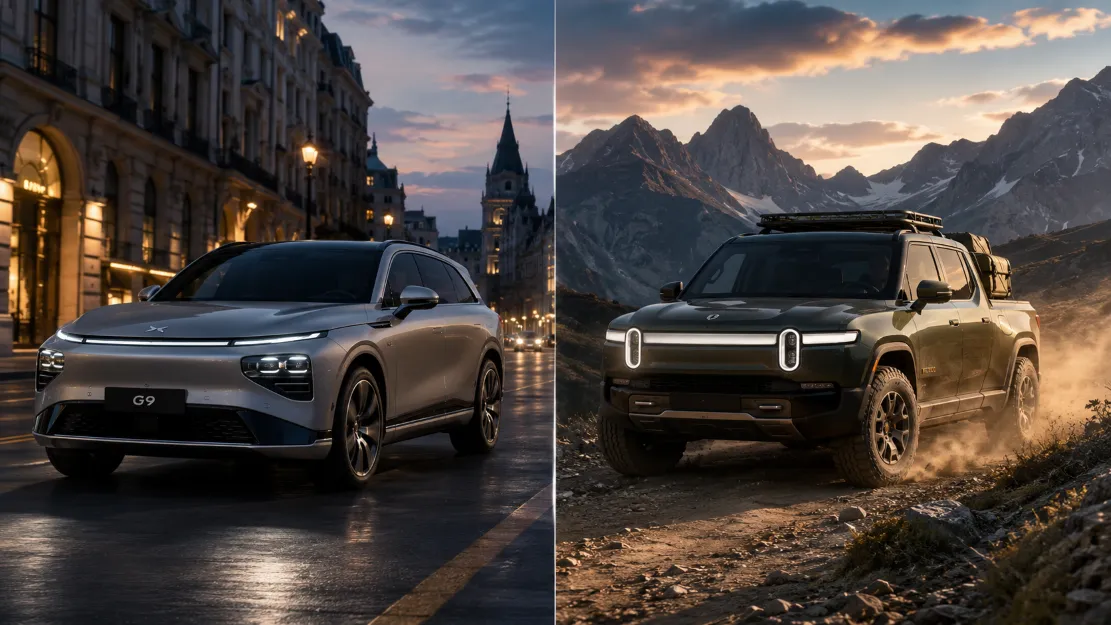
It would be easy to call this a head-to-head, but XPeng and Rivian aren’t really fighting for the same buyer. One sells sleek, AI-saturated crossovers and sedans to tech-forward city and motorway drivers in China and Europe. The other sells overbuilt trucks and SUVs to American buyers who want to leave the pavement behind. Comparing them is less about picking a winner and more about understanding two very different answers to the same question: what should an electric vehicle be for?
Meet the Contenders
XPeng, founded in Guangzhou in 2014 by former GAC executives, has always billed itself as a technology company that happens to build cars — alongside robots and “flying vehicles.” Its G9 is a mid-size electric SUV, and its P7+ is a sleek five-meter fastback sedan rivaling the VW ID.7, both designed around what XPeng calls “physical AI”: intelligence built into the hardware, not bolted on as software.
Rivian, founded in California in 2009, took the opposite route. Its R1T pickup and R1S SUV share the same rugged “skateboard” platform, both now two years into a Gen-2 refresh with native NACS charging standard across the range. Where XPeng chases software sophistication, Rivian chases mechanical capability — quad-motor torque vectoring, serious water fording, and an entire ecosystem built around camping and overlanding.
Adventure-Ready Add-ons for Either Side of This Comparison
A roadside emergency kit with a warning triangle and hi-vis vest covers equipment legally required to carry in many European countries — and sensible everywhere. A single compact bag keeps the essentials organized in the boot.
A rated tow and recovery strap is cheap insurance for getting a stuck or stranded vehicle moving safely. Compact enough to live permanently in the boot, and useful far beyond your own car.
Specs and Performance: AI-Defined vs Adventure-Built
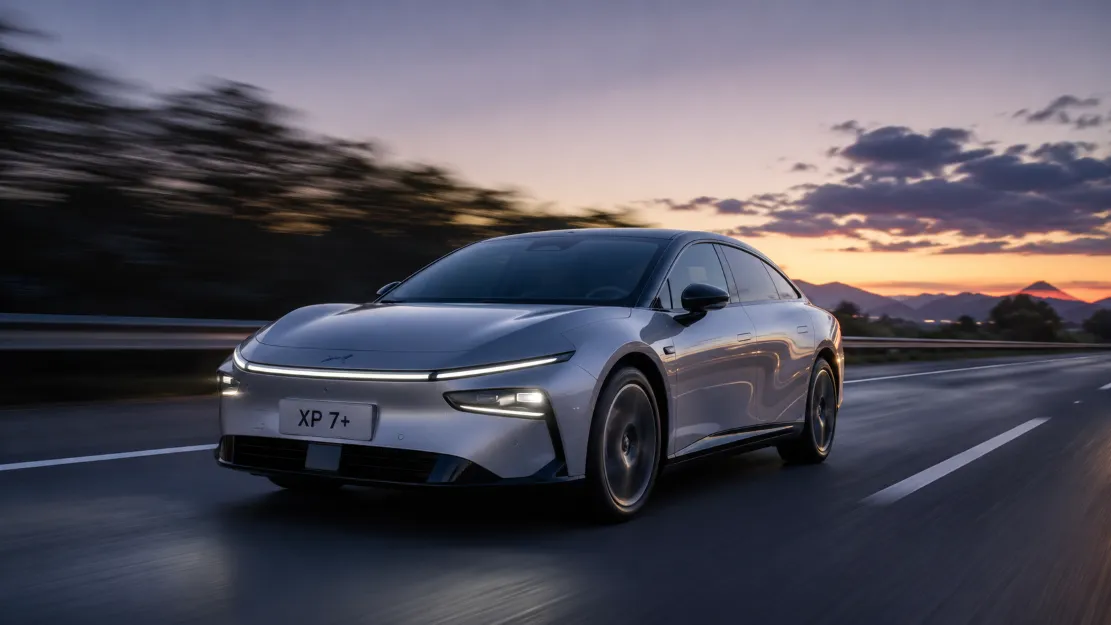
On paper, the two cars are not far apart in raw capability — they just point it in different directions. The XPeng G9 Long Range delivers around 346 to 575 hp depending on configuration, with a WLTP range of roughly 364 miles and 0-62 mph in about 6.4 seconds. The P7+ goes further on power, spanning 276 to 510 hp across its rear- and all-wheel-drive variants, built on XPeng’s SEPA 2.0 platform with claimed range up to 820 km (about 510 miles) on its most efficient configuration.
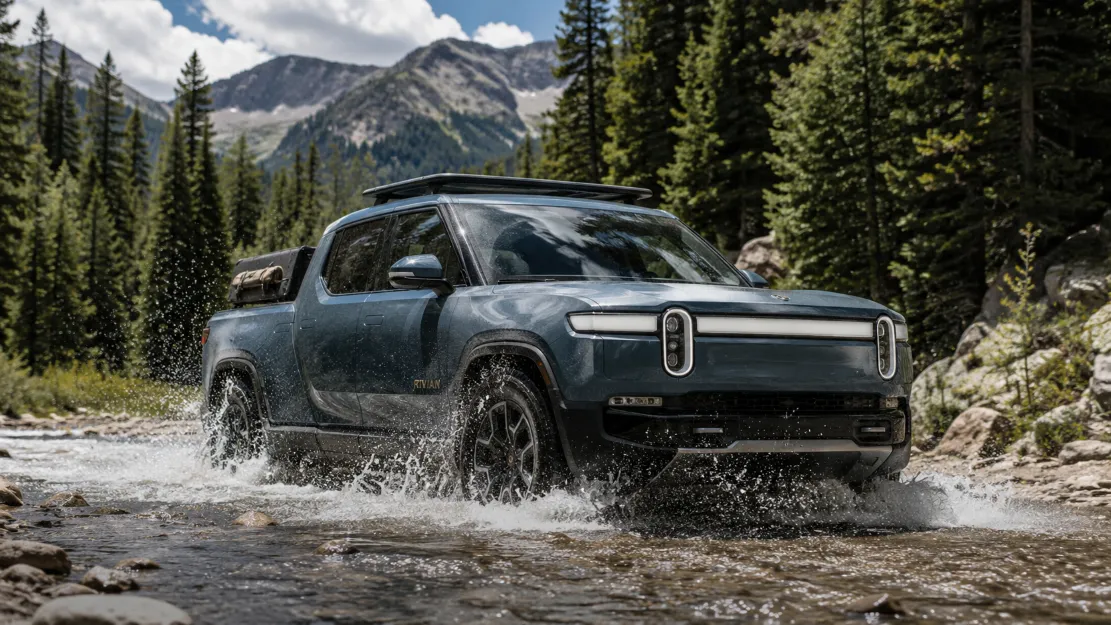
Rivian’s numbers tell a story about weight and capability rather than outright efficiency. The R1T spans 270 to 420-plus miles of range across Standard, Large and Max battery packs, towing up to 11,000 lbs and carrying a 2,317 lb payload. The range-topping Quad-Motor Launch Edition pushes 1,025 hp, a 2.5-second 0-60 mph time, and a party trick called Kick Turn for tight, tank-like maneuvers — numbers that exist to conquer terrain, not just a spec sheet.
- XPeng G9: ~346–575 hp, ~364 mi WLTP range, 6.4s 0-62 mph, air suspension, relaxed comfort-first tuning.
- XPeng P7+: 276–510 hp, up to ~510 mi claimed range, “AI-defined” SEPA 2.0 platform.
- Rivian R1T: up to 1,025 hp (Quad), 270–420+ mi range, 11,000 lb tow rating, 2,317 lb payload.
- Rivian R1S: up to 1,025 hp (Quad), 270–400+ mi range, three-row seating, full off-road hardware.
Charging and Range: Two Different Networks, Two Different Strengths
Both companies have invested heavily in charging, but for different audiences. XPeng’s G9 supports rapid DC charging fast enough for a 10-80% top-up in around 12 minutes on suitable hardware, useful across Europe’s growing fast-charging network. The P7+ pushes ultra-fast charging further still, part of XPeng’s pitch as a long-distance, software-rich cruiser.
Rivian, meanwhile, gives every 2026 R1T and R1S a native NACS port with a complimentary CCS adapter, unlocking direct access to Tesla’s Supercharger network across North America — a major practical advantage for road-tripping and overlanding in the US. The Max battery pack adds peak DC charging up to 220 kW, the only way to push either Rivian past 400 EPA miles.
💡 Buyer’s tip: Range figures use different test cycles — WLTP for XPeng, EPA for Rivian — and EPA numbers are typically the more conservative, real-world figure. Don’t compare the headline numbers directly; look up both on the same cycle if you can, or treat WLTP figures as somewhat optimistic by comparison.
Interior, Tech and Self-Driving Philosophy
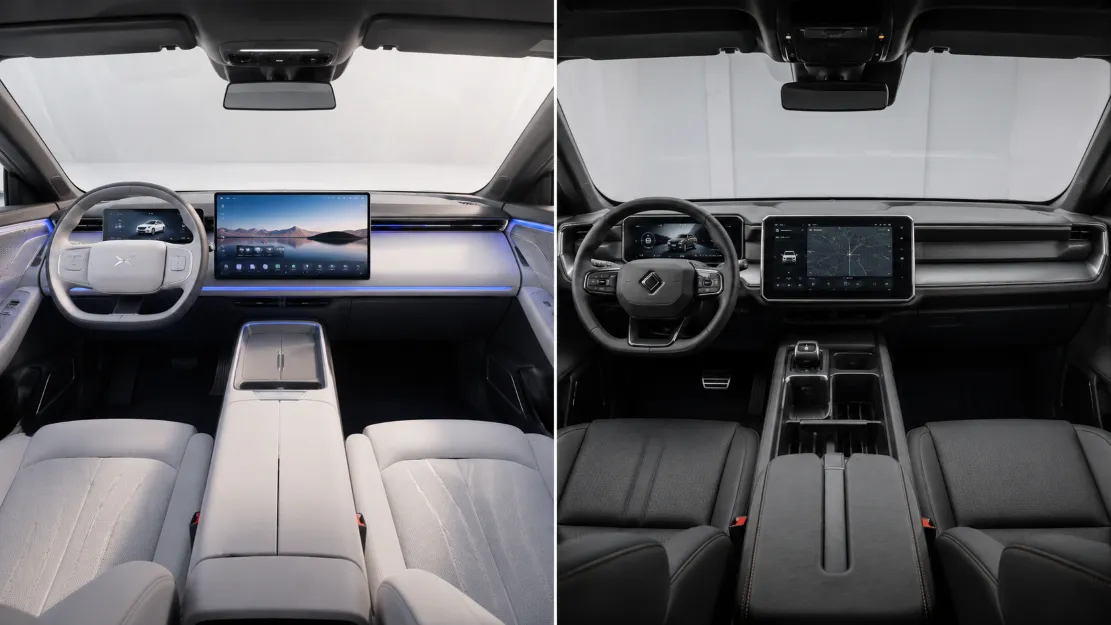
Step inside and the philosophical gap widens. XPeng’s cabins lean into screens, ambient lighting and AI: the G9 and P7+ both centre on large touchscreens, a configurable digital cluster, and XPeng’s XNGP driver-assistance system, which the company is steadily expanding toward more autonomous capability — alongside its robotaxi ambitions, currently limited to China. The vehicles themselves are described internally as platforms for “physical AI,” extending the same intelligence XPeng is building into humanoid robots and flying taxis.
Rivian’s cabins are calmer and more utilitarian by design — minimalist screens, real switchgear for key functions, and a software stack focused on reliability and over-the-air improvement rather than flashy autonomy claims. Its Autonomy Platform+ suite includes lane change on command and Enhanced Highway Assist, expanding gradually, but Rivian’s emphasis remains on hardware: 12 cameras and sensors built around safe, capable driving in difficult conditions rather than chasing full self-driving headlines.
That design language carries through to materials and detailing, too. XPeng’s interiors favour glossy surfaces, ambient lighting and panoramic glass, chasing a premium-tech feel similar to what buyers expect from a high-end smartphone brand. Rivian leans on tactile, durable materials — rubberized switches, washable flooring options, gear tunnels designed for muddy boots — because its target buyer is as likely to be loading kayaks as commuting. Neither cabin is “better” in the abstract; they’re simply engineered around opposite weekends.
XPeng vs Rivian: Specs at a Glance
The table below lines up representative trims from each lineup. Prices are approximate 2026 figures; XPeng’s are European launch prices since the brand does not sell in the US, while Rivian’s are US MSRP before incentives.
| Model | Starting Price | Range | Power | Best for |
|---|---|---|---|---|
| XPeng G9 (RWD Long Range) | ~€55,000 (EU) | ~364 mi WLTP | ~346 hp | Comfort-led tech SUV |
| XPeng P7+ (Standard Range) | ~€46,600 (EU) | up to ~510 mi claimed | 276–510 hp | AI-defined long-distance sedan |
| Rivian R1T (Dual Standard) | ~$72,990 (US) | 270 mi EPA | Dual-motor AWD | Adventure pickup, daily use |
| Rivian R1S (Dual Large) | ~$76,990–$87,690 (US) | 317 mi EPA | Dual-motor AWD | Three-row family overlanding |
| Rivian R1T/R1S Quad Launch Ed. | ~$120,000–$126,000 (US) | 325–400+ mi EPA | 1,025 hp | Flagship performance & capability |
Price and Positioning: Different Markets, Different Math
Pricing underlines just how separate these two worlds are. XPeng’s European launch prices put the P7+ from around €46,600 and the G9 from roughly €55,000 — competitive with mainstream German rivals like the VW ID.7, not luxury money. Rivian sits in an entirely different bracket: even the cheapest 2026 R1T starts near $72,990, climbing past $120,000 for the range-topping Quad-Motor Launch Edition, positioning it against premium trucks and luxury SUVs rather than mainstream EVs.
That gap is partly about ambition and partly about geography. XPeng is fighting for volume in a brutally competitive Chinese and European market, where pricing pressure is constant. Rivian is selling a premium, distinctly American product — built domestically, marketed on capability and craftsmanship — to buyers who are willing to pay accordingly. Neither approach is wrong; they’re simply optimized for completely different businesses.
⚠️ Important note: XPeng vehicles are not currently sold or supported in the United States, and Rivian does not sell outside North America. Treat this as a comparison of engineering philosophy and global EV trends rather than a same-market buying decision — always confirm current availability, pricing and specifications in your own region before deciding.
So Which Philosophy Wins?
Neither, really — and that’s the point. If you live somewhere XPeng sells and want a comfortable, tech-saturated cruiser that treats AI as a core feature rather than an add-on, the G9 or P7+ make a compelling, comparatively affordable case. If you’re in North America and want a vehicle built to tow a trailer, ford a stream, and still feel premium on the school run, nothing currently on sale matches the R1T or R1S for built-in capability.
What’s genuinely interesting is what each company’s choices say about where the EV industry is heading. XPeng is betting that intelligence — AI, autonomy, connected ecosystems — becomes the defining feature of cars within this decade. Rivian is betting that for a meaningful slice of buyers, mechanical capability and authentic adventure credentials will always matter more than how clever the software is. In 2026, both bets look like they’re paying off — just in very different markets.
Frequently Asked Questions
Can I buy an XPeng G9 or P7+ in the United States?
No. XPeng does not currently sell vehicles in the US. The G9 and P7+ are sold in China and have launched across Europe, including the UK and Germany, but American buyers cannot order one through official channels today.
How much does the Rivian R1T or R1S cost in 2026?
The 2026 Rivian R1T starts at roughly $72,990 for the Dual Standard trim and rises to around $120,000 for the Quad-Motor Launch Edition. The R1S SUV starts at about $76,990 and reaches similarly high figures on top trims.
What is the range of the XPeng G9 compared with the Rivian R1S?
The XPeng G9 Long Range is rated up to about 364 miles on the WLTP cycle. The Rivian R1S spans roughly 270 to over 400 miles depending on battery pack, with the Max pack needed to exceed 400 EPA miles.
Is XPeng or Rivian more focused on self-driving technology?
XPeng leans harder into AI and autonomy, describing its P7+ as an “AI-defined” vehicle built around its XNGP driver-assistance system. Rivian focuses more on off-road hardware and overlanding capability, though its Autonomy Platform+ suite continues to expand driver-assistance features.
Which is better for off-road and adventure use, XPeng or Rivian?
Rivian is purpose-built for adventure use, with class-leading water fording, air suspension tuned for trails, and a strong overlanding accessory ecosystem. XPeng’s G9 and P7+ are tech-and-comfort focused crossovers and a sedan, not designed or marketed for serious off-roading.
The Bottom Line
XPeng and Rivian rarely compete for the same buyer, but together they sketch out the two clearest visions for where electric vehicles are headed: one chasing software intelligence and ecosystem integration, the other chasing mechanical capability and outdoor authenticity. Both are genuinely impressive at what they set out to do.
For now, the choice mostly comes down to where you live and what you actually need a vehicle to do. But as XPeng pushes toward Europe and beyond, and as Rivian’s R2 platform opens the brand to a wider audience, the gap between these two worlds may not stay as wide as it looks in 2026.