Chinese EV OTA Updates: Which Brand Does It Best?
Over-the-air (OTA) updates are one of the most transformative developments in modern automotive technology, fundamentally changing how vehicles receive improvements and new features after purchase. Chinese EV manufacturers embraced this earlier and more enthusiastically than most, treating OTA updates as essential differentiators and genuine competitive advantages.
But which brand actually does it best? Answering that means looking past marketing to examine update frequency, feature scope, the quality of the user experience, and how clearly each manufacturer communicates with owners. In this guide we compare BYD, NIO, XPeng, and Li Auto to see who leads.
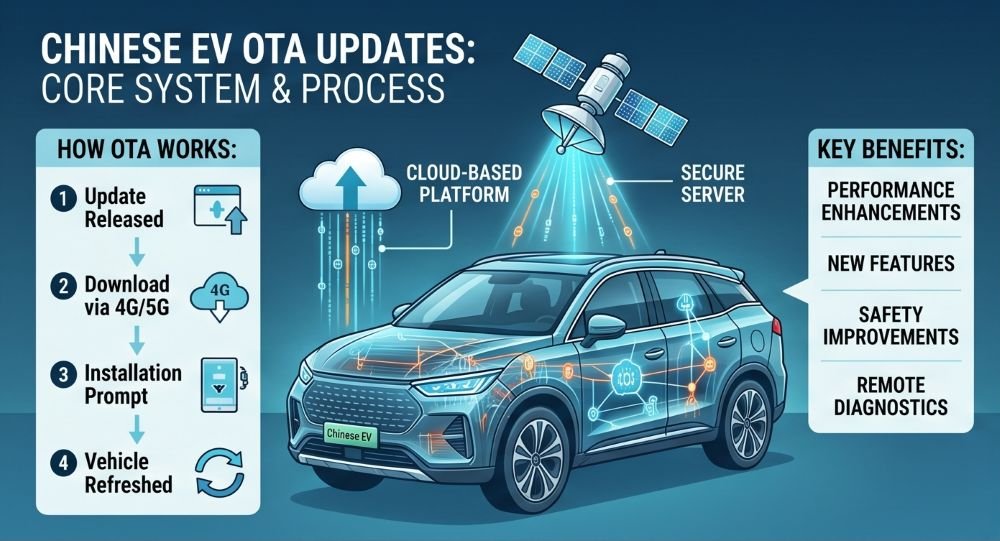
Not long ago, a car was at its technological peak the day it left the showroom and slowly fell behind from there. Software-defined EVs flipped that script entirely: today the right car can get faster, smarter, and more efficient years after purchase. Chinese manufacturers understood this shift before almost anyone, which is why their OTA programmes are now among the most advanced in the world. Before we compare them brand by brand, the short video below sums up the landscape.
With that overview in mind, let’s start with what OTA updates actually do, and why they matter so much more for electric vehicles than for traditional cars.
Understanding OTA Updates: A New Model of Ownership
OTA updates let manufacturers deliver software improvements, performance enhancements, and new features directly to vehicles through wireless connectivity, with no dealer visit required. This fundamentally transforms ownership, replacing static hardware that only ages with a platform that continuously improves. Chinese EV makers recognised that advantage early and built sophisticated OTA infrastructure as a core competency rather than an afterthought.
The benefits reach well beyond simple bug fixes to genuine feature additions, performance optimisation, and the expansion of driver-assistance capability. Owners receive tangible improvements months or even years after purchase, keeping a vehicle relevant despite rapid technological change. It is a profound break from traditional ownership, where a car inevitably became dated as newer models arrived with more advanced capabilities.
Tech Accessories That Complement a Software-Defined EV
If software is what keeps these cars feeling current, a couple of smart tech accessories round out the in-car digital experience. Both suit any modern EV, whichever brand’s OTA approach you prefer.
OTA updates keep the car’s own software fresh, and a wireless adapter does the same for your phone link — converting a wired CarPlay or Android Auto port into a cable-free connection. It is the easiest way to modernise an older infotainment setup without waiting on the manufacturer.
A connected, software-rich cabin runs on devices that need power, and a compact GaN multi-port charger keeps phones, tablets, and dashcams topped up at full speed. It is a small upgrade that makes a tech-heavy EV interior far more practical on longer drives.
Why OTA Updates Matter More for EVs
Electric vehicles depend heavily on software to manage battery systems, motor performance, and charging protocols. Unlike combustion engines with fixed mechanical parameters, EV systems benefit enormously from software optimisation. Early battery-management calibration is often conservative, leaving room for efficiency and thermal-management gains once manufacturers gather real-world data. OTA updates capture those improvements, delivering tangible benefits such as extended range, faster charging, and better reliability.
For driver-assistance and autonomous systems, OTA updates are even more critical. Capability advances through software iteration, with incremental improvements steadily expanding what the system can do. A car that receives regular updates can gradually approach capabilities that simply did not exist at the time of purchase.
BYD: Frequent Updates With Meaningful Features
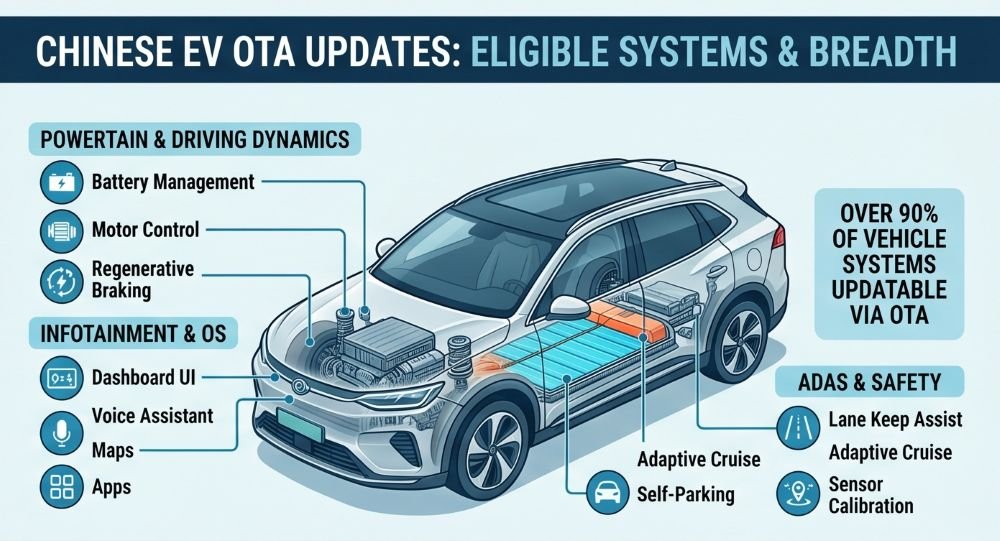
BYD runs an aggressive OTA schedule, with major updates arriving roughly every two to three months and security patches on shorter intervals. The company prioritises substantial feature additions over token tweaks, ensuring each release delivers something owners actually notice. BYD vehicles have gained new music-streaming integrations, improved voice recognition, enhanced climate features, and navigation upgrades. Crucially, BYD also publishes detailed release notes, so owners understand exactly what each update changes before installing it.
The real-world impact is concrete. Battery-optimisation updates have improved efficiency by a few percent for extended range, while charging-algorithm refinements have trimmed charging times. Other releases have broadened voice control across more commands and dialects, sharpened route optimisation, and expanded automated parking into tighter spaces. For owners who value steady, practical improvement, BYD’s approach is hard to beat.
NIO: The Premium OTA Experience
NIO treats OTA updates as a premium service that differentiates the brand. The company emphasises a personalised experience, letting owners customise update timing and enable optional features individually rather than pushing an identical feature set to every car. That granular control fits NIO’s luxury positioning, where updates frequently introduce sophisticated additions such as advanced assisted-driving capabilities, smarter AI-assistant behaviour, and premium entertainment integrations.
NIO’s updates also continually refine its battery-swap ecosystem, optimising station routing and overall battery management as the company gathers data from thousands of swap stations. Just as important is the communication around each release: advance notification, detailed previews, flexible scheduling, and post-update support. Autonomous-driving updates in particular are rolled out with transparent notes on new capabilities, limitations, and safety parameters, which builds owner trust as features expand.
💡 Pro Tip: When comparing EVs, treat OTA quality as a real spec, not a nice-to-have. A car that gains range, features, and capability over five years of updates can be worth meaningfully more than a rival that ships and then stagnates.
XPeng: Built Around Autonomous-Driving Advancement
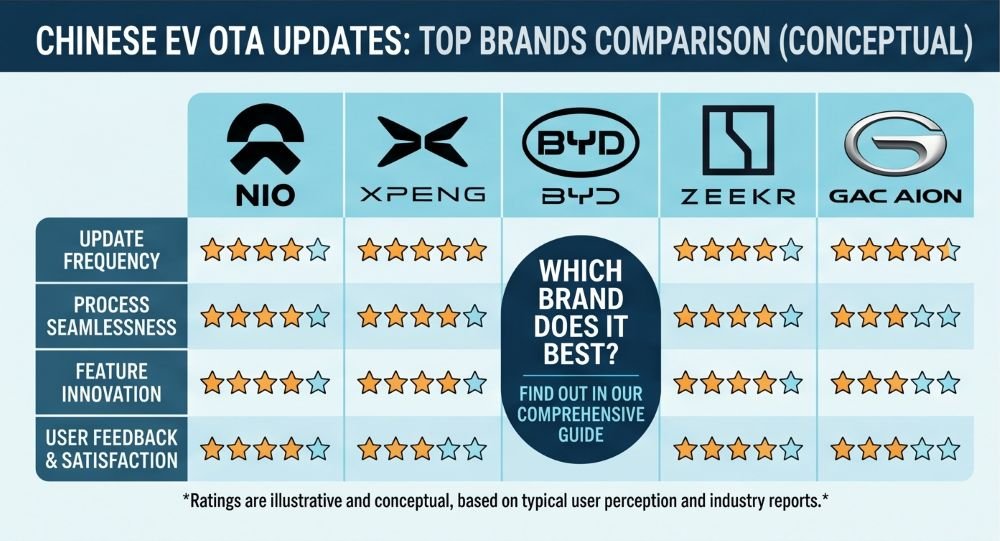
XPeng positions OTA updates as the primary channel for expanding autonomous-driving capability, with quarterly releases that introduce new features and refine existing behaviour. The company favours rapid iteration, testing new capabilities with willing owners before wider rollout, which lets its assisted-driving systems mature faster than more cautious rivals. Updates progress systematically from highway automation to urban scenarios and complex traffic, each one widening the system’s decision-making boundaries.
XPeng also leans uniquely on owner feedback, running community forums where drivers report issues, suggest improvements, and shape future features. This participatory model boosts engagement while enabling fast, real-world-driven iteration. The company reinforces it by publishing improvement metrics after major autonomous updates, demonstrating measurable progress and validating its development trajectory with data rather than promises.
Li Auto: Optimising the Extended-Range Hybrid
Li Auto’s OTA strategy is distinctive because its cars are extended-range electric vehicles rather than pure EVs. Updates focus on hybrid-powertrain optimisation, improving battery-charging algorithms, generator efficiency, and the coordination between electric and combustion operation. Where pure-EV makers tune a single energy source, Li Auto must optimise a seamless handoff between two, which makes its software work uniquely complex.
Releases regularly add new driving modes tailored to city commuting, highway cruising, or performance driving, and refine charging profiles around real owner habits to improve battery longevity and speed. It is a quieter, more specialised OTA programme than XPeng’s autonomy push, but for extended-range buyers it delivers exactly the optimisation that matters.
Comparative OTA Performance at a Glance
To make the contrast easy to scan, here is how the four leading brands compare on the factors that define a strong OTA programme.
| Manufacturer | Update Frequency | Major Features / Year | Autonomy Focus | Owner Communication |
|---|---|---|---|---|
| BYD | Every 2–3 months | 4–6 major updates | Moderate | Excellent |
| NIO | Quarterly | 4 major updates | High | Excellent (premium) |
| XPeng | Quarterly | 4–6 major updates | Excellent | Very good (community) |
| Li Auto | Every 3–4 months | 3–4 major updates | Moderate | Good |
The Infrastructure Behind Reliable OTA Updates
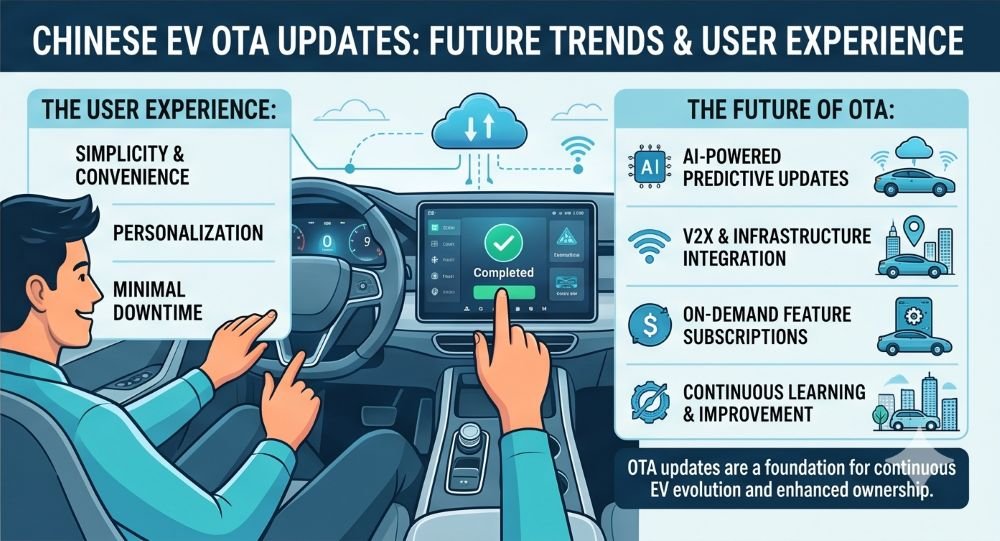
Effective OTA programmes require sophisticated backend infrastructure that manages millions of simultaneous connections, coordinates delivery, and monitors installation success. Chinese manufacturers invested heavily in cloud systems and content-delivery networks to ensure reliable distribution regardless of network conditions. The most advanced players use staggered rollouts, deploying updates gradually while watching for issues and enabling rapid rollback if problems appear, balancing speed with safety.
On the vehicle side, OTA-capable cars need substantial computing power and secure update systems that prevent unauthorised modification. Dual-partition storage lets a vehicle revert to a previous software version if a new one misbehaves, so a failed install never leaves a car inoperable. Security is paramount, with encryption, digital signatures, and multi-layer protocols guarding against malicious software, backed by regular patches as new vulnerabilities emerge.
Owner experience ultimately decides whether all this engineering matters, and here the feedback is largely enthusiastic. Drivers consistently praise measurable efficiency and range gains, smoother infotainment, and the simple novelty of a car that improves while parked on the driveway. Battery-optimisation updates draw the warmest reactions, since they directly counter the common worry that an EV’s performance only declines with age. Autonomous-driving updates, by contrast, divide opinion: enthusiasts welcome each new capability, while more cautious owners prefer to wait and watch. The strongest endorsements come from owners who feel their updates genuinely justify the price they paid, turning a one-time purchase into a product that keeps giving.
⚠️ Important Note: Owner feedback on OTA updates is mostly positive, but not universally so. Occasional post-update glitches can require troubleshooting, and some drivers dislike mandatory updates with no opt-out. Before buying, check how a brand handles update reliability, rollback, and consent, not just how many features it adds.
Which Brand Delivers the Best OTA Experience?
There is no single winner, because the best OTA approach depends on what you value. BYD edges ahead on pure frequency and feature richness, excelling at battery and charging improvements that deliver tangible, everyday benefits. XPeng deserves recognition for the sheer velocity of its autonomous-driving development, with a community-driven model that accelerates capability while keeping owners engaged. NIO offers the most premium experience, pairing sophisticated features with polished, personalised communication that justifies its positioning. And Li Auto provides the specialised hybrid optimisation that extended-range owners specifically need.
In short: choose BYD for practical, frequent gains; XPeng for autonomous advancement; NIO for a premium, personalised experience; and Li Auto for extended-range refinement. Each approach reflects the manufacturer’s broader philosophy and target market.
FAQ: Chinese EV OTA Updates
What are OTA updates in an electric car?
Over-the-air (OTA) updates are software improvements delivered wirelessly to a vehicle without a dealer visit. They can add features, fix bugs, optimise battery and charging performance, and expand driver-assistance capability, so the car keeps improving long after purchase.
Which Chinese EV brand does OTA updates best?
It depends on your priorities. BYD leads on frequent, practical updates like battery and charging gains; XPeng is strongest for autonomous-driving advancement; NIO offers the most premium, personalised OTA experience; and Li Auto focuses on optimising its extended-range hybrid powertrain.
Can OTA updates really improve an EV’s range?
Yes, modestly. Battery-management and efficiency updates can improve real-world range by a few percent and trim charging times, because EV performance depends heavily on software. These gains are incremental rather than dramatic, but they accumulate over an ownership period.
Are OTA updates safe and reversible?
Reputable manufacturers use encryption, digital signatures, and dual-partition storage that lets a vehicle roll back to the previous software version if an update causes problems. Staggered rollouts also limit risk by deploying gradually while monitoring for issues.
The Bottom Line: OTA as a Core Advantage
Chinese EV manufacturers have turned OTA updates from a technical feature into a primary competitive advantage, fundamentally reshaping what vehicle ownership is worth. Rather than growing obsolete through fixed hardware, these cars stay relevant and capable through continuous software improvement, and that aggressive OTA strategy has contributed directly to the brands’ success.
For buyers, the takeaway is clear: weigh OTA quality alongside hardware specifications, because the ability to keep improving has a real impact on long-term satisfaction and resale value. The manufacturer that strikes the best balance of update frequency, feature quality, and owner experience ultimately delivers superior value across the years you own the car.